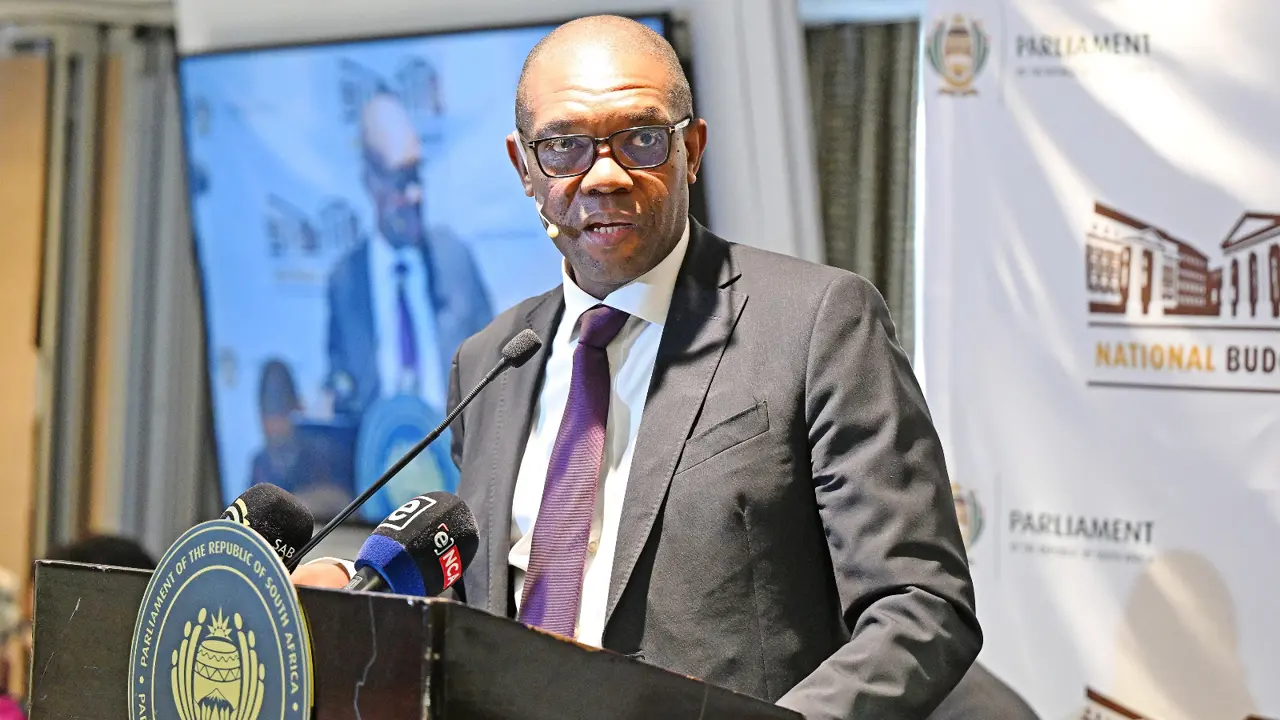
Chairperson of Parliament’s Standing Committee on Public Accounts (SCOPA), Songezo Zibi, at a parliamentary briefing on the national budget. Picture: Parliament/Phando Jikelo
The EFF said the decision by the National Treasury will not stabilise the economy or create jobs, but it will only deepen poverty, inequality and unemployment.
The National Treasury’s decision to suspend the transfer of equitable share funds to underperforming municipalities has received a mixed reaction from opposition parties, members of Parliament (MPs) and the labour sector.
The Economic Freedom Fighters (EFF) has warned that the National Treasury against pursuing what it calls “a path that seeks to collapse the State”, while handing over decisions on the fate of the country to the private sector and non-governmental organisations (NGOs).
However, the chairpersons of the Standing Committee on Public Accounts (SCOPA) and Cooperative Governance Committee have welcomed the move to temporarily withhold transfers to the 69 municipalities that are performing poorly.The EFF said the decision by the National Treasury will not stabilise the economy or create jobs, but it will only deepen poverty, inequality and unemployment.
The party said the solution is the creation of “a capable, well-resourced, corruption-free developmental state” that supports all of society.
The uMkhonto weSizwe (MK) Party has also rejected the move by the National Treasury, arguing that it shifts the cost of maladministration onto ordinary citizens instead of the decision-makers who caused it.
Rise Mzansi leader and SCOPA chairperson, Songezo Zibi, said the National Treasury was justified.“If anything, National Treasury has taken too long to act against these municipalities. They need to get their house in order.”
The Congress of South African Trade Unions (COSATU) has also raised concerns about the unintended consequences of withholding funds as a form of punishment.
The union federation says some municipalities are in such bad shape that some basic services would grind to a halt.
Never miss a major story. Get breaking news and the latest developments from South Africa and beyond as they happen.
The South African Municipal Workers’ Union (SAMWU) invites members of the media to cover its National Day of Action, which will take place on 9 July 2026 in Tshwane.
The march is expected to be attended by tens of thousands of municipal and water sector workers from across all nine provinces, as SAMWU takes to the streets in defence of workers, collective bargaining and public services.
SAMWU members and workers will gather at the Old Putco Depot in Marabastad, Tshwane, from where they will march to the National Treasury offices to deliver a Memorandum of Demands addressed to National Treasury, COGTA, SALGA and the Department of Water and Sanitation.
The march will raise critical issues affecting workers in municipalities and the water sector, including the underfunding of local government, National Treasury interference, the implementation of collective agreements, the City of Johannesburg PFA, the Wage Curve, Business Units, non-payment of salaries and benefits, outsourcing, consultants, load reduction, water boards and the victimisation of workers and shop stewards.
Details of the march are as follows:
Date: 9 July 2026 Gathering Point: Old Putco Depot, Marabastad, Tshwane Time: From 9am Destination: National Treasury offices Purpose: Delivery of Memorandum of Demands to National Treasury, COGTA, SALGA and the Department of Water and Sanitation
Members of the media are invited to attend and cover the march by confirming attendance with Cde Papikie Mohale on 076 795 8670 or via email on papikie@samwu.org.za.
Mangaung Correctional Centre in Bloemfontein. (Photo: Gallo Images / Volksblad / Mlungisi Louw)
Popcru escalates tensions at Mangaung Correctional Centre, accusing the Department of Correctional Services of bypassing court rulings and jeopardising the staff handover process.
The Police and Prison Civil Rights Union (Popcru) sent an urgent letter of demand on Monday, accusing the Department of Correctional Services of attempting to bypass a labour court ruling ordering the absorption of former G4S guards at the high-security Mangaung Correctional Centre.
The state-of-the-art maximum security centre outside Bloemfontein featured in national headlines in 2023 when escapee Thabo Bester was arrested a year after walking out of the correctional centre dressed as a prison guard.
The 25-year public/private concession was granted to Bloemfontein Correctional Contracts (BCC), which subcontracted to G4S in March 2000, but is due to revert to state control on Wednesday, 1 July.
The facility faced an immediate takeover by the Department of Correctional Services after Bester’s “embarrassing” escape, an action by National Commissioner of Correctional Services Makgothi Thobakgale, which has since been declared by the high court as unlawful.
No uniforms, no equipment
Mutsengi Attorneys, on behalf of Popcru, wrote to the department requesting the state to urgently provide uniforms and equipment and shift schedules for the incoming workforce by 1 July.
BCC has also warned that the department’s lack of cooperation stands to derail the handover.
BCC’s Itumeleng Mokoena wrote a “record of position” on Monday, copied to President Cyril Ramaphosa, Minister of Correctional Services Pieter Groenewald, Minister of Justice Mmamoloko Kubayi, Acting Minister of Police Firoz Cachalia and others, setting out the outstanding legal matter.
Minister of Correctional Services Pieter Groenewald. (Photo: Gallo Images / Jeffrey Abrahams)Minister of Justice and Constitutional Development Mmamoloko Kubayi. (Photo: OJ Koloti / Gallo Images)Acting Minister of Police Firoz Cachalia. (Photo: Gallo Images / Brenton Geach)
Mokoena wrote in his record that BCC “at no point opposed the conclusion of the concession agreement upon its expiry on 30 July 2026”, however, “for no fewer than six months, in a concerted and transparent manner, BCC has sought to make every stakeholder aware that time was of the essence and that a compliant and cooperative handover, a risk-managed transition and a sustainable improvement of the criminal justice system required timeous preparation and coordination”.
Mokoena noted that this was done through official correspondence, formal representations and public newspaper articles.
“Even in circumstances where those early warnings were not heeded, this remains BCC’s position today,” Mokoena said. Popcru on Monday asked the DSC to provide formal communication and allocation of shifts, beginning on 1 July 2026.
External recruitment
The Popcru legal demand also asks that the DSC stop its “aggressive recruitment process” and that, instead of absorbing G4S staff, this had been “a blatant attempt to circumvent and frustrate the court order”.
The DSC was asked to provide a written and unequivocal undertaking by noon on Monday, 29 June 2026. Daily Maverick approached the Minister of Correctional Services and had not received a reply at the time of writing.
Popcru warned that should demands not be met, it had instructed its attorneys to launch an urgent application for contempt of court against both the minister and the national commissioner and would seek “punitive sanctions and a punitive cost order” against the department.
On 30 April, the labour court declared that the termination of the concession contract constituted a transfer of business as a “going concern” under Section 197 of the Labour Relations Act.
This legally mandates that G4S employees automatically transfer to the Department of Correctional Services. Popcru alleges that the department is operating in “overdrive” with an aggressive recruitment process for roles at the MCC.
The department initially attempted to stay the execution of the court order and filed for an appeal, but these efforts failed as the appeal was filed “out of time”.
An application by the department to stay the execution of the transfer order was formally dismissed on 18 June 2026, but despite these legal defeats, Popcru claims the department has failed to make the necessary operational preparations.
Mokoena said that BCC “has acted throughout in good faith and as a responsible, ethical and professional corporate citizen and concessionaire”.
“This remains its position, and it is reflected in both the documentary and behavioural evidence trails. BCC stands ready, today and through the conclusion of the concession, to cooperate with every office addressed in this letter to secure the orderly handover, transition and sustainable improvement that the Republic and those in its care deserve”. DM
LOEMFONTEIN – The Police and Prisons Civil Rights Union (POPCRU) has announced it is taking further legal action to compel the Department of Correctional Services (DCS) to fully comply with a Labour Court order regarding the takeover of the Mangaung Correctional Centre in Bloemfontein, effective from yesterday, 1 July.
Free State POPCRU secretary Sibongile Ramahlokoane said the union instructed its legal team to file urgent court papers after learning through social media that the takeover of the centre had taken place at midnight.
The facility was subsequently renamed the Grootvlei Maximum Correctional Centre. This is the prison where convicted murderer and rapist Thabo Bester, known as Facebook Rapist, escaped on 3 May 2022 with the assistance of selected officials.
National Commissioner Makgothi Thobakgale reportedly oversaw the transition, which brought an end to the 25-year public-private partnership (PPP) between the department, Bloemfontein Correctional Contracts (BCC) and security firm G4S. The partnership officially ended yesterday, 30 June.
Ramahlokoane said that, further to the union’s dismay, about 500 workers affiliated with the union were locked out and denied access to the facility when reporting for duty this morning. Dozens were caught off guard and forced to stand outside in the cold by the gate of the facility, while others were seen queuing along the R702.
The new name appeared at the entrance to the facility and is now known as the Grootvlei Maximum Correctional Centre. PHOTO: Teboto Setena.
Ramahlokoane explained that the department’s action was a direct violation of the Labour Court order, which stipulates that Section 197 of the Labour Relations Act (LRA) applies to the transfer, including the absorption of workers who had been employed at the centre since June 2001. The department proceeded without giving effect to the rights and protections of affected workers as required by law.
“We are in the process of filing papers with our lawyers against the department for contempt of court. Our members will be represented by our legal team and POPCRU. We are saying National Commissioner must be arrested. We have learned through social media that the handover was a flawless exercise,” she said.
Ramahlokoane added: “The department is heartless. How can it lock out people who served this correctional centre for more than 25 years? These are human beings, and these members of POPCRU have families they need to provide for.”
She is confident justice will prevail. “We believe in justice. Our members should get their jobs back as mandated by the Labour Court order under Section 197 of the LRA,” she said.
POPCRU, together with G4S, previously approached the Labour Court seeking a declaratory order that Section 197 of the Labour Relations Act — which ensures that existing employees are transferred to the department — applies to the takeover. This was necessary because the department had sought to proceed with the takeover of the Mangaung Correctional Centre without giving effect to the rights and protections of affected workers as required by law.
Editor’s note: The department postponed a media briefing, initially scheduled for 1 July, at which it was expected to provide an explanation about the transition. A new date is yet to be confirmed.
Brandon George, chairperson of the South African Municipal Workers’ Union (Samwu). Photo: Facebook/Samwu
The industrial action was due to resume on Tuesday after the union and the municipality failed to reach an agreement.
The South African Municipal Workers’ Union (Samwu) in Msunduzi has temporarily suspended the planned resumption of its wage strike.
The industrial action, which had been put on hold last week, was due to resume on Tuesday after the union and the municipality failed to reach an agreement.
However, the union has decided to extend the suspension of the strike while further engagements continue.
Union chairperson in Msunduzi, Brandon George, told The Witness on Tuesday that a last-minute decision was taken to drop the resumption following a meeting between the union representative and Msunduzi troika on Monday.
George said the meeting has given the employees an undertaking that a special council meeting would be held on Wednesday to consider several of the workers’ outstanding demands.
The industrial action, which has disrupted service delivery across the city for nearly three weeks, saw refuse collection grind to a halt in many areas, leaving waste piling up and raising concerns about public health, sanitation and the municipality’s ability to provide essential services.
Although the union had planned to resume the strike on Tuesday, it announced on Monday that the action would remain suspended after fresh engagements with municipal leadership.
At the heart of the dispute is the union’s demand that all general assistants be regraded from salary level T3 to T7, arguing that workers were not being fairly compensated for the duties they perform.
The union has also raised concerns over salary disparities and has called for the municipality to conclude a long-awaited job evaluation process to ensure equitable grading across affected positions.
George said the South African Local Government Association (Salga) had advised that the municipality appoint Deloitte to oversee the grading and job evaluation process, a development the union views as progress towards resolving the dispute.
“We met with the municipal troika and received assurances that a special council meeting will deal with some of our issues, including the salary dispute,” said George.
We see this as a positive outcome from our engagements with the employer.
He acknowledged that no final decision could be taken without approval from the full council but expressed optimism that Wednesday’s meeting would bring the standoff to an end.
The suspension of the strike is expected to allow municipal workers to return to their duties and begin clearing the backlog of uncollected refuse while restoring other essential services.
Labour Appeal Court reinstates Woolworths supervisor over dismissal for ‘dumb’ remark. Image: Ai-Generated
A long-serving Woolworths supervisor who was dismissed for referring to cashiers as “dumb” has won her job back after the Labour Appeal Court in Durban ruled that the dismissal was excessively harsh for a single workplace remark.
Arunachellam, who had worked for the retailer for 28 years and held a supervisory position at the La Lucia Mall branch in Durban, was fired after allegedly describing till operators as “dumb” during a conversation with trainees and another employee in March 2019.
Although Arunachellam denied using the word and maintained that she had referred to staff as “confused” rather than “dumb”, the court upheld earlier findings that she had in fact used the offending term.
The Labour Appeal Court found that the Commission for Conciliation, Mediation and Arbitration (CCMA) commissioner who upheld the dismissal had failed to perform a crucial part of the fairness inquiry by not considering whether termination of employment was proportionate to the offence.
Acting Judge G N Moshoana together with judges Maletsatsi Mahalelo and van Niekerk JA concurring, said commissioners dealing with unfair dismissal disputes are legally obliged to determine not only whether misconduct occurred, but also whether dismissal is an appropriate punishment.
“The issue of substantive unfairness involves two legs,” the judgment said: whether the employee committed the misconduct and whether dismissal was an appropriate sanction for it.
The court criticised the commissioner for stating in the arbitration award that he had not been asked to consider the appropriateness of dismissal.
The judgment described this as factually incorrect, noting that the severity of the sanction had been explicitly raised during arbitration proceedings and that challenges to substantive fairness almost invariably include a challenge to dismissal as punishment.
The court found that the commissioner had effectively deferred to Woolworths’ disciplinary decision without independently assessing its fairness, amounting to a reviewable irregularity.
Arunachellam’s lengthy service and clean disciplinary record featured prominently in the court’s reasoning.
The judges noted that she had worked for the retailer for nearly three decades without incident and that there was no evidence she had a history of using offensive or abusive language in the workplace.
The court also rejected attempts to compare the incident with cases involving racist insults or language carrying racial overtones.
While Woolworths had argued that the comments damaged workplace relationships and pointed to previous dismissals for derogatory remarks, the court found that the examples provided involved racially charged language and were not comparable.
Importantly, the judges observed that the employees allegedly described as “dumb” were not present when the remark was made and therefore did not hear it themselves.
“It cannot be said that their feelings were hurt,” the court said, adding that claims of offence by those who overheard the remark had been exaggerated.
The judgment further found that Woolworths’ own disciplinary code contemplated progressive discipline rather than dismissal for a first offence of this nature.
It was further noted that the labour law generally favours corrective and progressive discipline, particularly for employees with long service and clean records.
The court concluded that a final written warning, rather than dismissal, was the appropriate response.
“The appropriate sanction to have been imposed for the offence of using the word ‘dumb’ is that of issuing the appellant with a final written warning valid for twelve months,” the judgment stated.
While the Labour Court had previously found the dismissal procedurally unfair and awarded Arunachellam three months’ compensation, the Labour Appeal Court overturned that finding, ruling that the disciplinary process had been procedurally fair.
The ultimate result was that Arunachellam’s dismissal was held to be procedurally fair but substantively unfair because the punishment did not fit the misconduct.
The supervisor was reinstated retrospectively to 6 May 2019. The order carries retrospective backpay from that date unless varied by agreement or a later court order.



/file/attachments/orphans/pappie_mokoena_552316.jpg "BCC’S Itumeleng Mokoena. (Photo: eNCA / Wikipedia)")
/file/attachments/orphans/GettyImages-2247196998_710769.jpg "President Cyril Ramaphosa. (Photo: Leon Neal / Getty Images)")
/file/dailymaverick/wp-content/uploads/2025/07/ED_547351-1.jpg "Minister of Correctional Services Pieter Groenewald. (Photo: Gallo Images / Jeffrey Abrahams)")
/file/dailymaverick/wp-content/uploads/2025/09/ED_550105-1.jpg "Minister of Justice and Constitutional Development Mmamoloko Kubayi. (Photo: OJ Koloti / Gallo Images)")
/file/attachments/orphans/ED_595542_745335.jpg "Acting Minister of Police Firoz Cachalia. (Photo: Gallo Images / Brenton Geach)")