The Congress of South African Trade Unions (Cosatu) has accused the United States, Israel and local right-wing groups of mounting diplomatic and economic pressure on South Africa over policies aimed at addressing apartheid-era inequality.
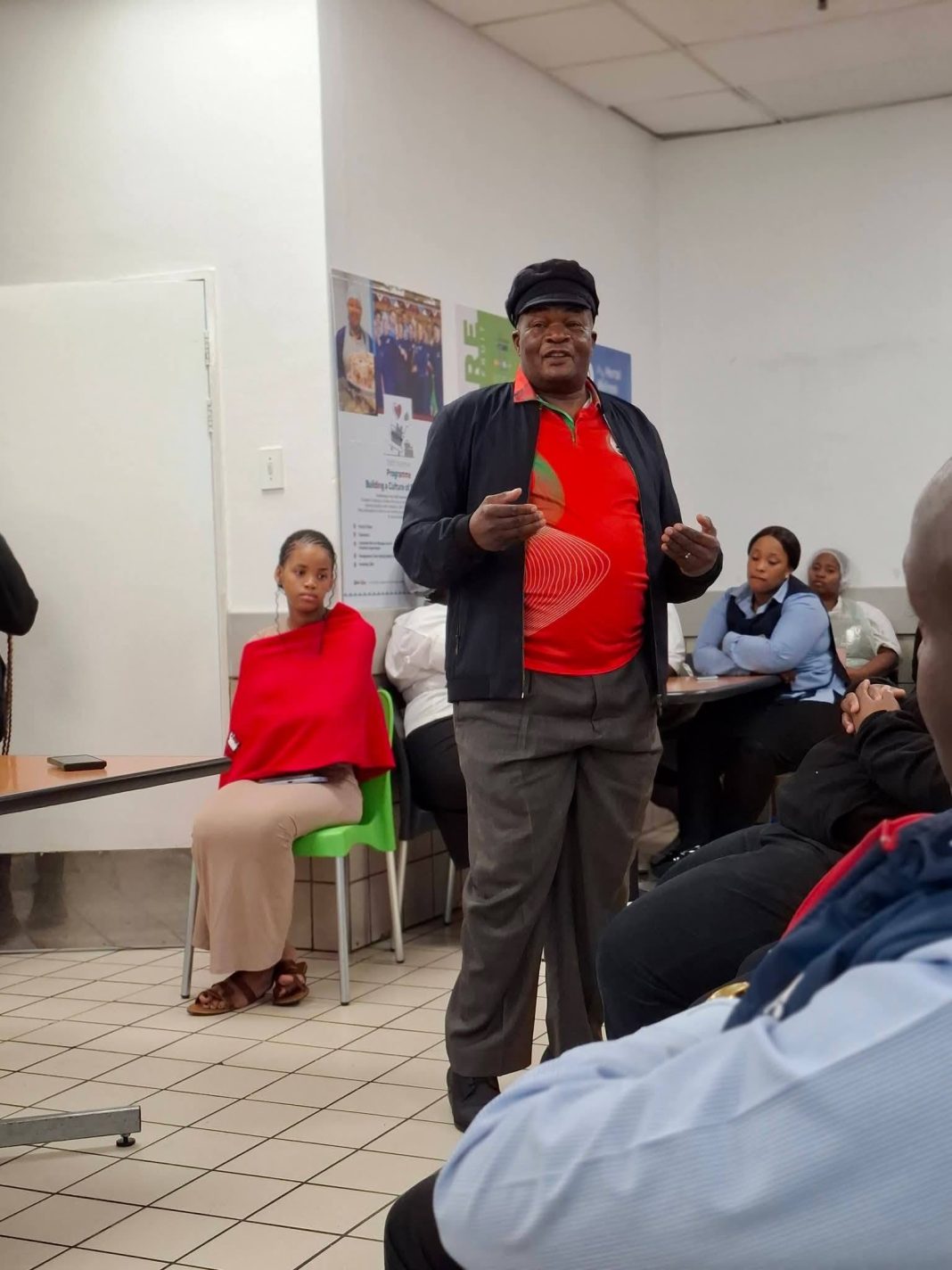
Cosatu general secretary Solly Phetoe made the claims in a statement marking the 81st anniversary of the World Federation of Trade Unions (WFTU), in which he called for greater international working-class solidarity.
“The 81st anniversary of the WFTU takes place at a time when our own country, South Africa, is under siege,” Phetoe said.
“US imperialism in alliance with apartheid Israel have declared diplomatic and economic warfare against our country for advancing progressive laws to redistribute land to the historically oppressed black majority.”
His comments come amid strained relations between Pretoria and Washington, including disagreements over South Africa’s domestic transformation policies and its foreign policy.
Phetoe also accused AfriForum and other groups on the political right of resisting measures aimed at addressing inequality.
“The racist alliance, in collaboration with local apartheid vestiges Afriforum are campaigning to keep apartheid inequalities and the black majority in permanent poverty,” he said.
Cosatu cited the Expropriation Act, National Health Insurance (NHI) and Basic Education Laws Amendment Act (BELA) among policies it has supported as part of efforts to transform South Africa’s economy, healthcare and education systems.
Phetoe said these measures had faced sustained opposition.
“We have seen vicious resistance by right-wing forces organised along the lines of MAGA (Make Apartheid Great Again) desperate to roll back our democratic gains,” he said.
Cosatu said it would continue defending what it described as the democratic and social gains made since apartheid.
“Our common history and rich struggles are sealed with the blood of our martyrs, who fought gallantly against apartheid and gave birth to COSATU during the most difficult years of banning, exiling, arrests and killings of our leaders,” Phetoe said.
“This is why we will not retreat an inch from defending our democratic and revolutionary gains.”
The federation also used the WFTU anniversary to place South Africa’s political and economic challenges within what it described as a broader struggle against imperialism in Africa and the Global South.
Phetoe referred to conflicts in Sudan and the Democratic Republic of Congo and accused France of imperialist intervention in parts of the Sahel, North Africa and West Africa.
“The source of our problems is the same; it is imperialism,” he said.
Cosatu said workers across Africa continued to bear a disproportionate burden of unemployment, poverty, hunger, disease and gender-based violence.
Phetoe also addressed South Africa’s gender-based violence and femicide crisis.
“COSATU condemns GBVF and all forms of violence, harassment and abuse of women. It is the primary duty of the working class to defend women and children from all and any form of abuse, criminality and violence,” he said.
The federation reaffirmed its solidarity with Palestinians and with people in Eswatini, Venezuela and Western Sahara, and reiterated its support for Cuba in opposition to US sanctions.
Phetoe said international mobilisation should ultimately translate into stronger trade union organisation.
“The question before COSATU is not simply whether we can mobilise workers for one day, the deeper question is if we can convert mobilisation into organisation, organisation into consciousness, consciousness into collective action, collective action into a strong federation,” he said.
The WFTU was established in Paris on October 3, 1945, following the Second World War, bringing together trade unions from dozens of countries. Its own historical records say its founding congress included representatives of 56 national organisations from 55 countries.
Cosatu said it remained committed to the WFTU’s “militant, class-oriented international trade union movement” and called for greater solidarity among workers internationally.
FILE: A police vehicle from the Mitchells Plain Police Station. Picture: Lizell Persens/Eyewitness News
Attacks on Western Cape Social Development staff are forcing the department to change how it operates in some communities
Since the start of the year, social services staff in the Western Cape have endured 27 hijackings while trying to do their work.
Last year, 17 cases were reported, while 86 social services employees have been hijacked over the past three years.
Two weeks ago, police recovered a stolen vehicle linked to the hijacking of Western Cape Department of Social Development staff, and two suspects were arrested.
Western Cape Social Development MEC Jaco Londt told CapeTalk’s Lester Kiewit that the escalation in attacks was deeply concerning.
“So many of these attacks are by armed criminals who have now targeted our staff while they are conducting home visits. It also happens at the office.”
The minister recounted an incident in August in which a social worker was conducting a monitoring visit at an NPO in Khayelitsha.“In that instance, a hijacker opened fire, and luckily she was able to drive away to safety to a petrol station to get help.”In another incident, staff in Khayelitsha were threatened with a gun at the department’s offices, while another staff member was hijacked at gunpoint in the driveway of his home in front of his family.Londt said the incidents had left staff traumatised.
“This is the unfortunate situation unfolding at the moment, the trauma that our staff are experiencing because of this.”
The rise in attacks has prompted the department to only conduct scheduled home visits in Khayelitsha, with social workers accompanied by an escort.
Londt acknowledged that the decision could affect response times, but said staff safety had to come first.
“We are doing everything as a department to make sure that our staff are safe and also that residents do receive the service.”
He reminded listeners that, unlike uniformed services such as police and fire departments, social work is not classified as a 24-hour service.
“In cases of after-hours emergency, residents are able to contact the police. And in cases of child protection emergencies, the police are also empowered according to the Children’s Act to remove those kids from dangerous situations.”Kiewit asked whether there were now effectively “red zones” for social workers, similar to areas where emergency medical services require police escorts.“Our staff are very committed to rendering these services. But also, we depend on police to escort them into these areas. But we also
Samwu members marched in Phuthaditjhaba. Photo supplied
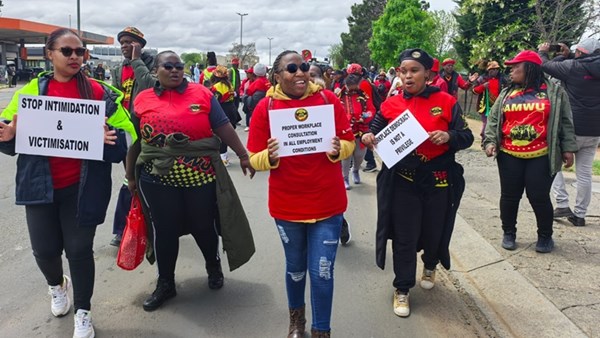
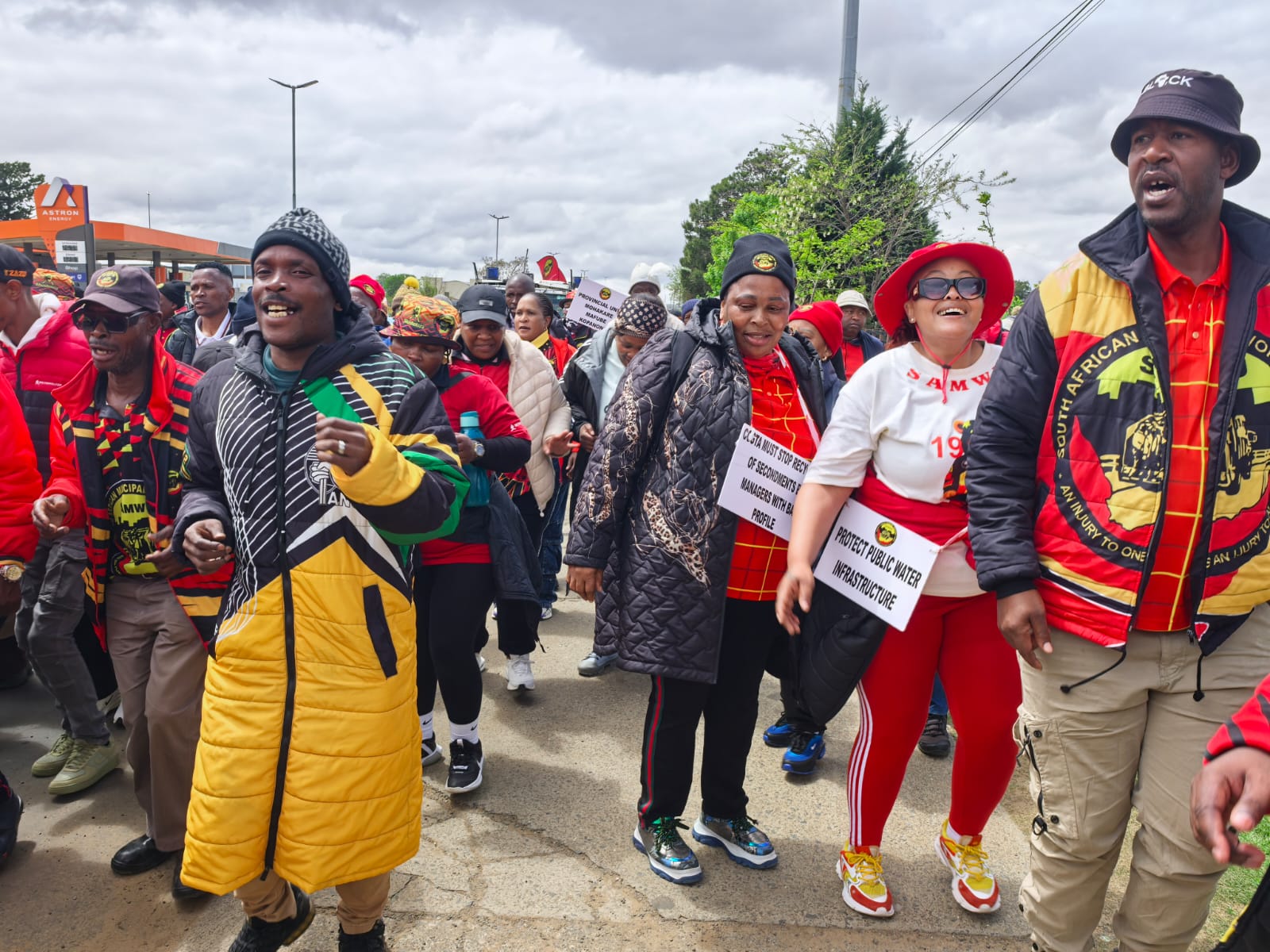
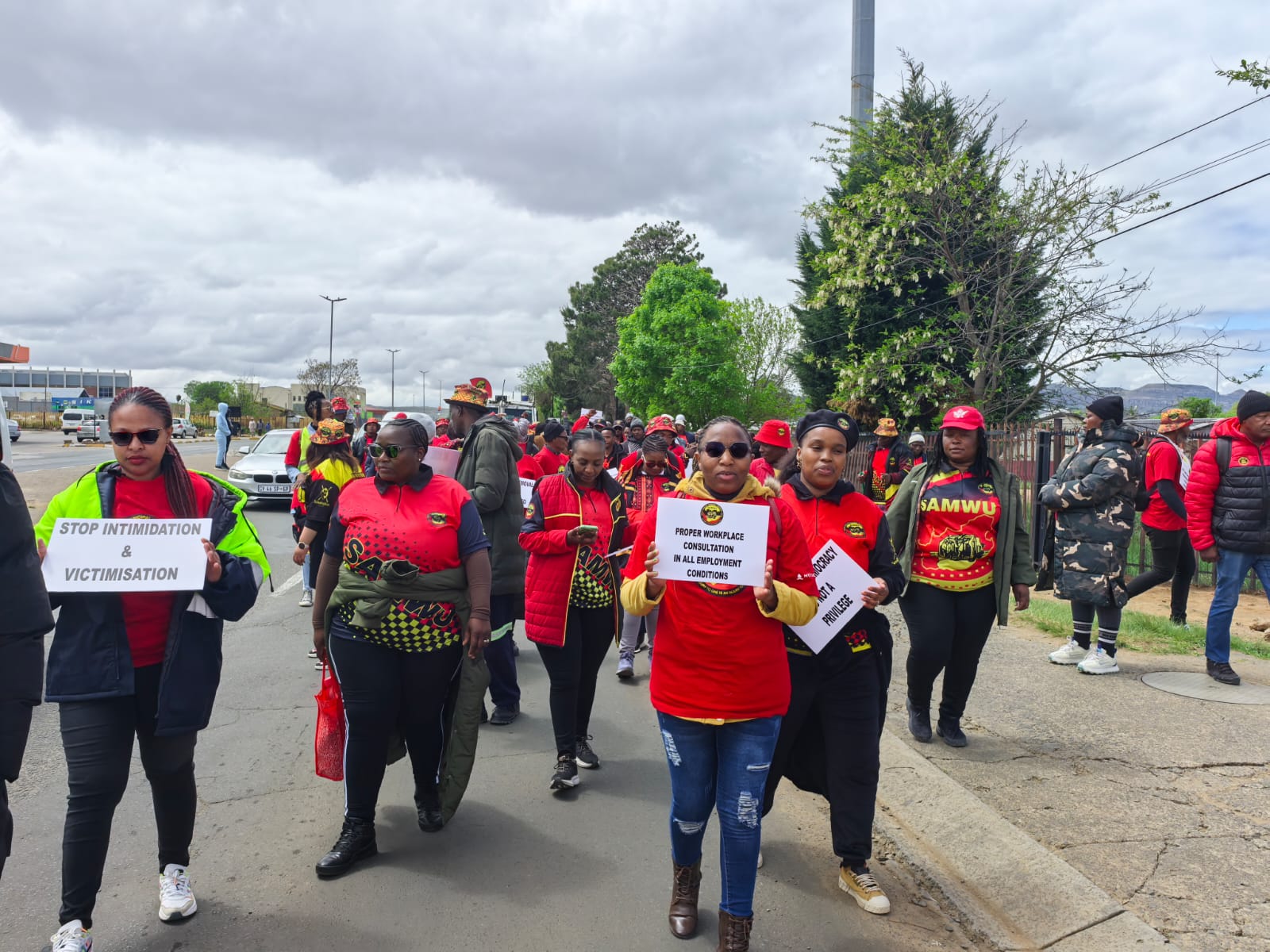
Scores of municipal workers marched to the Maluti-a-Phofung municipal headquarters in Phuthaditjhaba on Wednesday (30/9), demanding action over what they describe as unfair labour practices and deteriorating working conditions.
Members of the municipal workers’ union Samwu took part in the march as the union called on municipal leadership and senior officials to address grievances affecting workers across the Free State. These include unpaid salaries, workplace safety concerns and deductions allegedly not being paid to third parties.
Workers in several municipalities are experiencing similar problems, including deductions for services such as pension funds and medical aid that are allegedly not reaching the intended institutions, Samwu deputy secretary-general Sam Lekhuleni said. Masilonyana and Mantsopa are among the municipalities where these problems have reportedly persisted for extended periods.
“Among the issues we are raising, is the non-payment of salaries in Mafube local municipality, the situation at Maluti-a-Phofung Municipality and MAP Water, and other municipalities in the province that are not complying with the main collective agreement we signed at central and divisional level.”
Samwu members marched in Phuthaditjhaba. Photo supplied
Other grievances include inadequate workplace safety measures and shortages of protective clothing. The union is also concerned about what it describes as the victimisation of workers, particularly shop stewards, some of whom have been suspended or charged, while others have allegedly lost their jobs, said Lekhuleni.
Samwu has previously tried to resolve the disputes through political and government structures, including the ANC, Cosatu and the provincial department of cooperative governance and traditional affairs. Those interventions have not produced satisfactory solutions for affected workers, according to Lekhuleni.
The union also criticised the conduct of Maluti-a-Phofung’s municipal management. Workers want officials to account for the grievances raised and ensure that collective agreements and labour rights are respected.
The protest comes as Maluti-a-Phofung continues to deal with broader governance and service-delivery pressures. Residents have repeatedly raised concerns about water and electricity shortages, deteriorating roads and other basic municipal services.
The municipality’s political leadership recently changed after councillors passed a motion of no confidence against former mayor Malekula Melato. Former council speaker Tumelo Thebe subsequently took over as mayor.
Samwu members during the march in Phuthaditjhaba. Photo supplied
Thebe has committed to addressing some of the municipality’s most pressing problems, particularly unreliable water and electricity supply. Communities are also demanding improvements to roads and other infrastructure as the municipality works to stabilise service delivery.
For Samwu, however, the immediate concern remains the treatment of municipal employees. Workers want outstanding salaries and third-party deductions resolved, safer working conditions provided and what the union describes as victimisation brought to an end.
Housing issues has been a long standing problem affecting workers Image: Ayanda Ndamane/ Independent Newspapers
Cape Town’s housing crisis is increasingly becoming an economic and labour problem as working families are priced out of areas close to jobs and forced to spend more of their income and time travelling between home and work.
Housing advocacy organisation Ndifuna Ukwazi says the city’s affordability crisis has reached a point where large portions of the population can no longer realistically afford to live near employment, schools, healthcare and reliable public transport.
Yusrah Bardien, communications and engagements officer at Ndifuna Ukwazi, described Cape Town as facing an “extreme, escalating urban housing crisis”, arguing that decades of market-led development and insufficient use of well-located public land for social housing had reinforced existing spatial inequality.
According to the organisation, 76% of Cape Town residents earn below R22,000 a month, 58% below R10,000 and 25% below R3,500.
Using common affordability measures that housing costs should account for no more than about a third of household income, Ndifuna Ukwazi said more than half of Cape Town’s population could not afford rent or bond repayments above roughly R3,333 a month.
Housing costs are pushing workers to the city’s edges
Bardien said this meant working-class and lower-income families were increasingly being excluded from well-located parts of the city and pushed towards overcrowded informal settlements or peripheral areas far from economic opportunities.
Ndifuna Ukwazi referred to what has been described as the “40x40x40 syndrome”: households living in homes of around 40 square metres, as far as 40 kilometres from work, while spending up to 40% of their income on transport.
Dawie Roodt, chief economist at the Efficient Group, said the affordability problem could not be separated from South Africa’s weak economic growth.
“The South African economy is not growing fast enough,” Roodt said. “If the economy is growing fast enough, more employment, rising wages, all of that will make all these other issues become irrelevant or much less important.”
He also noted that lower-income households were not seeing their earnings keep pace with rental and housing costs.
He said Cape Town could ease pressure by making residential development faster and less costly, with less red tape and more land opened up for housing development.
Long commutes are becoming a workplace burden
For employees already travelling long distances, however, the housing crisis is also filtering directly into the workplace.
Labour lawyer Wendel Bloem, of Wendel Bloem Attorneys, said employees were generally expected to arrange their own transport to work unless their employment contracts made provision for travel allowances or accommodation.
“The expectation is that the employee will make the necessary arrangements with regards to transport and to getting to the place of work,” Bloem said.
He said employers could provide travel allowances or accommodation, but these arrangements were usually contractual rather than automatic obligations.
Bloem acknowledged that increasingly long and expensive commutes could place a heavy burden on low-paid workers.
“We understand clearly that it can create challenges, and it can create a greater burden financially and even geographically on the employee, especially if it’s a low-paid worker,” he said.
He said employers and employees could negotiate transport or accommodation arrangements, adding that such measures could also benefit employers by helping ensure workers were able to report for duty.
“There must certainly be a labour-related will, by in particular employers, to make those accommodations, especially with accommodation becoming scarce and employees living further and further away from where they work,” Bloem said.
Public land is central to the housing debate
Bardien said well-located public land remained central to solving the crisis.
Ndifuna Ukwazi’s People’s Land Map identified about 128 square kilometres of vacant or underutilised public land across Cape Town.
The organisation has highlighted military-owned land at Ysterplaat, Wingfield and Youngsfield, arguing that large public sites could be used far more aggressively for affordable housing.
It has also questioned why some well-located public land continues to be used for parking, recreational and commercial purposes while thousands of families remain excluded from areas near jobs.
Political parties call for more affordable housing near jobs
The affordability crisis has also become a political battleground.
GOOD Party MPL Brett Herron said Cape Town had not made sufficient progress in reversing apartheid spatial planning.
“Thirty years into democracy, the map of who lives where in Cape Town still looks very much like the map apartheid drew,” Herron said.
“Working and poor families continue to be housed on the periphery, far from jobs, and they carry the cost in time and money every day.”
Herron said public land should be used as an equity contribution to affordable housing rather than sold, and called for numerical targets for housing in areas including the CBD, Woodstock, Salt River, Observatory, Sea Point and Green Point.
Muhammed Khalid Sayed, ANC Leader of the Opposition in the Western Cape Provincial Parliament, said the housing crisis was “fundamentally a question of dignity, affordability and access to opportunity”.
He acknowledged developments such as Maitland Mews, Goodwood Station and Bothasig Gardens, but said isolated projects had not overcome the broader spatial divide.
“A family’s address should not determine its access to opportunity,” Sayed said.
“The workers who sustain Cape Town’s economy should be able to afford to live in the communities they serve.”
He said government should also consider the hidden cost of building housing on cheaper peripheral land.
“Cheap peripheral land can impose substantial costs on families through transport expenses, lost time and reduced access to employment,” he said.
City points to growing affordable-housing pipeline
Mayoral Committee Member for Human Settlements Carl Pophaim said the City’s housing strategy was aimed at reversing apartheid-era spatial planning through transit-oriented development and well-located affordable housing.
He said land parcels with a potential yield of more than 14,000 affordable units were in the active land-release or project-packaging stage, while a further 7,000 units were linked to land already awarded to developers.
More than 6,000 social housing units were already operating in Cape Town, while the City had released land valued at R1.7 billion for affordable housing over the past two years.
Pophaim said around 4,000 affordable units were entering construction phases in the central city this year.
He acknowledged that the cost and availability of well-located land remained significant constraints and said government subsidy programmes alone could not meet demand.
The City, he said, was relying on discounted land releases and private-sector partnerships to expand supply.
Pophaim also called for greater national funding and the release of large state-owned properties such as Ysterplaat, Youngsfield, Wingfield and Culemborg for housing development.
He said Cape Town would need more than one million additional housing units by 2050.
Security guards at Nqolonqolo Security Protection say they are still waiting for money owed.
Story audio is generated using AI
Six security guards employed by Inqolonqolo Security Protection are fighting to recover more than R27,000 in alleged unpaid wages after formal legal complaints exposed widespread underpayments, unfair dismissals and non-compliance with sector regulations.
The workers, represented by BM Mazibuko Attorneys, wrote to the company demanding accountability over alleged contract irregularities, unlawful hourly wage rates and missing statutory benefits.
Enforcement documents issued by the National Bargaining Council for the Private Security Sector (NBCPSS) under case number GP/2026/004/05356 confirm that the company owes R24,624 in direct salary shortfalls and unpaid Sunday work, pushing the total to R27,249 once statutory interest penalties are included.
According to council audit records, Inqolonqolo Security Protection was ordered to rectify multiple breaches, including R14,016 in basic salary underpayments and R9,583 in unpaid Sunday work compensation.
Approached for comment on the allegations and NBCPSS compliance order, a company representative identified as Mr Gule refused to answer questions that were sent two days earlier.
“This matter has nothing to do with you. I didn’t get your email; I didn’t see the WhatsApp. I can’t answer your questions,” Gule said before adding that no one else was available to speak on behalf of the firm and hanging up.
According to the council, there were also ongoing statutory violations dating back to February 2024 involving unlawful salary deductions, unpaid overtime, public holiday allowances, leave pay and non-contributions to the sector provident fund.
Official enforcement documents confirm that the employer was issued a formal compliance order detailing extensive contraventions of the security sector’s main collective agreement.
While the employer’s levy status is listed as “not registered” with the council, the council’s calculations show total basic salary underpayments per guard ranging up to R2,828, plus interest penalties under the Labour Relations Act.
There are two different companies; one is registered, and another is not registered. My payslips don’t even have official stamps of the company.
— Worker who wished to remain anonymous
The initial legal letter revealed that guards working 12-hour shifts were paid an unlawful rate of R20 per hour. Based on a standard 22-day working month, guards were receiving about R5,280, missing out on mandatory night shift allowances, Sunday pay and public holiday rates.
Attorneys also highlighted confusion regarding the company’s identity, noting that payslips, salary references, and timesheets bounced between two similarly named variations — Ingongolo Security Protection and Inqolonqolo Security Protection.
“There are two different companies; one is registered, and another is not registered. My payslips don’t even have official stamps of the company,” one worker who asked to remain anonymous said.
He said management indicated that six workers were owed a combined R26,000 but offered arbitrary settlement amounts.
“They told us they had money they wanted divided, but others received R2,000 and others got nothing. When we asked which company is the real one, they wouldn’t give us a straight answer and kept sending us from pillar to post.”
Payslips provided to Sowetan also confirm that no UIF contributions were deducted, reflecting R0.00 under UIF and PAYE with only a R6 PSIRA fee deducted. Workers expressed confusion after being told at UIF offices that they were not registered for the fund.
The NBCPSS subsequently escalated the matter to arbitration in Braamfontein, Johannesburg, but settlement talks broke down.
“After the case, they brought papers for us to sign through our lawyers so that we would discuss settlement negotiations,” the guard said. “We told them the money they wanted to bring to us was too small, so we decided we would not sign.”
Another guard said his situation deteriorated further when he was summarily dismissed after an allegation of stealing cement, which he denies.
“I wasn’t even at the site when the cement was stolen. I was fired without a fair process or any disciplinary hearing,” he said. “This thing has negatively affected me. I have four kids that live with their unemployed mother, and I am also unemployed.”