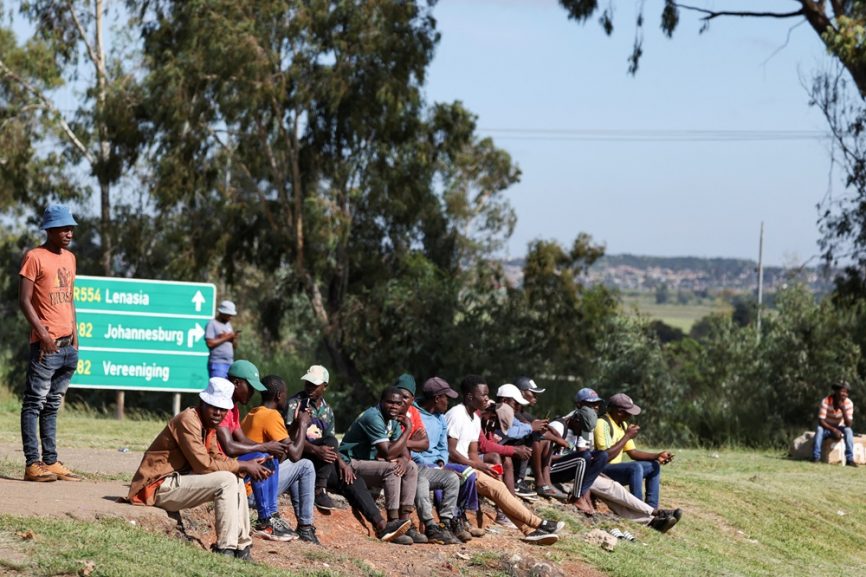
Job seekers wait beside a road for casual work offered by passing motorists in Eikenhof, south of Johannesburg, South Africa, February 26, 2025. Image Credits :Reuters
The Congress of South African Trade Unions (Cosatu) says the country’s unemployment rate is alarming. The labour federation was reacting to the latest Quarterly Labour Force Survey, which shows the official unemployment rate has risen to 33.6%.
Cosatu’s Parliamentary Coordinator Matthew Parks says these figures are more than just statistics and its only getting worse.
“It’s a crisis and I think for far too long, we’ve allowed ourselves to normalize it. We have a crisis of 43% unemployment. It’s been increasing continuously for much of the past decade. And in fact, it’s doubled since over the last 20 years. For young people, it’s even worse it’s over 62%.”
“So you have 12 million people who just can’t find work. About five million of them are young people. This creates a real crisis for them. We’re in danger of creating a permanent class of unemployed persons,” adds Parks.
VIDEO | Unemployment Rate | Unemployment crisis in SA continues:
Parks says the decrease in those employed creates further strain for those who are working due to the amount of people depending on one source of income.
“It also creates a crisis for those 17 million people who do have jobs because the money, the very medial wages are stretched even further trying to support unemployed relatives. And to be fair, look, this is not unexpected, given the war in the Middle East, and in fact, the massive spike in international oil prices.”
“What we’ve seen in South Africa, fuel prices skyrocketing with petrol up by 25%, diesel by 50%. But what we can’t continue to do is just to ignore this crisis,” explains Parks.
Labour federation Cosatu, a historical ally of the ANC, said the latest jobs report was ‘beyond depressing’ and demanded what it called bold and decisive action to tackle the crisis. (SUPPLIED)
Story audio is generated using AI
Young South Africans were again the worst affected as unemployment scaled higher in the second quarter of 2026, with community and social service, mining, agriculture and manufacturing sectors shedding the most jobs.
Just three months ahead of municipal elections, opposition parties were quick to pounce on the data from Stats SA on Tuesday as a clear sign of the government’s failure to spur the economy towards the growth levels needed to get millions of citizens working.
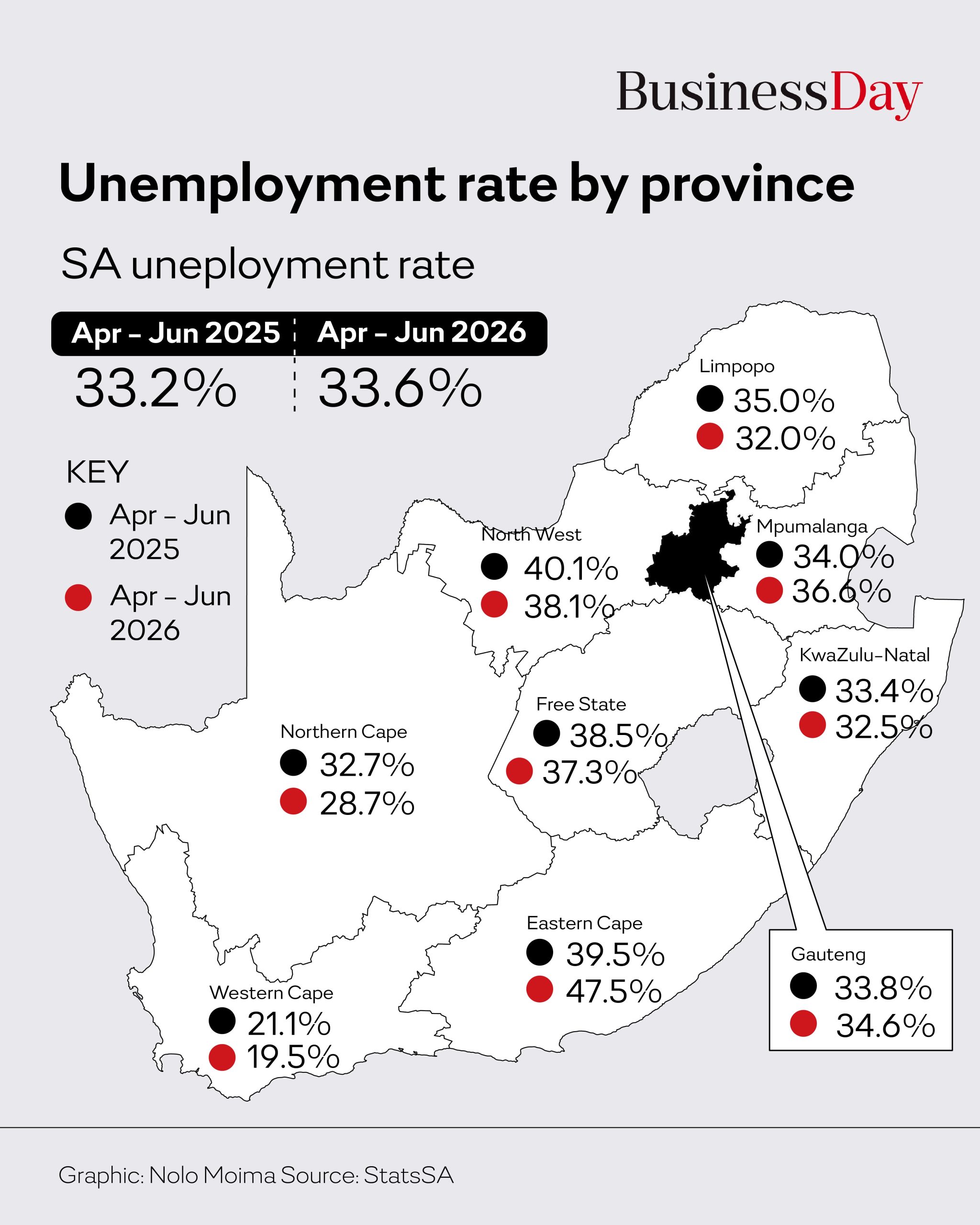
The jobless rate jumped to 33.6% in the second quarter from 32.7% in the first three months of the year, with the number of unemployed people increasing by 345,000 to 8.5-million while the total of those with jobs fell by 16,000 to 16.7-million.
SA unemployment rate by provinces. (Nolo Moima)
The number of jobless young people aged 15-34 soared by 264,000 to 5-million, almost matching the total of employed youth, which fell by 40,000 to 5.6-million. As a result, the youth unemployment rate increased by 1.5 percentage points to 47.4% in the second quarter.
ActionSA led a chorus of criticism from several parties that laid blame for the malaise at the feet of the government of national unity (GNU) formed by President Cyril Ramaphosa after his ANC lost its three-decade long outright parliamentary majority in the 2024 general elections.
“While millions of South Africans are unable to find work, the GNU remains consumed by internal battles, political horse-trading and disagreements between its constituent parties. Ministers continue to enjoy and abuse the privileges of office while South Africans are expected to endure an unemployment crisis that has persisted for years,” ActionSA MP Alan Beesley said in a statement.
The DA, the second largest party in the national ruling coalition, said it will push for greater urgency and ambition in the GNU’s economic reform agenda.
“Economic reform is happening far too slowly to spur growth at the pace required to create jobs. Businesses and investors are still held back by red tape, unreliable basic services, failing ports and rail, and crime that makes it harder and more expensive to build, invest and employ people,” DA leader Geordin Hill-Lewis said.
The Stats SA data shows the number of people employed in the formal and household sectors decreased by 41,000 and 9,000, respectively, in the second quarter, while those in the informal sector rose by 34,000.
The largest decreases in employment were recorded in community and social services (57,000), mining (26,000), as well as agriculture and manufacturing at 15,000 each.
Stemming the loss of jobs requires reinvigorating towns and cities where economic activity actually occurs, as well as fixing the drivers of industrialisation, Rise Mzansi leader Songezo Zibi said.
“Without capable, functional and accountable local governance, businesses cannot expand, basic services fail, and local economies crumble,” he said.
“We cannot industrialise or create sustainable jobs without getting the basics right. Water, energy and freight logistics are the lifeblood of economic growth. When ports are congested, rail lines break down, water supply collapses and energy remains precarious, industrial growth is impossible,” Zibi said.
Economists had predicted bleak jobs numbers for the second quarter, partly citing higher input costs for businesses due to the US-Iran war, which has sent oil prices spiralling.
The latest Rand Merchant Bank/Bureau for Economic Research confidence index shows local businesses came under significant pressure in the second quarter, with the operating environment deteriorating due to supply constraints linked to the Middle East conflict.
The government has long acknowledged that the economy, which only mustered growth of 1.1% last year, is not expanding anywhere near the levels needed to significantly dent unemployment.
Labour federation Cosatu, an ANC ally, said the latest jobs report is “beyond depressing” and demanded what it called bold, decisive action to tackle the crisis.
“We cannot continue to normalise 1% economic growth and dangerously high levels of unemployment, poverty and inequality,” Cosatu spokesperson Matthew Parks said.
“The extent of this crisis requires a bold and aggressive stimulus package to kickstart the economy, rebuild public and municipal services, make capital affordable and accessible for SMMEs and industrial sectors, and extend relief for the unemployed by expanding public employment programmes.
“Similarly, efforts to reduce the price of electricity, restore rail and ports to full capacity, and invest in economic infrastructure and tackle crime and corruption must be accelerated.”
The Motor Industry Staff Association (Misa) said the government, business and labour must urgently collaborate to create permanent employment opportunities, adding that investment in skills development, targeted support for small businesses and policies that stimulate industrial growth are crucial.
“The rising unemployment rate is not just a statistic; it represents families under pressure and communities losing hope. We must act with urgency and compassion to restore dignity through decent work,” said Martlé Keyter, CEO of operations at the association.
Youth unemployment in particular was the focus of an annual public economics conference hosted by the Government Technical Advisory Centre last month.
National Treasury director-general Duncan Pieterse told delegates that as the dominant divisions in the manufacturing sector, which used to provide jobs, become increasingly less labour intensive, the country must look to sectors such as tourism and construction to help reduce unemployment.
In an address to the same conference, finance minister Enoch Godongwana said that “South Africa will not defeat youth unemployment at scale without faster, inclusive economic growth”.
He added: “But growth will not happen by itself. It requires reform. Reform requires implementation. Implementation requires capable institutions. And capable institutions require credible public finances, good data, accountability and discipline.”
Pharmisa says the health department’s focus on price is squeezing local drug manufacturers out of crucial medicine tenders, resulting in job cuts. Picture: 123RF/PAVEL CHAGOCHKIN
Story audio is generated using AI
The health department has defended its public procurement processes and accused a pharmaceutical industry association of misleading parliament about the reasons behind the sector’s recent job loses.
The row goes to the heart of long-running tension between government policies that seek to support local industries and the budget pressures facing the health department, which has repeatedly drawn fire from domestic players for choosing cheaper imports over medicines made in South Africa.
Last week, Pharmaceuticals Made in South Africa (Pharmisa) told parliament’s portfolio committee on trade, industry & competition that the health department’s focus on price was squeezing local drug manufacturers out of crucial medicine tenders to such an extent that it had triggered the loss of 2,500 jobs in the past 18 months.
Pharmisa’s members include Aspen Pharmacare, Adcock Ingram, Biovac, Sandoz, the National Bioproducts Institute and Fresenius Kabi.
The organisation said local pharmaceutical manufacturers’ share of the HIV/Aids drug tender had plunged in value from 72% in 2008 to 28% in 2025, while their share of the tender for tablets and capsules by value had fallen from 56% in 2014 to 18% in 2026. It also drew attention to the impact of the health minister’s decision to award a below-inflation increase of just 1.47% for private sector medicine sales in 2026, and the effect on input costs of the war in the Middle East.
The health department hit back at the weekend, saying Pharmisa had presented MPs with a distorted picture of its procurement processes and glossed over crucial market developments putting pressure on manufacturers, such as more stringent regulatory requirements.
“South Africa needs a mature discussion about how to strengthen local pharmaceutical manufacturing. It does not benefit from sensationalism or the selective use of procurement data to create the impression that public procurement has failed,” it said.
“A reduction in the value of some of the contracts awarded to particular manufacturers is not, on its own, evidence that government policy has failed. It reflects a dynamic and increasingly competitive pharmaceutical market in which the government must balance industrial development with its constitutional obligation to maximise access to affordable medicines.”
The department rejected Pharmisa’s analysis of its tender awards, saying the association had used a definition of local manufacturing inconsistent with its own. Its own analysis showed support for local manufacturing had been maintained despite significant reductions in procurement prices.
It did not directly respond to Pharmisa’s analysis of tenders by value, focusing instead on how the tenders were split by volume. “On the solid dosage form tender (for tablets and capsules), the proportion of quantities awarded to locally produced products increased from 38% in 2023 to 45% in 2026. Similarly, on the ARV (HIV treatment) tender, quantities awarded to locally produced products increased from 67% in 2022 to 70% in 2025,” the department said.
Pharmisa had ignored fundamental changes to the pharmaceutical market over the past decade, including reductions in medicine prices through increased competition and the participation of more manufacturers, it said.
The pharmaceutical industry was also operating in an environment where regulatory expectations had increased significantly over the past decade, requiring substantial capital investment and continuous upgrading of production facilities. Companies that had been slow to modernise or make the required changes to maintain regulatory compliance were unable to compete effectively.
Pharmisa chair Stavros Nicolaou rejected the department’s analysis, which he claimed relied on medicine registration certificates instead of production data or customs records of imports. Medicine registration certificates list potential manufacturing sites and do not reflect where production has actually taken place, he said.
Pharmisa defines a local manufacturer as one that has invested in production capacity, imports active pharmaceutical ingredients and formulates medicines in South Africa. It excludes companies that repackage and label imported finished goods. Using this definition, its analysis of the latest Aids drug tender showed six of the eight companies that won a share of the core contract to supply monthly packs of the triple pill taken by most HIV patients had gone to importers, Nicolaou said.
“The only way to resolve this is to [have] a discussion with the health department. We hope it will give us an audience this week, given the gravity of the situation.”
South Africa’s biggest trade union federation, Cosatu, has called for immediate government intervention to halt the pharmaceutical manufacturing sector’s job losses. “While the government must seek the best value for money when procuring goods, including health supplies, this must not be taken to Thatcherite extremes or at the cost of badly needed local jobs, producers and value chains,” it said.
The closure of Premier Foods’ fruit processing plant in Tulbagh would remove almost half of the country’s canning capacity. Photo: Brent Meersman
Producers and labour warn that closing Tulbagh factory could leave hundreds of farmers without processing options before the November harvest
About 200 producers of deciduous fruit face possible ruin because of the prospective closure of Premier Foods’ fruit processing plant in Tulbagh.
Farmers say they need certainty about the factory’s closure before the November harvest.
Premier Foods says its Tulbagh fruit processing plant is no longer economically viable.
Producers warn its closure would remove half of South Africa’s fruit canning capacity.
COSATU wants the retrenchment process halted while business rescue plans are explored and the Competition Commission investigates.
The prospective closure of Premier Foods’ fruit processing plant in Tulbagh has raised concerns well beyond the loss of factory jobs. Producers warn it could leave hundreds of them scrambling for alternatives just months before the next harvest.
Premier has begun a Section 189 consultation process on the proposed closure of Fruit Products Western Cape (FPWC). The company says the business is no longer economically sustainable because of rising production costs and declining global demand. About 90% of the factory’s canned fruit is exported.
The company responded to GroundUp with a statement saying it is working with farmers, government, the Competition Commission and other stakeholders to minimise the impact on employees, farmers and the Tulbagh community.
Producers face uncertainty
“Basically half the capacity for the industry will disappear,” said Jacques Jordaan, chief executive of the Canning Fruit Producers’ Association (CFPA).
According to Jordaan, South Africa has two main canning facilities: the FPWC plant in Tulbagh and Langeberg Foods in Ashton. Closing Tulbagh would remove almost half of the country’s canning capacity.
The announcement comes shortly before the deciduous fruit harvesting season begins in November and producers have already incurred most of their annual production costs – pruning, fertilising, irrigating and controlling pests.
Jordaan says between 200 and 220 producers supply the Tulbagh factory, many producing fruit varieties specifically bred for canning rather than the long-shelf-life varieties required for the fresh export market.
Without the canning facility, producers will have to remove orchards and invest in alternative crops and in new packhouses and distribution infrastructure.
The association says producers operate under rolling, long-term supply agreements that provide for a two-year notice period, allowing time to adapt if processing capacity changes.
In a letter to producers, dated 29 July, the company confirmed it would pay outstanding balancing payments (“agterskotte”) for fruit supplied during the 2025/26 season at the end of October, in accordance with existing contracts.
The letter included projected final payments for apricots, peaches and pears while explaining that Premier had decided to exit the soft-fruit canning industry after deteriorating international market conditions.
“It’s not an honour to honour a contract. They have received the fruit, worked the fruit, and now they pay for it,” Jordaan said. “At this stage there have been no commitments to the future seasons. Premier had commitments. It cannot just walk away from them.”
Industry under pressure
Premier attributed its decision to global oversupply, higher United States tariffs, uncertainty surrounding the African Growth and Opportunity Act (AGOA), exchange-rate pressures, and consolidation within the canned fruit industry. It points to the closure of one of the United States’ two major fruit canning operations earlier this year.
“Canning fruit internationally is under pressure,” Jordaan agreed. But, he argues, South Africa remains internationally recognised for the quality of its canned fruit and should be competing at the premium end of the market.
The announcement has also prompted questions about why the company would close a facility that had recently benefited from substantial investment.
According to Jordaan, more than R200-million has been invested in the Tulbagh operation over the past three years, making it difficult for producers to understand why Premier now believes the plant has no viable future.
“It feels like Premier just took over and now says they are going to exit,” he said.
Earlier this year, Premier completed its acquisition of the Rhodes Food Group, adding the Tulbagh processing operation to its portfolio. Last year, Langeberg Foods took over the former Tiger Brands canning factory in Ashton. Premier says it intends to work with Langeberg Foods to process future harvests rather than continuing operations in Tulbagh.
Jordaan says shifting all processing to Langeberg Foods cannot be achieved within a few months and would create significant commercial and financial risks.
The first round of Section 189 consultations took place on Thursday.
Job losses
COSATU Western Cape provincial secretary Malvern de Bruyn said organised labour refused to engage on retrenchments during the first meeting, insisting that discussions should focus on saving jobs instead.
“Why throw in the towel right at the beginning?” De Bruyn asked.
“Our position remains that we want a halt to the Section 189 process and look for a business rescue alternative … They were able to save the Ashton factory, why can’t they do the same here?”
He said COSATU was not directly involved in negotiations but played a role through its affiliate Southern African Clothing and Textile Workers’ Union (SACTWU).
“Over 150 farms will be affected by this decision, so thousands more workers will be indirectly affected and could also lose their jobs. The farm owners will also suffer because of this inhumane decision,” he said.
“We are hopeful because we’ve got 60 days in which to find an agreement.”
The Competition Commission is also scrutinising the proposed closure.
De Bruyn said the Section 189 consultation process should be suspended while the Commission investigates whether the proposed retrenchments comply with public-interest conditions attached to Premier’s acquisition of Rhodes Food Group, including undertakings relating to employment. He said similar retrenchments following mergers had occurred elsewhere, and he cited PepsiCo’s acquisition of Pioneer Foods.
In the coming days, COSATU will consult with its national leadership on whether to seek an interdict to halt the retrenchment process.
The Commission did not respond to GroundUp’s questions.
The next round of Section 189 consultations is scheduled for 26 August. Labour must submit questions to the company by 14 August, with the company expected to respond by 21 August.
For producers, however, time is running out. With the next harvest only months away, producers say they need certainty about who will process their fruit, whether existing contracts will be honoured beyond this season, and how South Africa’s remaining canning capacity will absorb volumes previously handled by Tulbagh.
COSATU’s Parliamentary coordinator Matthew Parks. Picture: X/Radio702
The union has commanded a bold and decisive action to tackle the country’s unemployment crisis.
The Congress of South African Trade Unions (COSATU) has sharply criticised South Africa’s worsening unemployment.
COSATU has dubbed the latest Statistics South Africa (Stats SA)’s Quarterly Labour Force Survey (QLFS) for the second quarter, showing an increase to 33.6% in the second quarter, a “ticking time bomb” and a national emergency.
The union has commanded a bold and decisive action to tackle the country’s unemployment crisis.
“This extent of this crisis requires a bold and aggressive stimulus package to kickstart the economy rebuild, public and municipal services, make capital affordable and accessible for SMEs [small and medium-sized enterprises] and industrial sectors and extend relief and expand public employment programmes,” said COSATU’s parliamentary coordinator, Matthews Parks.
MMABATHO – The Democratic Nursing Organisation of South Africa (DENOSA) in North West warmly welcomes yesterday’s ruling by the Johannesburg Labour Court on the review application by Department of Health in North West of the Public Health Social Development Bargaining Council (PHSDSBC) arbitration award to DENOSA to have an assistant nurse paid 8 percent Rural Allowance, backdated to April 2018 when she commenced her employment for government.
Upholding the previous ruling by the PHSDSBC Arbitration, that the nurse must be paid Rural Allowance retrospectively, proves that DENOSA has been right all along that PHSDSBC Resolution 2 of 2004 has been implemented inadequately as it has been excluding Enrolled Nurses (ENs) and Enrolled Nursing Assistants (ENAs), when in fact the Resolution includes them.
DENOSA took this matter on behalf of the nurse in December 2020. The nurse works in one of the rural healthcare facilities in the North West, and has not been receiving Rural Allowance since she commenced her employment, leaving her 8 percent poorer in terms of salary every month.
At the centre of the matter is the wrong interpretation of PHSDSBC Resolution 2 of 2004 by the Department of Health in North West, and by extension other health departments in the country. The Department interprets the Resolution as saying only a category “Professional Nurse” should be paid the 8 percent Rural Allowance if they are working in a clinical area in areas that are designated as rural areas, whereas this term in the Resolution is used to describe a nurse that is registered at the South African Nursing Council, the country’s regulatory authority for nursing, not to a nursing rank.
The Resolution is clear that those who are excluded from the Resolution are student nurses.
Since 2004 when the agreement was signed in the public sector, the Enrolled Nurses and Enrolled Nursing Assistants have been excluded from getting Rural Allowance. The ruling by the court will have far-reaching effects as thousands of other Enrolled Nurses and Enrolled Nursing Assistants are in the same quagmire countrywide.
DENOSA will enforce the implementation of this ruling by the Department of Health so that justice and fairness are served on the affected nurses.
DENOSA is happy that, finally, justice has been served.