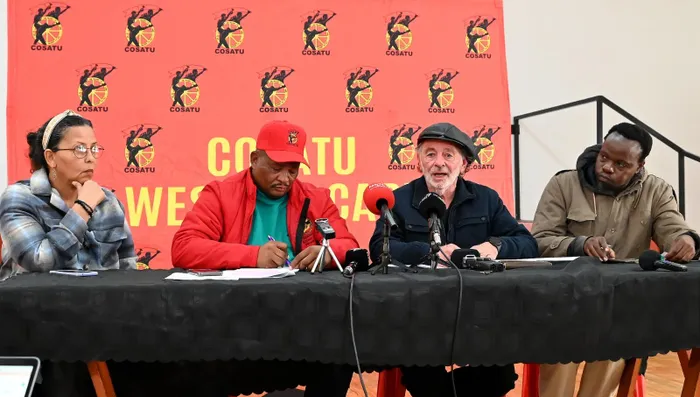
WCC AX Lorna Houston, Cosatu Western Cape’s Malvern De Bruyn, WCC AX Roger Etkind and Danmore Chuma at the media briefing on Monday. Image: BHEKI RADEBE /ANA Studios
It’s all hands on deck in Cape Town on Tuesday as law enforcement is mobilising all available resources to address the potential violence stemming from the anti-immigrant demonstrations planned.
Safety and Security mayco member, JP Smith, said law enforcement officers will not tolerate any violence or disruption and opportunistic criminals.
“I am aware the situation has caused tension and anxiety amongst Capetonians, but I want to ensure that City enforcement services are ready,” said Smith.
This comes as foreign nationals have flocked out of the country ahead of Tuesday’s June 30 deadline initiated by the March and March Movement.
Cosatu Western Cape and the Western Cape Coalition against Xenophobia (WCC-AX) said the Department of Home Affairs should be held accountable for its role in keeping migrants stateless, without papers, and in a state of limbo.
March and March have insisted the national protest on Tuesday will be peaceful, while its leader, Jacinta Ngobese-Zuma, said the movement will not take responsibility for any violence on the day, arguing that public safety is the job of the State.
In a briefing at their offices on Monday, Cosatu’s Malvern de Bruyn read out a joint statement on behalf of both organisations, in which they voiced their solidarity and opposition to March and March and affiliated xenophobic groups’ escalating assault on African migrants.
“We understand that this is a particularly brutal attempt to divide the working class and the poor. It is intended to distract attention from the abject failures of the government over more than 30 years, to build an economy that works for ordinary people. Instead, we have an elite who live a life of luxury, while millions go hungry and jobless.
“We reject with contempt the so-called 30 June ‘deadline’ which has already caused so much chaos, suffering, and violence. It risks being but one of many upsurges of mass repatriations, tribalism, threats, and bullying,” De Bruyn said.
“March and March spreads lies about people who move to and around South Africa, obscuring the colonial roots and history of mobility across our continent. We see the conflict in the DRC, stirred up by multinational companies with their never-ending appetite for profit. We see the devastating effects of climate change in Malawi and Mozambique, as whole regions become uninhabitable.
“We understand that Africa must unite and not fragment into its colonial compartments. We also remember that this country was built from migrant labour. We remember our battles against the dompas, and we now call for renewed resistance against apartheid logics of influx control that xenophobes have taken up,” De Bruyn said.
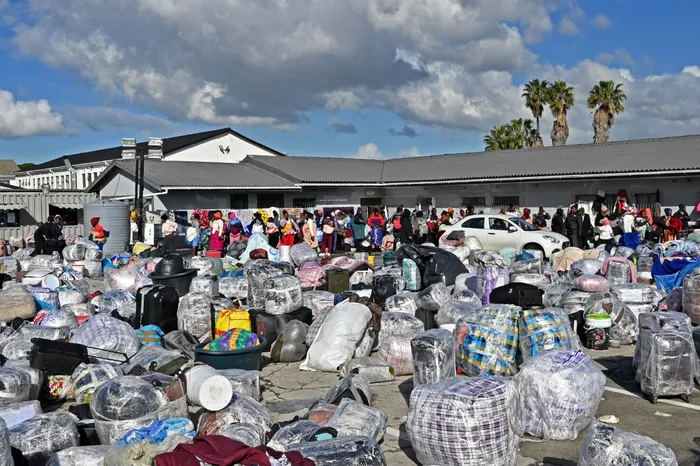
Hundreds of foreign nationals are waiting to be processed at the Epping Home Affairs refugee centre. Image: BHEKI RADEBE/ANA Studio
The office of Home Affairs Minister Leon Schreiber was contacted for comment.
WCC-AX’s Danmore Chuma, from Zimbabwe, said he feels “really disturbed and betrayed” because the working class and the poor are fighting against each other instead of uniting to fight unemployment, poverty, inequality, and austerity.
“Immigrants are not people who are irrelevant. Immigrants are not objects. Immigrants are people who have contributed, people who can contribute to the economic development of the country,” Chuma said.
President Cyril Ramaphosa said while the right to protest is enshrined in the Constitution, it “does not allow people to threaten or intimidate others, or to engage in acts of vandalism or violence”.
“What we should seek as citizens and as a society is to work together to address the legitimate concerns that many South Africans have raised. The government has a responsibility not only to listen to these concerns but to respond with effective action. Citizens have a responsibility to pursue change peacefully and within the framework of our Constitution.
“Government has accepted that our immigration system requires substantial reform. We are strengthening border management, increasing enforcement against undocumented immigration, improving the integrity of the asylum and visa systems, and taking action against corruption that has weakened immigration control,” Ramaphosa said.
“We also recognise that where our systems have failed, they must be corrected. Where corruption has enabled illegal immigration, those responsible must be held accountable. Where enforcement has been inadequate, it must improve.”
Premier Alan Winde said: “Anyone acting outside of the law must be arrested and prosecuted. We fully respect every resident’s constitutional right to protest. However, this right must always be exercised peacefully and within the bounds of the law. I call on all residents to reject violence in all its forms.”
Xenophobia is “intended to distract attention from the abject failures of government” says COSATU’s Malvern de Bruyn
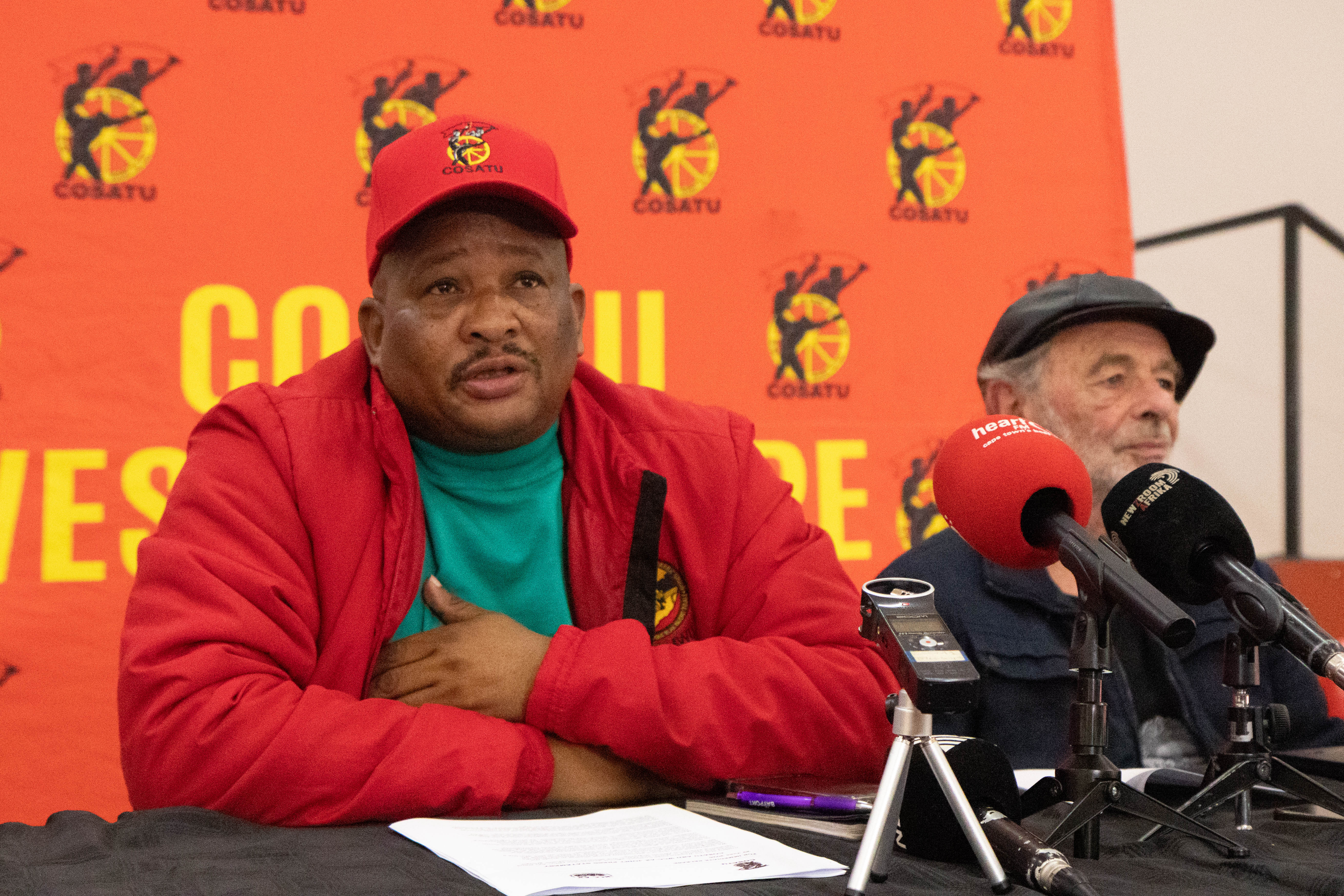
COSATU Western Cape secretary Malvern de Bruyn says actions by groups like March and March are an attempt to “divide the working class and the poor”. Photos: Liezl Human
Unions and members of the Western Cape Coalition Against Xenophobia are urging people to reject the “fabricated” deadline of 30 June set by March and March for all undocumented immigrants to leave the country.
During a press briefing on Monday, COSATU’s Western Cape secretary said that actions by groups like March and March are “intended to distract attention from the abject failures of government”.
President Cyril Ramaphosa on Monday cautioned those participating in protests tomorrow that while South Africans have a right to protest, “freedom of expression does not allow people to threaten or intimidate others, or to engage in acts of vandalism or violence”.
COSATU and the Western Cape Coalition Against Xenophobia (WCC-AX) are calling on the government and South Africans to stand against escalating threats of violence against African immigrants. They have urged people to reject the “fabricated” deadline of 30 June set by March and March for all undocumented immigrants to leave the country.
During a press briefing at Community House on Monday, Malvern de Bruyn, COSATU Western Cape secretary, said xenophobic threats are “intended to distract attention from the abject failures of government, over more than 30 years, to build an economy that works for ordinary people”.
He said actions by groups like March and March are an attempt to “divide the working class and the poor”.
COSATU called on workers to be “vigilant” on Tuesday and report any criminal activities to authorities. COSATU also called on employers to be understanding of employees who could not go to work due to any action.
Lorna Houston, from the WCC-AX, said, “The idea that migrants are responsible for the problems we face in South Africa is an effort at scapegoating and directing attention away from capitalist exploitation, inequality, corruption, and government failures.”
Houston said that the deadline that March and March set was “unconstitutional”.
“It presents an unconditional attack on human rights and dignity … The state has a specific obligation to protect and promote human rights for everyone,” she said.
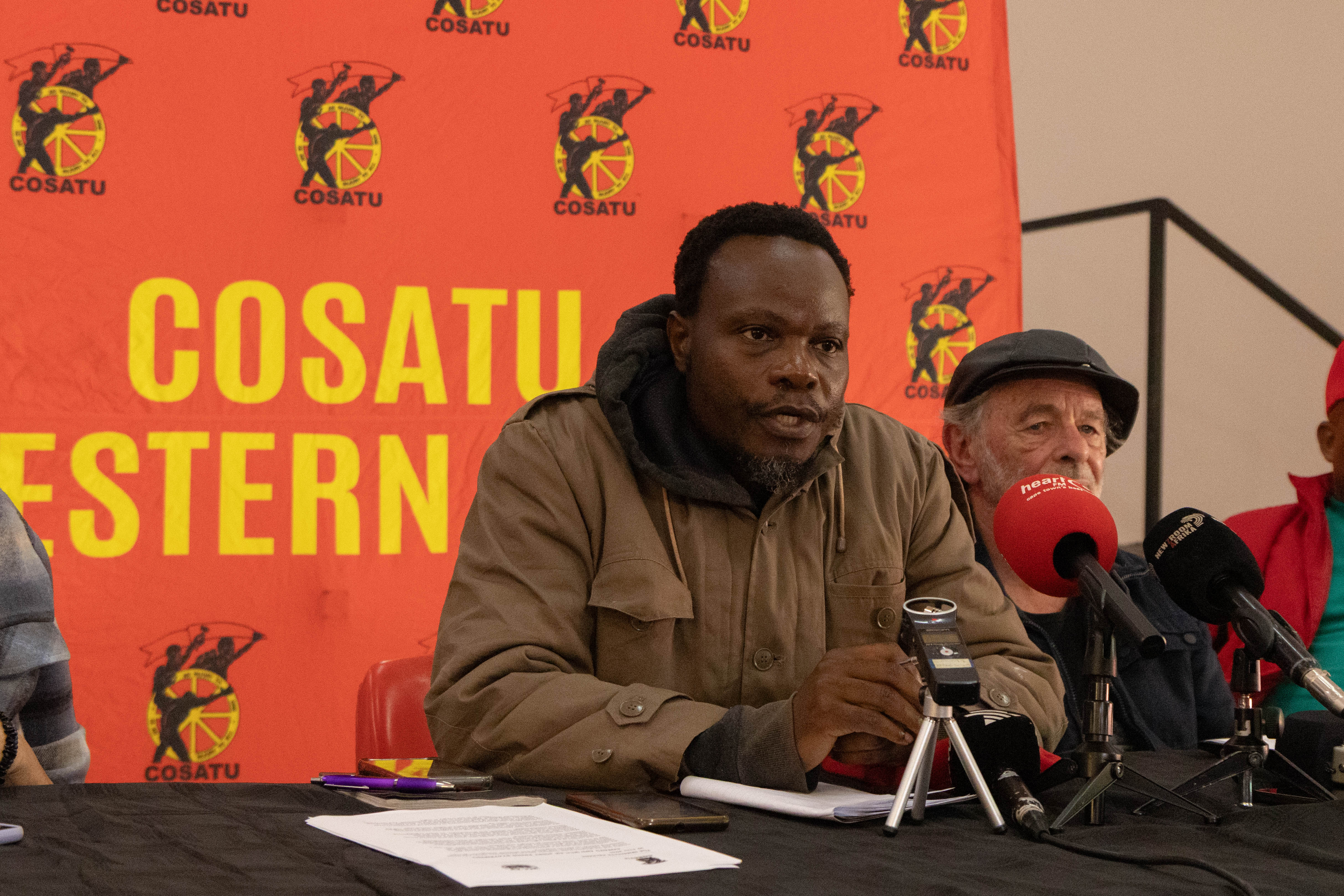
Danmore Chuma, from Chronicles of Refugees and Immigrants, an affiliate of WCC-AX, said he was concerned about the reports of undocumented immigrants recently getting “harassed and arrested by the police” since this “legitimised” actions by March and March.
“We call upon the government not to be complicit,” he said.
Chuma said he was “disturbed” to see that thousands of Africans are forced to be repatriated despite “contributing to the economic development and social development of the country”.
Danmore Chuma, from Chronicles of Refugees and Immigrants, addressing the media at a briefing on Monday.
Across the country, in Cape Town, Pietermaritzburg, Durban and Johannesburg, thousands of immigrants have been displaced and are awaiting repatriation to their countries of origin.
A statement by President Cyril Ramaphosa on Monday noted that while South Africans have a right to protest, “freedom of expression does not allow people to threaten or intimidate others, or to engage in acts of vandalism or violence”.
Ramaphosa said the country’s “immigration system requires substantial reform”.
“We are strengthening border management, increasing enforcement against undocumented immigration, improving the integrity of the asylum and visa systems, and taking action against corruption that has weakened immigration control.”
“Some foreign nationals who live in South Africa are here lawfully. They work, study, raise families, invest in our economy and contribute positively to our society. They too are entitled to the protection of our laws and our Constitution,” he said.
Women on Farms Project, an NGO representing farm workers, in a press statement also rejected the “unlawful deadline” and condemned the xenophobic violence across the country.
“Women farm workers know that it is not other poor, vulnerable African women who are to blame for their precarious employment on farms, low wages, and landlessness,” said WFP.
Anti-immigrant protesters are expected to take to the streets across SA on Tuesday after their deadline for undocumented foreigners to leave the country expired at midnight.
But by first light, police across the country said they had not recorded any major incidents linked to the planned action.
More than 25,000 foreigners had already been bussed out of the country, while thousands more had fled their homes and taken refuge in repatriation centres, consulates and makeshift camps.
This as the state deployed thousands of police and soldiers across the country — at a cost of R600m and counting — to prevent the protests from turning violent, as they did in 2008.
That year, mobs torched homes, looted shops and butchered 62 people across the country, sending tens of thousands fleeing for their lives.
Tuesday’s mass protest action, which became known as June 30 after the deadline set for undocumented foreigners to leave, also draws a strong parallel to the 2021 unrest that followed ex-president Jacob Zuma’s jailing, in which more than 350 died.
And praying history would not repeat itself, worshippers from different faiths packed mosques dotted across SA on Monday night.
Province by province, police reported a quiet start to Tuesday.
In Gauteng, the centre of the planned marches, police spokesperson Colonel Dimakatso Nevhuhulwi said at 5.40am that nothing had been reported so far.
In the Eastern Cape, Kouga police spokesperson Captain Marius McCarthy said at 5.15am that no violent incidents had been reported.
In Mpumalanga, police spokesperson Lieutenant Colonel Jabu Ndubane said there had been no incidents linked to the protests, apart from an armed robbery in Standerton in which three suspects were arrested.
In Limpopo, police spokesperson Brigadier Hlulani Mashaba said no violent incidents had been reported.
Mashaba said a video circulating online of a shop being looted in Steelpoort was old footage and disinformation.
Mashaba said police in the Maake precinct had arrested a 48-year-old farm owner and 15 undocumented workers for contravening the Immigration Act during a compliance inspection at a farm in Trichardsdal on Monday.
In the Western Cape, provincial traffic chief Maxine Bezuidenhout said at 5.25am that no disruptions had been reported.
Mossel Bay municipal spokesperson Cornelle Carstens also said no incidents had been reported so far.
Overstrand mayor Archie Klaas said that while nothing had been reported by 5.30am, he had received intelligence on Monday warning of major disruptions and large protests in the coastal region between Cape Town and Cape Agulhas.
The National Joint Operational and Intelligence Structure (Natjoints) briefed the media in Pretoria on Monday night, saying its operation was now in full swing.
Lieutenant General Tebello Mosikili, deputy national commissioner for policing and chairperson of Natjoints, said more than 25,000 foreign nationals had been repatriated so far.
She said since March 1, NatJoints recorded at least 103 cases of anti-immigrant violence and made 195 arrests.
“The state is ready, and law enforcement is ready,” she said.
“Physical infrastructure will be protected and maintained, and our operators are on the ground.”
She said Natjoints would respond swiftly to anyone who intended to break the law.
“Don’t test the state,” she said.
“Freedom to protest is guaranteed, but it must be peaceful.
Meanwhile, the organisers listed starting points for the marches in cities across the country, all carrying the instruction that no weapons were allowed:
Johannesburg, from Bayers Naude Square to Hillbrow at 9am;
Pretoria, from Church Square to Sunnyside at 9am;
Durban, the main march, from King Dinuzulu Park at 9am;
Cape Town, from the provincial parliament at Wale Street at 10am;
Emalahleni in Mpumalanga, from a park between the hospital and waterworks at 9am;
Tzaneen in Limpopo, from the Tzaneen Show Grounds at 8am;
Kroonstad in the Free State, from HA Smith at 8am; and
Kimberley in the Northern Cape, from the Kemo Hotel to the premier’s office at 9am.
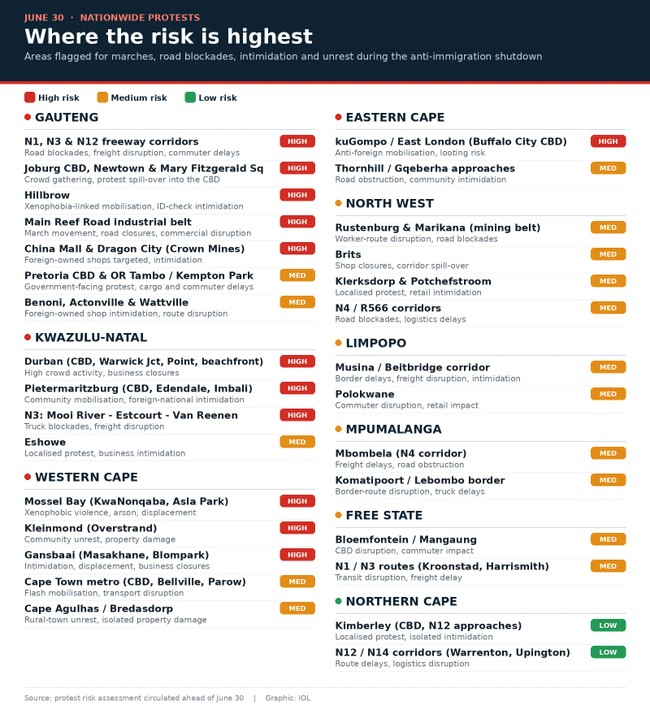
Security planners flagged several high-risk flashpoints ahead of the protests.
These included the Johannesburg CBD and Hillbrow, the N1, N3 and N12 freight corridors in Gauteng, Durban and Pietermaritzburg in KwaZulu-Natal, Mossel Bay, Kleinmond and Gansbaai in the Western Cape, and KuGompo City, formerly known as East London
The deadline has triggered an exodus of foreign nationals, many fleeing in fear and others lining up to be sent home.
Some hotspot areas
In Cape Town, more than 2,000 Zimbabwean nationals are sheltering at the Cape Town Refugee Reception Centre, a home affairs building in Epping built to hold about 300, waiting to be repatriated.
They were moved there on Sunday after camping outside the Zimbabwean consulate in District Six for days, some for as long as five nights.
Among them was Jakes Chirwa, a 32-year-old Zimbabwean who had lived and worked in Makhanda for the past two years before moving to Knysna, where he earned a living as a cementer.
He had trekked to the consulate in Cape Town and was among those moved to Epping on Sunday morning, leaving without being able to fetch his girlfriend.
He said he was happy that he would see his two children and his mother in Zimbabwe if he was repatriated, but that he did not know how he would support them.
“I am a father,” he said.
“I love my kids and I will die for my kids, but how will I provide for them?
“There are no jobs for us in Zimbabwe.
“After Mugabe we have no real president and nothing works in our country.”
In Durban, the temporary repatriation site at the Old Drive-In was due to close on Tuesday, after about 7,000 undocumented Malawian nationals were bussed to a holding facility in Musina, Limpopo.
The eThekwini municipality said 58 buses had left the site on Monday and more on Tuesday morning, with only about 300 people still waiting.
“We remain committed to supporting the national government in ensuring that the repatriation process is carried out in a safe, dignified, and orderly manner,” the municipality said.
In the Eastern Cape, the provincial government said about 700 foreign nationals, mainly Malawians, had been processed for repatriation in Jeffreys Bay and St Francis Bay.
Kouga mayor Hattingh Bornman said more than 1,000 foreign nationals had left the municipality ahead of Tuesday.
The St Francis Disaster Volunteer Group asked for R540,000 to fund two buses needed to repatriate Malawian nationals sheltering at Sea Vista Hall.
It said the Malawian embassy had exhausted all available funding and families were at risk of being left behind.
On Monday, scores of residents marched in Soweto in a final protest before the deadline, many carrying traditional weapons such as shields and sticks, from the Jabulani Amphitheatre to the Protea police station.
“We are losing our children to nyaope and unemployment while government fails to protect us from illegal immigrants,” said Anna Dhlomo, a resident of Jabulani Hostel.
An organiser, Nkosikhona Ndabandaba, said more than 10,000 people had turned out and urged shopkeepers to stay open.
Major General Fred Kekana, the deputy provincial police commissioner in Gauteng, said the march was peaceful and under control.
“The people are marching, and of course, it’s their right to march,” he said.
“Even if after tomorrow, we are not going to stop operating and ensuring that the community is safe,” he said.
In Germiston, a vigil in the form of a march began on Monday night, and similar vigil marches were held in other parts of the country.
In Limpopo, marchers were due to gather at the Tzaneen Show Grounds, in a province that had become a key corridor for the exodus, with thousands of Malawians bussed to a holding site at Musina, near the Beitbridge border.
In Mpumalanga, a march was planned in Emalahleni, where police had earlier arrested seven undocumented foreign nationals after uncovering an illegal alcohol operation in Ogies.
In the Northern Cape, marchers in Kimberley planned to walk from the Kemo Hotel to the premier’s office.
In the Free State, where anti-immigrant protests in June were marred by looting, a march was set to begin at HA Smith in Kroonstad.
Police said they had arrested 15,384 people nationwide in operations between June 22 and 28, including 2,884 foreign nationals for immigration offences.
The arrests included 146 for murder, 111 for rape and more than 1,100 for assault, with police seizing 101 unlicensed firearms.
At the Beitbridge border post, a 39-year-old Malawian bus driver was arrested after officials allegedly found explosives worth R100,000 hidden in bags of rice.
Border Management Authority found four reels of detonating cord, and the driver, Gondwe Samson Tonne, was remanded in custody by the Musina magistrate’s court.
“The NPA commends the Border Management Authority for its vigilance and dedication in safeguarding the country’s ports of entry,” said National Prosecuting Authority spokesperson Mashudu Malabi.
Provincial leaders appealed for calm.
Eastern Cape premier Oscar Mabuyane said Tuesday was business as usual, but warned that anyone who turned to violence, intimidation or incitement would be dealt with decisively.
Western Cape premier Alan Winde said his government had stepped up coordination to head off unrest.
“We have already seen tensions escalate, the Western Cape government has responded decisively by enhancing inter-agency coordination and implementing contingency plans to prevent any further social unrest,” he said.
Both Nelson Mandela Bay and the Western Cape activated disaster joint operations centres to coordinate their response and keep the protests peaceful.
Business groups braced for disruption.
Nelson Mandela Bay Business Chamber spokesperson Sibongile Dimbaza said the prospect of disruptions had prompted a number of businesses to put precautionary measures in place.
“Several chamber members have indicated that they will be adjusting their operations for the day by avoiding identified protest routes, postponing or suspending out-of-town deliveries, limiting staff travel where appropriate and strengthening on-site security measures,” Dimbaza said.
Labour lawyers warned that workers who stayed away could face the no-work, no-pay principle, because the shutdown was not a protected strike.
“The key message for the public is that tomorrow remains an ordinary working day,” human rights attorney Yolanda Akram said.
Parliament urged street vendors and small traders, who could be among the most vulnerable if protests turned violent, to take precautions.
“No grievance can ever justify vandalism, intimidation, assault or any other form of criminal conduct,” said Sonja Boshoff, who chairs Parliament’s select committee on economic development and trade.
Trade union federation Cosatu and the Western Cape Coalition Against Xenophobia rejected the deadline and said it had fuelled chaos and violence.
“We reject with contempt the so-called June 30 deadline which has already caused so much chaos, suffering, and violence,” Cosatu’s Malvern de Bruyn said.
“The only crisis we have is a home affairs crisis,” said Daniel Chuma of the coalition.
Migrants are estimated to make up fewer than four million of SA’s roughly 63 million people, but have long been scapegoated for crime and joblessness amid an unemployment rate of more than 40%.
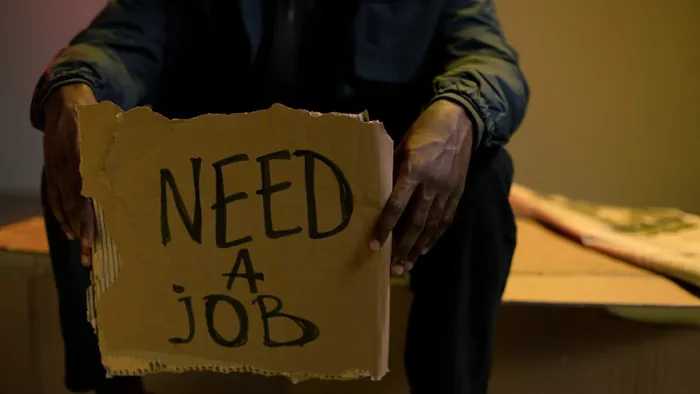
Stats SA’s release of Quarterly Employment Statistics for March 2026 on Tuesday indicated that total employment decreased by 80 000, or -0.8%, quarter-on-quarter, from 10 548 000 in December 2025 to 10 468 000 in March 2026. Image: Ron Lach/Pexels
South Africa’s jobs crisis worsened in the first three months of this year after employment fell by 80 000 to 10 47 million who held jobs by the end of March 2026, and outlook is equally bleak.
Stats SA’s Quarterly Employment Statistics for March 2026 released on Tuesday indicated that total employment decreased by -0.8%, quarter-on-quarter, which economists said was of great concern given the already high unemployment rate, but it not unexpected.
Stats SA reported that there were decreases in community services jobs (-53 000), trade (-40 000), transport (-3 000), and electricity (-1 000).
“There were increases reported by manufacturing (7 000), business services (7 000), mining (2 000), and construction (1 000). Total employment decreased by 121 000, or -1.1% year-on-year between March 2025 and March 2026.”
“Full-time employment decreased by 24 000, or -0.3%, quarter-on-quarter, from 9 43 million in December 2025 to 9 41 million in March 2026. This was due to decreases in the following industries: trade (-27 000), community services (-3 000), transport (-2 000), and construction (-1 000), manufacturing (-1 000), while electricity remained unchanged.
However, there were increases reported by business services (8 000, or 0.4%), and mining (2 000, or 0.4%).
“It’s showing that South Africa’s economic recovery is not yet translating into broad-based employment creation. At the back of a 1.1% GDP growth for 2025, it’s an economy that is stabilising rather than growing, considering that we need at least 3.5% to 4% GDP growth to begin to dent the problem of unemployment, which is at 32.7%, and much higher at 43% if you use the broad definition of unemployment.”
Madikizela said any loss or decrease in employment reverses the small economic gains that the country has achieved.
“I must hasten to caution that most of the jobs lost are seasonal in nature, coming from the festive season where there would have been more hiring in retail, hospitality such as restaurants, hotels, and related industries, which will reduce the temporary staff after December. It’s 24 000 permanent jobs lost over the first quarter, and we would like to see jobs created and sustained rather than lost. One lost job is far too many as the employed person supports four to seven family members.”
Madikizela said it’s a warning sign of an economy that is fragile and responds to shocks. “Clearly, there is an impact as well from the geopolitical challenges in the Middle East that began at the end of February 2026 and other rising operating costs for businesses that result in weak business confidence and weak economic growth, as shown by the 0.5% GDP in the first quarter and pressures on the economy.”
“The latest jobs report released is beyond depressing. The construction as well as community and social services sectors have been particularly hard hit, notwithstanding some positive jobs increases in manufacturing, mining, and agriculture,” he said.
Parks said the outlook for the second quarter is likely to be similarly bleak due to the war in the Middle East and the big impact it has had on international oil and fuel prices, essentially doubling over the last two months.
“This has already seen economic growth projections for South Africa for 2026 slashed from an already meagre 1.4% to 1%. Inflation for transport has already jumped, with food and other essential goods likely to soon follow suit. This may see the Reserve Bank hike the repo rate, inflicting even further pain upon highly indebted workers and an embattled economy,” said Parks.
Abigail Moyo, spokesperson of the trade union UASA said that the lower employment reminds South Africans of the persistent economic challenge, as the economy continues to struggle to create enough sustainable jobs.
“The overall employment picture does not look promising, given that the rate at which we are losing jobs exceeds the rate at which jobs are being created. The employment crisis remains far from over. Sadly, every retrenchment puts a family’s financial security at risk,” said Moyo.
The Chemical, Energy, Paper, Printing, Wood, and Allied Workers Union (CEPPWAWU) is proud to announce a major legal victory in a long-standing labour dispute involving twenty-four of our members employed by Hoya Lens South Africa (Pty) Ltd.
The matter, cited as CEPPWAWU obo Moyo Golden and 23 Others, reached a decisive conclusion when the Labour Court of South Africa, through Judge Dyk AJ, delivered judgment on 09 June 2026 in favor of the workers.
The dispute originates from the unfair dismissal of 24 workers on 18 August 2020. Following the dismissal, CEPPWAWU pursued justice through the Commission for Conciliation Mediation and Arbitration (CCMA). On 17 February 2022, the CCMA issued an arbitration award in case GAJB17634-21, where the Commissioner found that the dismissal of the workers was substantively unfair and ordered the reinstatement of all 24 workers.
However, instead of complying with the lawful award, the employer filed an application for review on 28 March 2022 and set aside the arbitration award. Despite the legal process, the employer continued to refuse compliance.
In the latest judgment, the Labour Court found Hoya Lens South Africa (Pty) Ltd guilty of contempt of court for failing to comply with the arbitration award, which had already been certified in terms of Section 143 of the Labour Relations Act 66 of 1995 on 16 August 2024.
As a result of this historic victory, the 24 workers will be reinstated retrospectively on 24 June 2026, ending more than five years of unemployment, hardship, and injustice caused by unfair employer conduct.
CEPPWAWU celebrates this important victory and congratulates all 24 members who remained resilient throughout this difficult struggle.
Their determination has proven that workers united through strong organisation can defeat injustice.
This victory once again demonstrates the critical importance of workers belonging to trade unions. Without collective organization, workers are vulnerable to exploitation, victimisation, and unlawful conduct by employers.
CEPPWAWU remains committed to defending workers against unfair labour practices and ensuring that employers respect workers’ rights, dignity, and the laws of South Africa.
We call on all workers across the country to organise, unite, and strengthen worker power because an injury to one is an injury to all.
The Congress of South African Trade Unions (COSATU) in Gauteng notes the announcement by Gauteng Premier, Panyaza Lesufi, regarding the transformation of the Traffic Wardens programme into a new “Super Wardens” model aimed at fighting crime and protecting public infrastructure across the province.
COSATU welcomes all genuine efforts to address the high levels of crime that continue to affect working-class communities. Crime, vandalism, cable theft, illegal dumping, and the destruction of public infrastructure place a heavy burden on workers and their families. Every day, workers face the fear of robbery while travelling to work, businesses lose income due to criminal activity, and communities are deprived of essential services because of damaged infrastructure.
The Federation believes that safer communities are important for economic growth, job creation, and social stability. The protection of schools, clinics, hospitals, roads, public transport facilities, and other government infrastructure is critical to ensuring that workers and poor communities have access to quality services.
COSATU also welcomes the potential for the programme to create employment opportunities for young people, particularly at a time when youth unemployment remains one of the biggest challenges facing Gauteng and the country. Any initiative that provides skills development, training, and meaningful employment opportunities deserves support.
However, COSATU stresses that the success of the programme will depend on proper training, adequate resources, clear accountability measures, and strict adherence to the law. Wardens entrusted with law-enforcement responsibilities must be properly trained and supervised to ensure that the rights of residents are protected and that public confidence in the programme is maintained.
The Federation further calls on the Gauteng Provincial Government to ensure that workers employed within the programme enjoy decent working conditions, fair wages, access to benefits, and opportunities for career development. Crime-fighting initiatives should not be built on insecure or exploitative forms of employment.
COSATU acknowledges that crime cannot be defeated through law-enforcement interventions alone. Sustainable solutions require government to tackle the root causes of crime, including unemployment, poverty, inequality, substance abuse, and the lack of opportunities for young people. Greater investment in education, skills development, social services, and local economic development remains essential.
The Federation calls on communities, law-enforcement agencies, organised labour, business, and civil society to work together in building safer communities and protecting public assets. The fight against crime is a collective responsibility that requires unity and cooperation from all sectors of society.
COSATU will continue to monitor the implementation of the programme and engage with government to ensure that it advances the interests of workers, strengthens community safety, and contributes to the broader goal of building a safer and more prosperous Gauteng for all.