FNB eBucks has partnered with Boxer Superstores to expand access to its 99c bread benefit, making one of the country’s most practical savings initiatives available at Boxer stores nationwide. From 1 July, FNB Easy, Aspire and Prime Life customers who shop at Boxer and swipe their cards in-store will qualify for the 99c bread benefit from the following week, for up to four loaves of bread per month.
As food costs continue to place pressure on household budgets, bread remains one of the most frequently purchased household essentials, making even small savings meaningful over time. By expanding the benefit through Boxer and extending the 99c bread benefit beyond the FNB Easy customer base by adding the FNB Aspire and Prime Life customer segments, FNB is making it impactful and easier for more customers to access this benefit as part of their everyday shopping.
Lytania Johnson, CEO of FNB, says the expansion of this benefit is focused on helping customers reduce the cost of everyday living. “The financial pressure that many households face is often felt most at the grocery till, which is why the most meaningful solutions are those that provide simple, practical relief to customers’ pockets. This benefit is grounded in us listening to our customers and understanding the real pressures they face, so we can focus our support where it delivers the most significant difference in their daily lives.
By expanding our 99c bread benefit through a like-minded partner such as Boxer, with its extensive footprint reaching into rural and semi-rural communities, we are able to take this value even further, ensuring it reaches the customers who need it most, in a way that is both accessible and sustainable.”
This partnership forms part of FNB’s broader strategy to deliver solutions that go beyond banking by combining financial services, retail access, and data-driven insights to support customers in their daily lives.
Marek Masojada, CEO of Boxer adds, “The strength of this initiative lies in its simplicity, relevance, and the shared commitment behind it. FNB brings the deep customer insights and a clear understanding of the financial pressures that households face, while Boxer provides a trusted, accessible retail footprint rooted in communities across the country.
Together, this allows us to deliver a benefit that is not only easy to understand and simple to access, but one that customers can rely on every time they shop. At its core, this partnership is about turning everyday shopping into a moment of real value, helping customers stretch their budgets while maintaining access to essential food items.”
Since launching the 99c bread benefit in September 2024 with Pick n Pay, FNB has seen strong impact, with over 6.3 million loaves issued and more than R9.6 million in direct savings delivered to customers.
“This level of uptake speaks directly to what customers are experiencing in their daily lives. More and more, South Africans are looking for support that helps them get through their daily essentials, not just something they benefit from occasionally,” says Pieter Woodhatch, CEO of eBucks. “The 99c bread benefit meets customers where it matters most, at the point of purchase, helping them stretch limited budgets and put food on the table with greater certainty. This is the kind of impact we are focused on as we continue to grow the eBucks programme, making sure we deliver value that customers can rely on. Our focus is on value propositions that have resonated with customers and scaling them in ways that are easy to access and have real value.”
The expansion to Boxer builds on the continued success of the initiative while broadening customer choice and accessibility.
Paul Coetzee, Commercial Marketing, Retail Media & Factories Group Executive at Boxer, says, “Boxer serves communities where affordability is critical and small savings add up over time. This partnership allows us to provide a basic staple at an affordable price point that supports household needs. Together, we’re helping families save on something they buy every week.”
As the programme continues to grow, FNB says the focus is on evolving rewards to better reflect how customers live, spend, and save today.
Woodhatch concludes, “For many South Africans, something as simple as a loaf of bread can make a real difference. This benefit supports customers in those everyday moments, helping them stretch what they have a little further. As we continue to grow this initiative with Boxer, our focus remains on ensuring that the customers who need this support most can access it easily. We are excited about the opportunity to deepen our partnership with Boxer and expand into additional rewards categories over time. This is just the beginning of what we believe will be a powerful and impactful journey together.
Pick n Pay says new AI-powered feature lets customers shop using voice, text or photos instead of searching for products
Grocery retailers are entering an AI arms race for customer loyalty and market share as competition shifts beyond delivery speed and promotions to personalised digital shopping experiences.
On Thursday, Pick n Pay unveiled Penny, an AI-powered grocery shopping assistant for its asap! delivery app, becoming the latest retailer to use AI to win over South Africa’s increasingly digital grocery shoppers.
The launch comes three months after Checkers Sixty60 introduced its AI-powered shopping assistant, Pixie, and as retailers intensify efforts to use AI to remove friction from online shopping, personalise recommendations and drive customer loyalty.
Available on the latest version of the asap! app from Monday, Penny allows shoppers to build baskets using voice notes, text messages or photographs instead of scrolling through product categories and search results.
(Dorothy Kgosi)
Speaking at the launch in Johannesburg on Thursday, Pick n Pay omnichannel retail executive Enrico Ferigolli said retailers are entering a new phase of e-commerce where convenience is no longer defined only by delivery speed.
“For years the focus has been on faster delivery. The next disruption is removing the effort from shopping itself,” he said. “Consumers no longer just want speed — they want shopping apps to think for them.”
Ferigolli said online grocery retail has become one of the most competitive sectors in commerce globally, forcing retailers to continuously innovate.
“We have built a business that is really ahead of global standards. South Africa today has one of the most advanced online grocery markets in the world. It’s quite competitive and because of that, we can’t rest on our laurels,” he said.
Pick n Pay said Penny is powered by Google’s Gemini AI models and uses multimodal technology, allowing customers to communicate through voice, text and images. Users can upload handwritten shopping lists, photograph products they want, snap ingredients already in their fridge and ask for recipe suggestions.
During a demonstration, Ferigolli showed how customers could ask Penny to create a weekly meal plan for four people with spending limits and dietary preferences, with ingredients automatically added to a shopping basket.
“We wanted to transform shopping so that all customers have to do is simply ask,” he said.
The launch follows Checkers Sixty60’s rollout of Pixie in April. Developed by ShopriteX, Pixie analyses customers’ shopping habits, buying patterns and preferences to predict what products they are likely to need before they begin searching.
Shoprite described Pixie as South Africa’s first personalised AI shopping assistant and said the technology becomes smarter with every purchase through insights gathered from the retailer’s Xtra Savings rewards programme.
Shoprite has also been investing heavily in retail technology, recently introducing its AI-powered Smart Trolley, which allows shoppers to scan products and track spending while shopping in-store as the retailer expands its use of AI beyond online channels.
The emergence of Penny and Pixie highlights how the battleground between South Africa’s largest retailers is shifting beyond pricing, promotions and delivery times towards AI-powered personalisation.
Google South Africa country director Kabelo Makwane said changing consumer behaviour is driving retailers to rethink how customers interact with technology.
“The way you search today is no longer one-word searches,” said Makwane. “Consumers are giving much more detailed instructions and asking far more complex questions. The technology has to understand intent.”
He said retailers are under pressure from rising customer expectations, growing competition and the rapid pace of technological change.
“You guys have been given superpowers by AI,” Makwane joked, referring to consumers’ growing use of AI tools, adding that retailers need to up their superpowers to “match you toe-for-toe in terms of your likes, dislikes and requirements around the experience”.
Makwane said: “We are entering an era where intelligent personal assistants work for you.”
For Pick n Pay that begins with Penny acting as a grocery-shopping companion capable of recommending products, suggesting recipes, reloading previous baskets and personalising recommendations through the retailer’s Smart Shopper loyalty programme.
Ferigolli said the technology was made possible by a major rebuild of Pick n Pay’s digital platforms completed last year. It “was a milestone year for us because we rebuilt our entire system”, he said. “That gives us the ability to bring new innovations to customers much faster.”
As South Africa’s online grocery market matures, retailers increasingly appear convinced that the next phase of competition will not be determined by who delivers fastest, but by which AI assistant understands customers best.
“This is only the beginning of what AI can unlock for everyday grocery shopping,” said Ferigolli. “Penny is the first step in that journey.”
Two years into its turnaround plans, Pick n Pay believes its foundations are far stronger and that it can return to sustainable profitability.
Two key developments that should reflect in the retailer’s future results are the signing of a better logistics contract and the reconfiguration of Pick n Pay’s labour model.
The retailer is also set to continue reaping the rewards of its completed store estate reset, which has seen Pick n Pay close down numerous loss-making stores over the past few years.
Pick n Pay’s large stake in discount retailer Boxer, which the retailer said it does not plan to sell down further, will also boost the company’s value in investors’ eyes.
In its Integrated Annual Report for the 2026 financial year, Pick n Pay CEO Sean Summers called it an “important year” for the retailer’s recovery.
“While there is still a significant amount of work ahead of us, Pick n Pay today is fundamentally stronger than it was at the beginning of this journey,” he said.
A Pick n Pay stalwart, having served as CEO from 1999 to 2007, Summers has spearheaded the retailer’s recovery efforts since he took back the helm in 2023.
From a R4 billion rights offer, to unbundling and listing Boxer, closing over 100 stores, and selling even more of its Boxer stake, Summers has been hard at work to restore Pick n Pay to its former glory.
“We have sharpened our focus on the very fundamentals of retail execution,” Summers said in the annual report.
“We have improved our store standards, expanded our range, strengthened product availability, enhanced our Fresh offer and continued to focus on our price competitiveness in an exceptionally constrained consumer environment.”
“Encouragingly, our customers are responding positively to the improvements being made across the business.”
However, the nagging problem remains that these improvements are taking a long time to reflect in Pick n Pay’s bottom line.
While the group has managed to reduce its headline loss per share in the 2026 financial year, the retailer’s stand-alone Pick n Pay Stores segment remains in the red.
In addition, Summers announced earlier this year that Pick n Pay’s break-even target date for this segment would be pushed back to the 2029 financial year, a year later than initially anticipated.
More work to be done
Summers acknowledged that the gains Pick n Pay has made so far have been measured and incremental, though he said they have all gone towards rebuilding a stronger and more competitive retailer.
“We remain clear-eyed about the reality that Pick n Pay is still loss‑making. That remains the central challenge we are working to overcome, and it is why the work of rebuilding the business cannot lose momentum,” he said.
“We are absolutely resolute in returning Pick n Pay to break-even and then on to sustainable long-term profitability.”
He said that while the recovery path remains demanding, the operational foundations being rebuilt across the group are steadily positioning Pick n Pay for a stronger and more sustainable future.
While it may have struggled over the past decade, Pick n Pay remains a business of note – if only due to its sheer brand recognition among South African consumers.
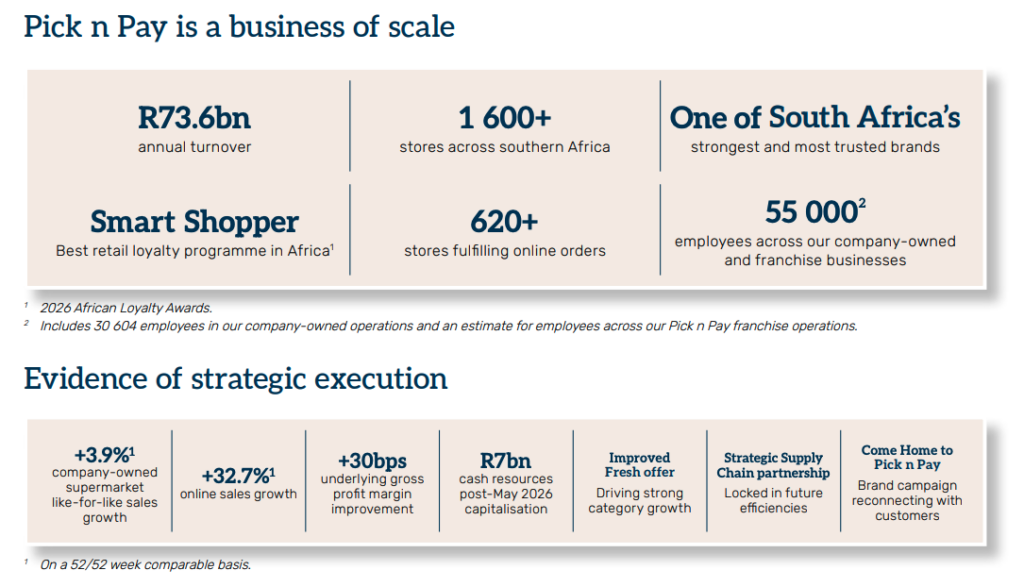
In addition, while the business’s bottom line is struggling, this does not change the fact that it still generated an immense R73.6 billion in turnover for the 2026 financial year.
It also boasts a footprint of more than 1,600 stores across southern Africa, even after completing the store closure programme.
The retailer’s stake in Boxer also gives it an edge, as the discount retailer is booming, and Pick n Pay still holds a sizeable 53.1% stake.
While the next three years will be telling – particularly regarding the Pick n Pay segment’s break-even target – some investors have bought into the retailer’s turnaround.
For example, Protea Capital Management CEO JP Verster recently said that he is optimistic about Pick n Pay’s prospects for the first time in a decade.
Other investors will need more convincing, with Pick n Pay’s share price currently down around 14% in the year to date.
“For 59 years, Raymond and Wendy Ackerman built an institution grounded in values, service, courage and care for South Africa and its people,” Summers said.
“All of us who are part of Pick n Pay today carry a responsibility to protect and rebuild that legacy for the next generation.”
“Our work is far from complete, but meaningful progress is being made.”
Woolworths’ Financial Services division has launched a new tier for the retailer’s rewards programme, exclusively for customers with a Woolies Credit Card or Store Card.
This comes as South African retailers are investing heavily in expanding their rewards programmes to increase customer loyalty and gain market share.
On Friday, 3 July, Woolworths Financial Services announced the launch of MyDifference PLUS, which rewards customers for shopping and for the way in which they manage their accounts.
“With MyDifference PLUS, we’re empowering customers to unlock greater value on their own terms through completion of actions that result in meaningful cashback, personalised offers, and exclusive savings,” Woolworths Financial Services chief customer officer Maré Louw.
“By putting choice, relevance, and flexibility at the heart of the experience, we’ve created a programme that is not only more rewarding but one that builds deeper, more enduring customer relationships.”
With MyDifference PLUS, cashback earn rates are achieved by completing personalised actions such as paying on time, shopping regularly with a Woolies Credit Card or Store Card, engaging with the Woolies app, or setting up a debit order.
Woolworths customers can also unlock personalised vouchers by achieving shopping goals tailored to their purchasing habits.
MyDifference PLUS also offers promotions that provide additional savings through exclusive discounts on selected Woolworths products when customers pay with their Woolies Credit Card or Store Card.
“Today’s customers expect loyalty programmes to do far more than deliver discounts at the till, Louw said.
“They expect every interaction to be recognised, every engagement to be meaningful, and every reward to reflect the value of their relationship with the brand.”
“MyDifference PLUS represents a new generation of loyalty, one that transforms daily spending and engagement with their Woolies cards into an ongoing rewards journey.”
Customers can access the MyDifference programme through the Woolworths app.
Fighting for loyalty
Woolworths’ move comes as South African retailers are investing heavily in their reward programmes as a way to ensure customer loyalty.
A strong rewards programme has emerged as a necessary component to compete in South Africa’s increasingly competitive retail landscape.
This is because South African consumers are highly price sensitive and willing to go to different retailers based on promotions, price differences, and discounts.
Therefore, measures that reward customer loyalty can be an effective way for retailers to ensure they remain top of mind with consumers and to encourage further brand loyalty.
In Woolworths’ latest results presentation for the 26 weeks ended 28 December 2025, the retailer said it is doubling down on its MyDifference programme.
“We are doubling down on ensuring that we lead in customer experience, across all channels, leveraging our loyalty programmes and innovative technologies,” the retailer said.
Woolworths reported that its loyalty programme is driving incremental sales and stronger cross-shopping behaviour from customers.
To boost their rewards programmes, some South African retailers have also partnered with other companies to offer greater value for loyal customers.
For example, Pick n Pay’s partnership with FNB has been highly successful, with the companies having joined forces with their Smart Shopper and eBucks programmes, respectively.
The companies recently reported that, in just the past year, they have returned more than R600 million in value to customers.
They have also sold 6.2 million burgers through the Burger Friday promotion and issued R45 million worth of Pick n Pay vouchers.
The partnership was recently extended to include Boxer, with eBucks CEO Pieter Woodhatch telling Daily Investor that this relationship makes sense given the retailer’s market and proposition.
“If we think about our customer and how we give value back, Boxer makes sense. If you walk into the store, you will see the promise to never pay more than the Boxer price,” he said.
Shoprite’s Xtra Savings rewards programme has also gone from strength to strength.
For the 26 weeks ended 28 December 2025, Shoprite reported that it had given R9.7 billion in instant Xtra Savings discounts to its customers.
Cosatu Western Cape and the Western Cape Coalition against Xenophobia (WCC-AX) held a media briefing in Salt River and accused the Department of Home Affairs of keeping migrants “stateless, without papers and in a state of limbo” amid concerns about the June 30 deadline and related protests.
Groups oppose March and March and linked xenophobic actions
At the briefing, Cosatu’s Malvern de Bruyn read a joint statement on behalf of both organisations saying they “stand united and opposed to groups affiliated to March and March on the escalating assault on African migrants.” The statement described the so-called 30 June deadline as already having “caused so much chaos, suffering, and violence.”
What Cosatu and WCC-AX said
De Bruyn said the campaign was “a particularly brutal attempt to divide the working class and the poor” and argued it was intended “to distract attention from the abject failures of the government over more than 30 years, to build an economy that works for ordinary people.”
He warned the deadline “risks being but one of many upsurges of mass repatriations, tribalism, threats, and bullying.”
De Bruyn also criticised what he called a failure by the Department of Home Affairs, saying:
“Blaming undocumented migrants fails to hold the Department of Home Affairs accountable for its role in keeping people stateless, without papers and in a state of limbo. The Department of Home Affairs is itself in effect creating undocumented migrants by failing to process them efficiently, if at all.”
Voices from the coalition and migrant community
WCC-AX’s Danmore Chuma, identified in the briefing as from Zimbabwe, said he feels “really disturbed and betrayed” that the working class and poor are pitted against each other instead of uniting to tackle “unemployment, poverty, inequality, and posterity.”
Chuma added:
“Immigrants are not people who are irrelevant. Immigrants are not objects. Immigrants are people who have contributed, people who can contribute to the economic development of the country.”
Responses and national remarks
The office of Home Affairs Minister Leon Schreiber was contacted for comment, the briefing noted.
President Cyril Ramaphosa commented on the right to protest, saying that while it is constitutionally protected it “does not allow people to threaten or intimidate others, or to engage in acts of vandalism or violence.” He said government accepts the immigration system “requires substantial reform” and outlined actions including strengthening border management, increasing enforcement against undocumented immigration, improving asylum and visa integrity, and addressing corruption that has weakened immigration control.
Premier Alan Winde was also quoted, saying:
“Anyone acting outside of the law must be arrested and prosecuted. We fully respect every resident’s constitutional right to protest. However, this right must always be exercised peacefully and within the bounds of the law. I call on all residents to reject violence in all its forms.”
Calls to the public
Cosatu and WCC-AX urged South Africans to “reject the 30 June fabricated deadline,” to report actions against migrants to authorities and civil society groups, and to “act in the spirit of ubuntu and support their neighbours,” according to the joint statement read by De Bruyn.
South Africa is currently on the edge as nationwide anti-migrant protests spark fears of xenophobic violence.
NaijaOnPoint Nigeria reports that an atmosphere of uncertainty and fear gripped several communities across South Africa on Monday ahead of nationwide anti-migrant protests, with authorities warning against violence as thousands of foreign nationals prepared for possible unrest.
The demonstrations, organised by anti-migrant groups, coincide with a June 30 deadline they set for undocumented immigrants to leave the country, following weeks of protests, intimidation and attacks targeting foreign nationals.
Although President Cyril Ramaphosa’s administration has appealed to protesters to exercise their constitutional rights peacefully, thousands of migrants remain stranded in temporary camps, while many others have chosen to leave South Africa through voluntary repatriation programmes.
Several African countries, including Nigeria, Zimbabwe, Mozambique, Ghana, Kenya, Malawi and the Democratic Republic of Congo, have begun evacuating citizens who no longer feel safe remaining in South Africa.
Nigeria has already repatriated 324 citizens through two official evacuation flights under an emergency voluntary return programme.
Official estimates place the documented Nigerian population in South Africa at between 25,000 and 35,000 people.
Many migrants say growing threats and hostility forced them to abandon their homes and livelihoods.
One migrant said he decided to leave after neighbours repeatedly warned that foreigners would be attacked once the June 30 deadline expired.
“That’s why today I decided to join our brothers and go home,” he said.
Another migrant disclosed that he was forced to leave his children behind with his South African wife after she informed him she could no longer support the family alone.
The protests follow reports that at least three migrants—two Mozambicans and one Malawian—have been killed in recent weeks, further heightening fears of xenophobic violence.
In response, South African authorities have increased security across the country, warning that anyone attempting to incite violence or take the law into their own hands will be arrested.
Police and private security agencies have identified Gauteng, KwaZulu-Natal, the Western Cape and the Eastern Cape as potential flashpoints.
In a statement issued on Sunday, President Ramaphosa acknowledged that peaceful protest is protected under South Africa’s Constitution but stressed that intimidation, threats and violence would not be tolerated.
“The right to protest and freedom of expression does not allow people to threaten or intimidate others, or to engage in acts of vandalism or violence,” he said.
Ramaphosa reaffirmed that South Africa remains a constitutional democracy governed by the rule of law and reminded citizens that many foreign nationals live and work legally in the country.
“Some foreign nationals who live in South Africa are here lawfully. They work, study, raise families, invest in our economy, and contribute positively to our society. They, too, are entitled to the protection of our laws and our Constitution,” the President stated.
He also welcomed assurances from some protest organisers that demonstrations would remain peaceful, warning that they would be held accountable should violence occur.
Despite the government’s appeal, many businesses planned to close temporarily over fears that protests could disrupt commercial activities.
However, business groups and labour unions rejected claims that migrants are responsible for South Africa’s economic challenges.
A coalition within the National Economic Development and Labour Council (NEDLAC), comprising COSATU, FEDUSA, SAFTU and NACTU, argued that unemployment, poverty, corruption, economic stagnation and weak governance—not migrants—are the real causes of the country’s economic difficulties.
“Removing foreign nationals from workplaces, communities, or public spaces will not reopen factories or create sustainable jobs,” the coalition said, urging authorities to focus on addressing the country’s underlying economic problems.
The organisations also warned that rising anti-migrant rhetoric risks deepening social divisions while distracting attention from longstanding governance failures.
Business chambers, including the Johannesburg Chamber of Commerce and Industry and the Pietermaritzburg Chamber of Business, stopped short of advising members to shut down but recommended avoiding unnecessary travel, particularly in areas identified as protest hotspots.
Meanwhile, thousands of migrants continued waiting in makeshift camps for transportation back to their home countries.
At a temporary camp near Durban, 28-year-old Wilson Petro expressed relief at finally leaving after days of uncertainty.
“We are here because we have been struggling as foreigners. Today we will be leaving this camp and going to Limpopo and then, hopefully, to Malawi,” he said.
Nearby, families lived under difficult conditions, with clothes hanging from perimeter fences while parents and children waited anxiously for evacuation.
At the Che Guevara Home Affairs office, asylum seeker Salima Tusame said she had spent nearly five weeks trying to resolve her immigration status despite possessing valid documentation.
“I came to South Africa in 2015, and I have been at this Home Affairs for five weeks because of the march. I know I have papers which allow me to stay in South Africa, but they don’t care whether you have papers or not,” she said.
Tusame alleged she had experienced verbal and physical abuse and could no longer continue her fruit-selling business due to growing hostility toward foreigners.
“I don’t know what will happen with the planned protests tomorrow,” she added.
KwaZulu-Natal Premier Thami Ntuli also appealed for calm, warning against a repeat of the destructive unrest that engulfed the province in July 2021.
“July 2021 set us back years; we have not yet fully recovered. That is the price chaos extracted from this province,” Ntuli said.
“We buried that pain once. We will not dig that grave again—not for unrest, and not for hatred dressed up as protest.”
As South Africa entered a day of nationwide demonstrations, security agencies remained on high alert amid growing concerns that the protests could escalate into another wave of xenophobic violence if not properly contained.