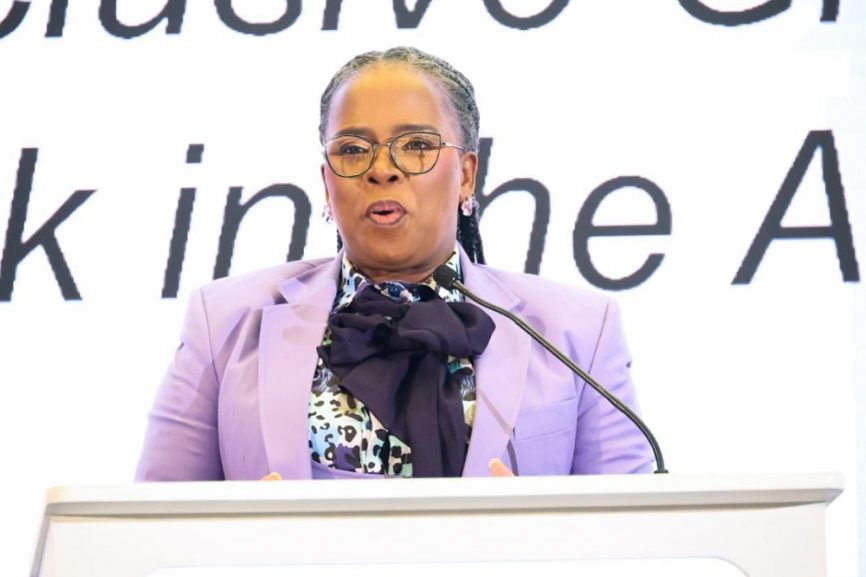
She delivered the opening address at the 31st Nedlac Annual Summit in Pretoria.
The gathering of business, government, labour and civil society is convened under the theme “Advancing Inclusive Growth and Decent Work in the Age of AI”.
The minister says social dialogue remains the most effective mechanism to ensure a just transition for all workers.
“To realise the full potential of AI while safeguarding decent work, we must strengthen collaboration among all social partners, government, business, labour and community. This entails not only sharing insights but also committing to actionable strategies and policy recommendations that promote inclusive growth and social justice. This event must therefore not be a conversation that ends when we leave this room.”
Employment & Labour Minister Nomakhosazana Meth says it’s important for Nedlac social partners to harness the transformative power of AI in a manner that is inclusive, equitable and sustainable. She delivered the opening address at the 31st annual summit in Pretoria.#sabcnewspic.twitter.com/17HnFGpnal
COSATU renewed its call for the government to temporarily suspend a portion of the fuel levy following major price increases on 2 September 2026 Low-wage workers spend up to 40% of their monthly income on commuting, making the latest fuel price increases unsustainable, the union federation warned Preliminary data from the Central Energy Fund suggests further fuel price pressure could arrive in October 2026
A petrol filling station. Images: artas/Getty Source: Getty Images
SOUTH AFRICA — The Congress of South African Trade Unions (COSATU) has urged the South African government to reinstate temporary fuel levy relief, following significant fuel price increases that took effect on 2 September 2026.
COSATU spokesperson Zanele Sabela said a partial suspension of the fuel levy, similar to an arrangement implemented earlier in the year, was essential to shield workers and the wider economy from mounting financial pressure.
Workers bear the brunt of rising fuel costs
The federation pointed out that low-wage workers already allocate as much as 40% of their monthly earnings to transport costs alone. With fuel prices climbing further, COSATU argued that the situation had become untenable for millions of South Africans who depend on public and private transport to reach their workplaces.
Beyond commuting, COSATU warned of a cascading effect across the broader economy. Higher fuel prices, the federation noted, push up costs for food, goods, and general transport services, deepening an already severe cost-of-living crisis.
September fuel price increases
The Department of Mineral and Petroleum Resources implemented the following adjustments from 2 September 2026, citing rising international crude oil prices and supply chain constraints:
Petrol (93 and 95 ULP/LRP) increased by R1.29 to R1.34 per litre. Diesel (0.05% sulphur) increased by R2.93 per litre. Diesel (0.005% sulphur) increased by R3.14 per litre, and illuminating paraffin (wholesale) increased by R2.13 per litre
Industry bodies add to pressure on government
COSATU is not alone in its concerns. The Public Servants Association (PSA) and the Road Freight Association (RFA) have both cautioned that the sharp rise in diesel prices translates directly into higher operational costs for businesses, with consumers ultimately absorbing those increases through elevated shelf prices.
Looking ahead, preliminary data from the Central Energy Fund (CEF) points to continued under-recoveries in the fuel pricing system. Persistent global oil price volatility could mean further upward pressure on fuel prices when October 2026 adjustments are announced.
More on SA’s cost-of-living crisis
Briefly News recently reported on which South African province has the most expensive grocery basket, and the numbers surprised many shoppers.
A content creator’s reaction to a simple phone charger being sold on a lengthy instalment plan struck a nerve with cash-strapped South Africans.
Healthcare staffing shortages continue to place immense pressure on nurses with some general ward nurses responsible for more than 40 patients per shift Image Credits: Reuters
The Democratic Nursing Organisation of South Africa (DENOSA) in Gauteng has given the provincial Health Department until next month to address nursing staff shortages, reduce the number of acting managerial positions and improve health infrastructure.
The union also wants hospitals across the province to be adequately supplied with medical equipment and medication to enable healthcare workers to deliver quality services.
DENOSA Gauteng Chairperson Bongani Banda says failure to address the concerns by the deadline will lead to protests to ensure that the union’s demands are met.
“In many healthcare facilities, a single nurse in a general ward is responsible for more than 40 patients per shift. A single midwife may attend to around eight women or more in labour, while the situation is even worse in clinics. This is due to inadequate staffing levels,” says Banda.
He says regarding leadership instability, there is a continuing high vacancy rate in key executive management positions, such as Chief Executive Officer (CEO), with many individuals serving in an acting capacity.
The clothing bargaining council says a government pilot project is being used to keep inspectors out
The National Bargaining Council for the Clothing Manufacturing Industry says the labour department has unlawfully granted “amnesty” to certain non-compliant clothing factories. Illustration: Bronwyn Webb
The National Bargaining Council for the Clothing Manufacturing Industry says some Newcastle factory owners have refused its inspectors access, claiming they are protected by an 18-month labour department pilot project.
This follows the council taking legal action against clothing manufacturers it claims are contracting with non-compliant “sweatshops”.
The council wants the Labour Court to declare that the department cannot suspend or defer compliance with the council’s collective agreement.
The National Bargaining Council for the Clothing Manufacturing Industry says the Department of Employment and Labour has unlawfully granted “amnesty” to some clothing manufacturers it claims are contracting with non-compliant “sweatshops”.
The council has launched an urgent application in the Labour Court in Durban, seeking an order that the department has no right to grant any grace period for compliance through its national advocacy pilot project in Newcastle, called “Decent Work in the Chinese Business Community, KwaZulu-Natal Province”.
It further seeks orders that any policy which interferes with its powers be declared unlawful. It also wants the 25 factories cited in the application to be bound by the main collective agreement and must allow the council’s investigators access to their premises.
The application is to be heard on 6 October with the department and the 25 cited factories to file opposing papers by 18 September. We will publish a report once the opposing papers have been filed.
In her affidavit, the council’s KZN general secretary, Chantal Naidoo, said it wants to “protect the integrity of its powers and functions”, particularly the power to monitor and enforce compliance with basic conditions of employment, including minimum wage agreements.
“That power is the council’s alone: no other body may enforce the main collective agreement and no other body may suspend, defer or excuse compliance with it,” she said.
Naidoo said the council had become aware that a group of 31 factories in Newcastle, known as G31, believed they were currently excused from compliance. This was based on their reading of the department’s Newcastle project, which suggested that full compliance would only be expected at the end of a proposed 18-month intervention period.
Naidoo said the council was not opposed to the project which had “laudable aims”.
“The crux of its challenge is that the project has been interpreted as relaxing, rather than strengthening compliance in respect of a selected group of factories to the exclusion of other textile manufacturers and in a manner which interferes with the exercise by the council of its powers to enforce compliance with basic conditions of employment.”
She said because of this, council officials had been refused entry into premises by owners who “appear to believe that a grace period … places them above the law and beyond the council’s reach”.
The department invited the council to a meeting in March 2026 when a “phase-in period” of 18 months was mooted for the G31 factories, but this was not agreed to by the council representative.
Later that month, 30 other clothing factories in Newcastle wrote to the department complaining that they had not been invited to the meeting and objecting to the “selective grace period” offered to the G31 factories.
Deputy minister Jomo Sibiya said that employers participating in the project would be “ringfenced for the purpose of implementing strategic compliance”, and that “while these companies would still be expected to comply with the Labour Laws, they would be assisted to do so in the manner that would be outlined in the project document”.
Naidoo said the meaning of Sibiya’s letter was unclear, but to the extent that it purported to grant amnesty to the G31 factories, was unlawful. Only the council has that power.
The impact on the ground for council inspectors was immediate, she said. A substantial number of factories evaded inspections and denied access to inspectors. In one case, inspectors were turned away by an “armed and aggressive” security guard.
At a meeting in June, the department indicated that it would issue a “compliance certificate” to the participating factories.
The council’s representative again made it clear that this was not lawful. However, later that month, the department sent out an implementation plan, indicating that resolutions had been adopted at the meeting.
Naidoo said no final decisions had been taken at the meeting.
The council sent letters of objection to the department but there was no resolution to the issue. “It is clear that the G31 factories are using the project as a tool to shield themselves from inspection and that they will do so to evade other compliance mechanisms invoked by the council unless and until this court intervenes to clarify the legal position,” Naidoo said.
“The more a culture of impunity is permitted to take root and become entrenched, the greater the challenge to reverse the trend and attain proper compliance. Impunity for the G31 [factories] will also have a detrimental effect on the culture of compliance of those who are currently compliant. Non-compliance by some creates an uneven playing field for others and renders them less competitive.”
Earlier this year, the council took legal action against two suppliers of fashion apparel in South Africa, Drake Clothing and Gemelli.
The council alleges that the companies are contracting with “sweatshops” that masquerade as co-operatives. Both companies are opposing the applications, which are still in the legal process.
JOHANNESBURG – Twelve SAPS members were killed in the line of duty between April 2025 and March 2026.
Those fallen heroes were remembered in Pretoria on Sunday.
Popcru’s Mosadiwamaje Mokokong said an attack on a police officer is an attack on the state.
“This is a crisis. Hence, as a union coming from our recent Central Executive Committee, we again reaffirmed our long-standing resolution that says the government must declare a deliberate killing of a police officer as treason.
“We cannot afford to have the criminals that goes out and kill law enforcement officers because in our view, when you attack and kill a police officer you are not just killing an individual employee, but this according to us, is an attack on the authority and the capacity of a democratic state so hence we have made that call to say can we declare this is a treason those that are killing the police officers.”