Key affiliates follow suit over the suspension of First Deputy President Mike Shingange, leaving the Midrand gathering in limbo as behind-closed-doors negotiations attempt to salvage the event.
MIDRAND — The COSATU 15th National Congress at Gallagher Estate in Midrand faces an imminent collapse after the National Union of Mineworkers (NUM) led a decisive charge to withdraw its credentials. This critical development threatens the federation’s ability to form the mandatory two-thirds quorum required to proceed with voting for new office bearers.
The NUM was not alone in its withdrawal. Several other major affiliates, including SAMWU, DENOSA, SACCAWU, SAMATU, SAEPU, and SASBO, also refused to submit their credentials to the gathering. Under established congress rules, delegations that do not provide their credentials are officially deemed absent, directly jeopardizing the viability of the event.
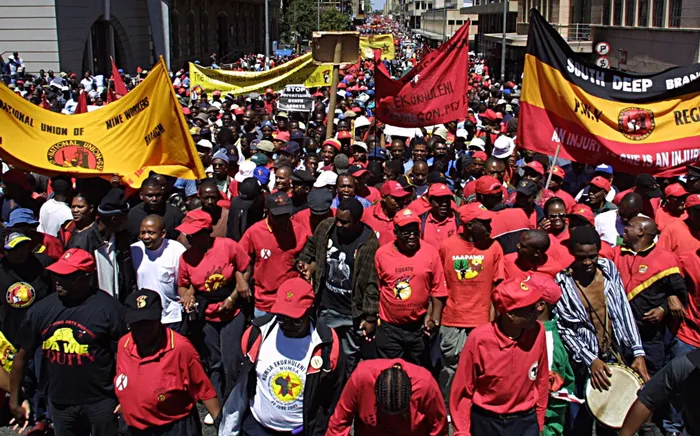
Proceedings, which were delayed until approximately 12:00 noon following unsuccessful attempts by current COSATU leadership to quiet the singing and dancing of delegates to get started, quickly hit a roadblock. The first item on the agenda was the formal announcement of the federation’s credentials, which immediately triggered the mass refusal by key affiliates.
At the heart of the NUM’s withdrawal is deep concern over the sudden suspension of COSATU First Deputy President Mike Shingange. Shingange was suspended by his home union, the NUM, in his capacity as its president just on the eve of the congress. Union representatives emphasized that in a democratic political process, the suspension of a nominated individual immediately before a major congress is a highly worrying factor. The NUM noted that after extensive engagements, it had previously made the formal decision to support Shingange’s bid to become president of the federation, making the last-minute suspension a direct disruption to democratic processes.
As of 4:00 p.m., the COSATU Congress remained in limbo and had not properly started. Union leaders were reportedly on an extended lunch break behind closed doors, engaging in urgent negotiations in a final attempt to revive the congress, resolve the credential disputes, and prevent a complete organizational collapse.
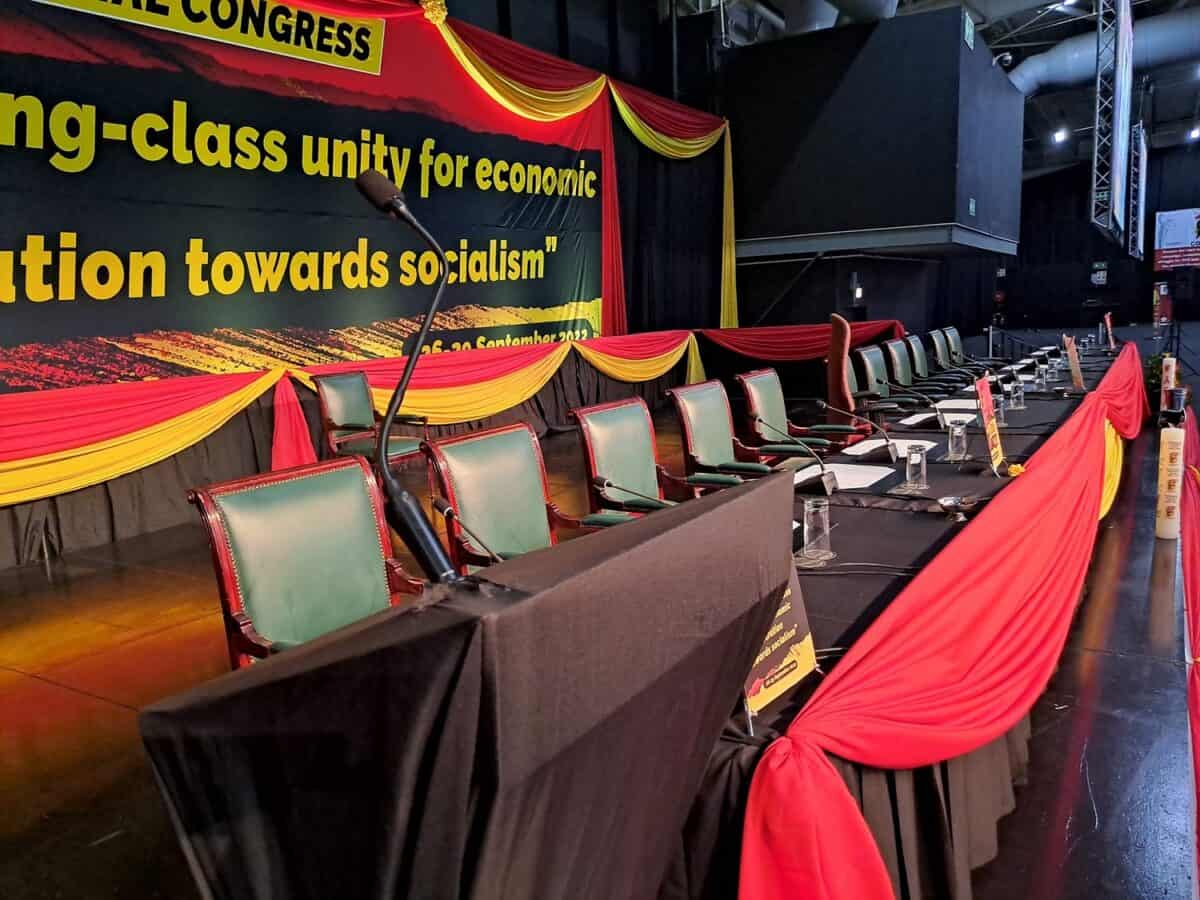
Cosatu’s 14th national congress in September 2022 at Gallagher Convention Centre in Midrand. Johannesburg. Picture: Twitter/@_cosatu
Controversy centres on deputy president Shingange’s eligibility to succeed Losi after Nehawu placed him on precautionary suspension.
The Cosatu succession debate has placed the trade union federation’s 15th national congress on the brink of collapse, with several unions insisting on withholding their congress credentials until the succession issue is resolved.
Some senior Cosatu leaders expressed concern at the prospect of the congress collapsing, which would be a waste of at least R80 million spent to organise the gathering, which ends at Gallagher Convention Centre in Midrand tomorrow.
Senior Cosatu leaders concerned about congress collapsing
The gathering is attended by 1 800 delegates from 16 affiliated trade unions countrywide.
At the centre of the controversy was whether Cosatu deputy president Mike Shingange is eligible to be elected the federation’s next president, succeeding incumbent Zingisa Losi.
Despite approval for his candidacy from the central executive committee (CEC), which includes all Cosatu affiliates and its top leadership, disagreements about his eligibility have emerged.
The issue surrounding Shingange ignited heated debate and tensions between members.
This intensified when Shingange’s union, the National Education, Health and Allied Workers’ Union (Nehawu), placed him on precautionary suspension.
This raised questions about his eligibility for the position according to the Cosatu constitution.
Succession battle over Shingange’s eligibility
However, the federation’s extended CEC and its management committee, which met until the early hours yesterday, concluded – based on a legal opinion – that Shingange was eligible to stand.
In a statement read by Cosatu general secretary Solly Phetoe, it was argued Shingange had not been expelled from Nehawu, rather, he had only been placed on precautionary suspension.
He remained the deputy president of Cosatu and was not removed from his position as a shop steward at his workplace.
Despite this resolution allegedly endorsed by all affiliates present at the night-long CEC meeting, the congress remained divided.
Unions such as Popcru aligned with the CEC decision, cautioning that neither fellow affiliates nor the federation should interfere in an affiliate’s affairs.
“The congress must now proceed because we have resolved this matter,” said a Popcru member.
Unions withholding credentials
But, a SA Emergency Personnel’s Union member disagreed, asserting no agreement had been reached and that the union would not submit its credentials until the matter was resolved.
Despite Nehawu’s position that Shingange could contest the federation’s presidency, even with his precautionary suspension, several other unions also refused to submit their congress credentials until his situation was clarified.
Others questioned the validity of the legal opinion and its implications. Further debate on the issue was expected.
In other matters, the federation’s political report highlighted contradictions within the government of national unity, which have contributed to the ANC losing its political identity.
“Cosatu’s stance on the grand coalition between the ANC and the DA is based on our view regarding the betrayal of commitments and principled agreements made at the alliance level concerning post-electoral scenarios agreed upon in the event the ANC fails to win an absolute majority,” the report said.
“After the elections, ANC leadership negotiated behind our backs as alliance partners, making secret deals with the DA, which represents the sworn enemy of workers and the poor.
“The DA remains an anti-worker, anti-poor and white supremacist organisation, funded by capital to pursue its interests.”
The DA was collaborating with Business Unity South Africa, AfriForum and medical aid schemes to threaten litigation and disseminate media propaganda against the National Health Insurance.
“It remains to be seen whether even already promulgated transformative legislation on land reform, the National Health Insurance and access to education will be implemented,” the report said.
The Congress of South African Trade Unions (COSATU) has asked The Foschini Group (TFG) to consider the impact of its store closures.
This followed an announcement by TFG earlier this year that it plans to close down hundreds of stores over the next few years.
This, TFG CEO Anthony Thunström explained, was needed because they faced a weak consumer environment and changing demand.
The planned store closures followed a period of rapid expansion, driven by an aggressive acquisition strategy.
TFG acquired Street Fever, White Stuff, JD Sports, Granny Goose, Coricraft, Volpes, Dial-a-Bed, and The Bed Store.
These acquisitions have aided the group’s topline, particularly as organic growth is hard to come by for retailers in a weak consumer environment like South Africa.
However, these acquisitions came at a cost, and The Foschini Group’s financial performance started to deteriorate.
This is because its interest-bearing debt increased to fund these acquisitions, which increased finance costs and ate into profits.
TFG’s finance costs increased from R783.8 million in the 2022 financial year to R2.05 billion in the 2026 financial year.
The acquisitions have also exposed TFG to brand impairments, with the retailer having incurred a R1.02 billion write-down in 2026.
So, while TFG has diversified its retail portfolio, it is now saddled with high debt and fragile intangible assets, which have led to a contracted bottom line.
To address this, TFG announced an aggressive store rationalisation strategy, with hundreds of stores on the chopping block in the coming years.
COSATU warns TFG about store closures
The Congress of South African Trade Unions (COSATU) has called on TFG to consider the impact of store closures on its staff.
This call followed TFG’s announcement that it plans to close 280 African outlets over the next three financial years.
“The fashion retailer has already commenced the process, with closures finalised this year,” COSATU said in a press statement.
“The group has cited a list of reasons behind the move, including the surge in the online market surpassing the performance of its physical stores.”
The trade union said these closures come as South Africa faces stagnant economic growth and high unemployment.
“The slow economic growth has undermined efforts to generate jobs and tackle our stubbornly high unemployment rate of 43.8%,” it said.
It added that the store closures coincide with the rise of artificial intelligence and automation, which contribute to retrenchments.
“Behind Foschini Group’s popular clothing brands, such as Foschini, Sportscene and Markham, are hard-working individuals,” COSATU said.
“The business is where it is today largely due to the blood and sweat of its staff. The billions it accumulates in sales are due to the toil of workers.”
COSATU said it would join forces with its affiliates to stop this blow to workers across the African continent and to find progressive alternatives.
The affiliates include the South African Commercial, Catering and Allied Workers’ Union (SACCAWU) and the Southern African Clothing and Textile Workers Union (SACTWU).
“It is vital that Foschini Group demonstrates solidarity towards its workforce, engages in good faith and finds alternatives to store closures,” it said.
The union argued that hasty decisions are not an option when people’s livelihoods are at stake.
“Throwing workers into the unemployment den should not be the pinnacle of decision-making and solution-finding processes,” it said.
The Congress of South African Trade Unions (Cosatu) has made a significant declaration reaffirming its non-partisan role within the tripartite alliance ahead of the elections with ANC and SACP contesting elections independently from each other. Image: File
Ahead of what can be termed the most brutal local government elections, with the ANC and the South African Communist Party (SACP) not seeing eye to eye, the Congress of South African Trade Unions (Cosatu) has given itself the task of convening a meeting between the three formidable alliance partners.
This comes as the labour federation has reaffirmed its role as a non-partisan partner within the tripartite alliance, a decision underscored during a recent press briefing following its Central Executive Committee (CEC) meeting on August 25, following the establishment of an Alliance Political Council to oversee discussions among the three alliance partners.
“Even with the SACP contesting elections, and Cosatu respects the decision of the SACP to contest elections, that is why the Central Committee of Cosatu, the 8th Central Committee, directed us to convene the Alliance Political Council so that our political alliance partners can find modalities on how they are going to contest elections in a manner that they will… So, the SACP will contest elections, the ANC will contest elections, what are the modalities of doing that,” said Cosatu’s first deputy president Mike Shingange during a press briefing on Saturday.
At what is seen as a critical juncture, Cosatu’s leadership has also taken a firm stance on the ongoing migration crisis that has strained relations between South Africa and several neighbouring countries. Reports highlight that more than 200,000 migrants have fled South Africa, with returnees originating from countries including Zimbabwe, Malawi, Mozambique, Ghana and Nigeria, exacerbated by large-scale protests against difficult socio-economic conditions earlier this year.
Cosatu president Zingiswa Losi and first deputy Mike Shingange voiced concerns about the worsening state of migration across the continent. Losi argued that South Africa cannot be expected to tackle the migration issue alone, calling on African leaders to collectively address the situations driving their citizens to seek refuge elsewhere.
“South Africa on its own cannot take responsibility for issues of migration outside the entire leadership of the African continent. You can’t have leaders who, when they go to Geneva, when they go to the UN, when they go elsewhere, have an entourage of officials to do what? And the cost of that is enormous when people back home are left not knowing what it is, where they are going to find the next employment, and there are no commitments,” Losi stated.
Echoing Losi’s sentiments, Shingange asserted the necessity for African governments to cultivate conditions that would prevent citizens from feeling compelled to leave their homelands. “Nobody will willingly abandon their country for an uncomfortable foreign land unless there are pressing socio-economic and political issues or severe persecution. There ought to be a responsible way of managing the push and pull factors involved in both legal and illegal migration,” he said.
As preparations continue for Cosatu’s 15th National Congress, scheduled to be convened in Midrand from September 14 to 17, the federation has called on its alliance partners to find common ground ahead of the local government elections.
[FILE] Basic Education Minister Siviwe Gwarube speaks during a media briefing. Image Credits: X-@DBE_SA
The South African Democratic Teachers Union (SADTU) is calling on President Cyril Ramaphosa to sanction Basic Education Minister Siviwe Gwarube over the continued suspension of the new Foundation Phase textbook catalogue.
It is also accusing the minister of political interference, saying this could undermine transformation and smaller publishers.
SADTU Secretariat Officer Xolani Fakude says the Grades 1 to 3 catalogue should be implemented.
“Ourselves as a sector, now needing to implement that national catalogue for Grade 1 to 3 foundation phase and then we’re told that it cannot be, and we are also now arguing back- and we’re saying that it can also not be- that the minister has got such a vested interest in terms of how we deal with issues at an administrative level…”
Fakude says the union will not accept further delays.
“That’s where we are right now, and we’re saying that it should be implemented- we’ve seen the frustrations before, and we’re not going to accept that any longer,” Fakude said.
Related video | Plans on track to ease school principals’ administrative burden