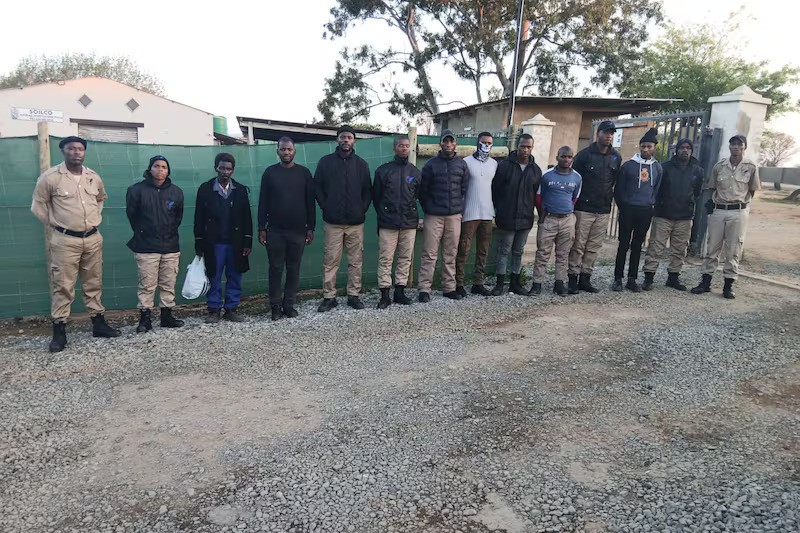
Security guards at Nqolonqolo Security Protection say they are still waiting for money owed.
Story audio is generated using AI
Six security guards employed by Inqolonqolo Security Protection are fighting to recover more than R27,000 in alleged unpaid wages after formal legal complaints exposed widespread underpayments, unfair dismissals and non-compliance with sector regulations.
The workers, represented by BM Mazibuko Attorneys, wrote to the company demanding accountability over alleged contract irregularities, unlawful hourly wage rates and missing statutory benefits.
Enforcement documents issued by the National Bargaining Council for the Private Security Sector (NBCPSS) under case number GP/2026/004/05356 confirm that the company owes R24,624 in direct salary shortfalls and unpaid Sunday work, pushing the total to R27,249 once statutory interest penalties are included.
According to council audit records, Inqolonqolo Security Protection was ordered to rectify multiple breaches, including R14,016 in basic salary underpayments and R9,583 in unpaid Sunday work compensation.
Approached for comment on the allegations and NBCPSS compliance order, a company representative identified as Mr Gule refused to answer questions that were sent two days earlier.
“This matter has nothing to do with you. I didn’t get your email; I didn’t see the WhatsApp. I can’t answer your questions,” Gule said before adding that no one else was available to speak on behalf of the firm and hanging up.
According to the council, there were also ongoing statutory violations dating back to February 2024 involving unlawful salary deductions, unpaid overtime, public holiday allowances, leave pay and non-contributions to the sector provident fund.
Official enforcement documents confirm that the employer was issued a formal compliance order detailing extensive contraventions of the security sector’s main collective agreement.
While the employer’s levy status is listed as “not registered” with the council, the council’s calculations show total basic salary underpayments per guard ranging up to R2,828, plus interest penalties under the Labour Relations Act.
There are two different companies; one is registered, and another is not registered. My payslips don’t even have official stamps of the company.
— Worker who wished to remain anonymous
The initial legal letter revealed that guards working 12-hour shifts were paid an unlawful rate of R20 per hour. Based on a standard 22-day working month, guards were receiving about R5,280, missing out on mandatory night shift allowances, Sunday pay and public holiday rates.
Attorneys also highlighted confusion regarding the company’s identity, noting that payslips, salary references, and timesheets bounced between two similarly named variations — Ingongolo Security Protection and Inqolonqolo Security Protection.
“There are two different companies; one is registered, and another is not registered. My payslips don’t even have official stamps of the company,” one worker who asked to remain anonymous said.
He said management indicated that six workers were owed a combined R26,000 but offered arbitrary settlement amounts.
“They told us they had money they wanted divided, but others received R2,000 and others got nothing. When we asked which company is the real one, they wouldn’t give us a straight answer and kept sending us from pillar to post.”
Payslips provided to Sowetan also confirm that no UIF contributions were deducted, reflecting R0.00 under UIF and PAYE with only a R6 PSIRA fee deducted. Workers expressed confusion after being told at UIF offices that they were not registered for the fund.
The NBCPSS subsequently escalated the matter to arbitration in Braamfontein, Johannesburg, but settlement talks broke down.
“After the case, they brought papers for us to sign through our lawyers so that we would discuss settlement negotiations,” the guard said. “We told them the money they wanted to bring to us was too small, so we decided we would not sign.”
Another guard said his situation deteriorated further when he was summarily dismissed after an allegation of stealing cement, which he denies.
“I wasn’t even at the site when the cement was stolen. I was fired without a fair process or any disciplinary hearing,” he said. “This thing has negatively affected me. I have four kids that live with their unemployed mother, and I am also unemployed.”
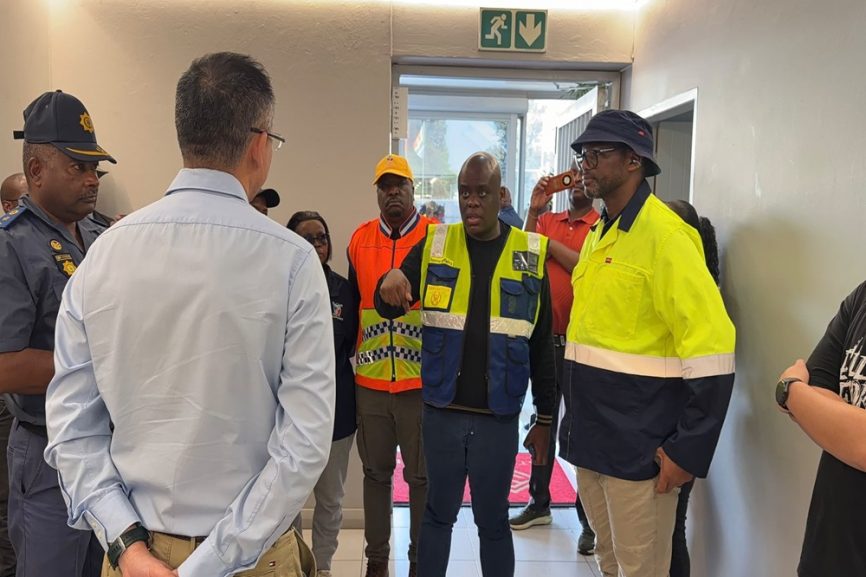
Officials from the Department of Employment and Labour. Image Credits: X | @deptoflabour
Employment and Labour Deputy Minister Jomo Sibiya has vowed to conduct another unannounced visit at a steel manufacturing company in Alberton, Ekurhuleni after receiving a tip off that it company employs more than 200 illegal immigrants.
Speaking during a raid Sibiya revealed that most employees they were targeting were told not come to work today.
[📸 Happening Now] Deputy Minister Jomo Sibiya together with Deputy Minister Njabulo Nzuza, Deputy Minister Steve Letsike and Executive Mayor Xhakaza currently leading Multidisciplinary High Impact Blitz Inspections in and around the City of Ekurhuleni. https://t.co/FNSst7uO89
— Department of Employment and Labour (@deptoflabour) September 22, 2026
Sibiya, together with Deputy Ministers of Home Affairs and Women, Youth and Persons with Disabilities and Ekurhuleni Executive Mayor conducted a raid to assess if the company complied with labour laws among others.
“We’re here at this big steel company owned by Chinese nationals, we’re here to check if they’re complying with all the labour laws, all the immigration laws and all the bylaws. We’re trying to enforce our laws, to make sure that everybody understands that we’re not a banana republic.”
“There’s a slippage that we’ve found, these employees that we find here, the mayor also understands that these are just few and we’ve been told by other employees who are here. We found that quite a number of illegal immigrants were told yesterday not to come today. We’re not going to end here, we’re going to come back, they might have evaded us today, but we’re still going to engage with the employer,” adds Sibiya.
VIDEO | Labour and immigration officials conduct raid in Alberton
The company has begun consultations over possible job cuts, raising concerns for workers and communities that depend on the coal mining industry.
Almost 800 jobs are on the line at Eskom coal supplier Seriti Resources.
The company has begun consultations over possible job cuts, raising concerns for workers and communities that depend on the coal mining industry.
Seriti is one of Eskom’s major coal suppliers, with the utility saying Seriti and Exxaro together account for around 80% of Eskom’s annual coal supply.
Seriti has previously warned of more than a thousand potential job cuts at two of its opencast operations in 2024.
These potential losses come as the coal industry faces pressure from rising costs, changing energy demand and South Africa’s long-term shift towards cleaner energy.
Seriti has also been investing in renewable energy, including wind power in Mpumalanga, as it looks to diversify beyond coal.
The latest consultation could, therefore, add to the pressure on coal-mining communities in Mpumalanga, where mining remains a major source of employment.
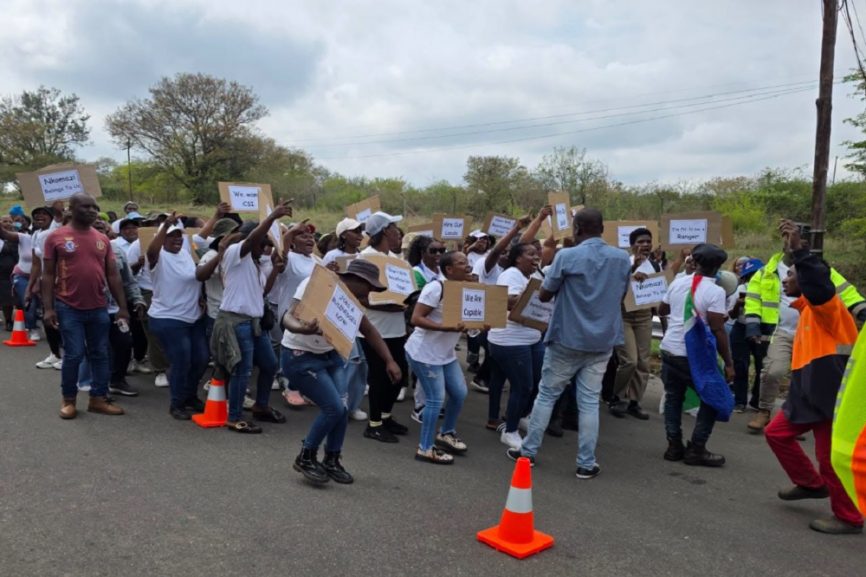
Young people protest outside the Kruger National Park. Image Credits: Nhlanhla Jele
Scores of young unemployed people in Nkomazi have marched to the Kruger National Park’s Malelane Gate to hand over a memorandum of grievances. They have accused the park’s management of deliberately ignoring young people in their communities when job opportunities are available.
The enraged youngsters say for years they have been applying for employment without any success. The young people are now demanding to be prioritised for employment at the park.
Among other things, they accused the park management of nepotism.
They also want the KNP to consider young businesspeople for tenders. Those who participated say they have been looking for employment over the years.
“We’ve been seeing posts, we are applying, but we are not being employed. So, that is why we came here today, to cry and tell them that we are not happy that every year we are busy applying, but we don’t see anyone around our place coming here to work.”
Another says, “I have experience as a reservations consultant in hospitality. We’ve come here today with the hope that we’ll get answers on how the application processes are going since we’ve been applying for a long time.”
In response, the Kruger National Park spokesperson, Rey Thakhuli denied the youth of Nkomazi’s allegations of being overlooked for employment.
“We have received the memorandum. We’ve had the demands of the memorandum. I will take it back to the principals, where we will have to respond within the 14 days that they’ve given us. But I must say that we have a database that clearly shows that there’s definitely people that work from Nkomazi in the park. But of course, that information has not reached them, and we’ll make sure that that information reaches them. And if there are opportunities, these opportunities will be shared equally with all people that are actually residing adjacent to this iconic national park.”
March organiser, Sibusiso Mhlanga says their aim is to see more young people find employment at the local farms and businesses including the Kruger National Park before the end of next year.
“They have a database, as they say, but then it’s 5% out of 100. So, we do not appreciate that. If you just take a walk inside the park yourself, without any command, just be there for a day, you’ll understand our cries. So, they’re just defending themselves. They know very well. They cannot say that in media or anywhere, because it will look very unfair to them.”
The Kruger National Park has 14 days to respond to the grievances.
VIDEO | Unemployment currently stands at 33.6% in South Africa:
Workers at the Gauteng Emergency Medical Services (EMS) have been suspended after refusing to work more than their 160-hour contracts.
The suspension is expected to last for one month and will affect 17 personnel from the Selby, Hillbrow, and Mofolo EMS bases.
The dispute centres around the EMS’s employee contracts, which require its staff to work 160 hours within a month, and its shift system.
The department operates on a 12-hour shift roster, which is four days on, four days off. This system often leaves EMS employees scheduled with additional working hours.
The suspended employees have said that this has resulted in them working an additional 20 to 25 hours per month, without being paid for the extra work.
As part of their suspension, the workers’ salaries have been reduced by up to R4,000 for “incomplete shifts worked”, equivalent to the overtime they refused to work.
The Gauteng Department of Health has reportedly instructed all EMS personnel to work the extra hours without additional remuneration.
Those who refuse are threatened with dismissals and a potential reporting to the Health Professions Council of South Africa for alleged “strike action”.
Three of the suspended employees face disciplinary hearings on charges of “gross insubordination” and “dereliction of duty”.
They argue that they have not abandoned any patients or failed to respond to emergencies, but declined to work extra hours without receiving more pay.
Member of the Gauteng Provincial Legislature, Madeleine Hicklin, said the suspension raised concerns about the potential impact on emergency medical services across the province.
“EMS personnel provide a critical, life-saving service where delays can have serious consequences,” Hicklin said.
“The alleged dispute must be resolved to prevent it from compromising EMS capacity, staff morale, or the delivery of patients’ emergency care.”
Hicklin called on the department to properly record and compensate EMS workers for any additional hours that they work.
“Instead of implementing disciplinary action on frontline emergency workers, the department should have corrected its rostering system,” Hicklin said.
“The 160-hour contractual limit should not be exceeded because of ineffective scheduling practices.”