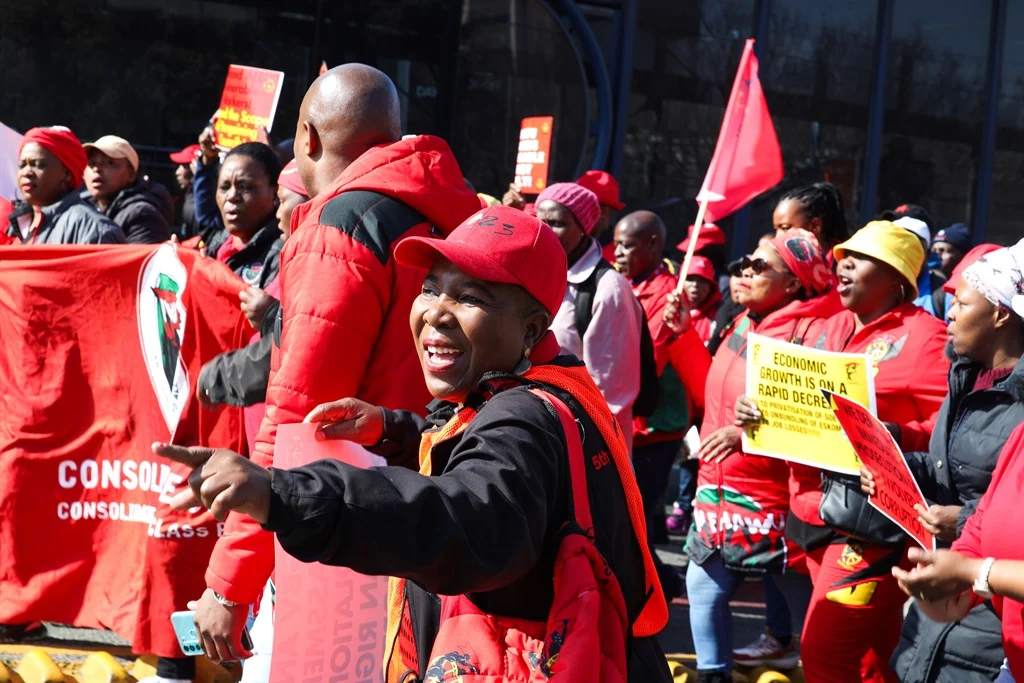
Cosatu members march during the National Day of Action in Johannesburg. PHOTO: Gallo Images/Luba Lesolle)
By Amy Musgrave
Cosatu’s 16 affiliates are split on whether to dissolve the federation’s national congress, which had not started by Tuesday afternoon.
The four-day meeting has been marred by violence, insults and delays about the legalities of the meeting. The national office bearers told delegates to go to lunch and called another central executive committee (CEC) meeting after discussions over the way forward broke down.
At the centre of the chaos are disputed credentials, the legal standing of Cosatu first deputy president Mike Shingange and whether the congress is proceeding lawfully. Unions including the National Union of Mineworkers (NUM) and the SA Municipal Workers Union (Samwu) say the congress must be postponed because a quorum was not reached on time.
Section 3.4.2 of Cosatu’s constitution states: “If after three hours of the time fixed for the meeting, a quorum is not present, the meeting must stand adjourned to a time and place decided upon by the president, provided that the meeting must be held within (1) month.”
The reason for this is that the majority of affiliates had not submitted their credential documents by lunchtime on Monday because they first wanted clarity on Shingange, who was put on precautionary suspension by his union, Nehawu, of which he is the president.
It has taken issue with Shingange wanting to accept nomination to stand as Cosatu’s next president and the matter is in the Labour Court, according to insiders.
Several affiliates are backing him, however, Nehawu is apparently supporting SA Democratic Techers’ Union deputy president Mabutho Cele.
Unions are yet to officially announce which candidates they will support for Cosatu’s top six positions.
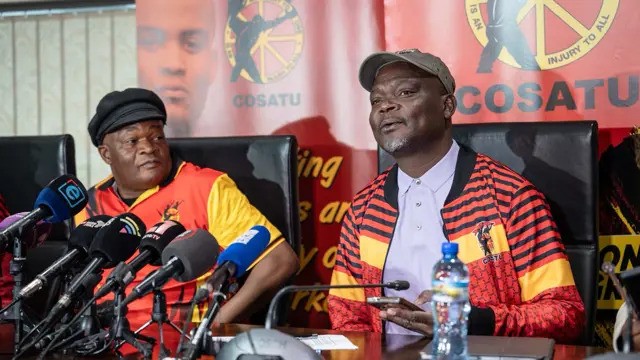
Cosatu general secretary Solly Phetoe told delegates that a special meeting of the CEC, which sat late into Monday and Tuesday morning, had agreed that Shingange was under provisional suspension in terms of Nehawu’s constitution, not Cosatu’s constitution.
This meant that he remained the federation’s deputy president.
However, some unions are demanding a legal opinion on the matter. They also believe that with the time wasted, the congress will not have sufficient time to discuss its reports and reach resolutions.
NUM deputy president Olihile Kgwari said in reaction to the CEC decision, that it is not a “tested legal opinion”.
He said while “a lot of money” will be lost by postponing the meeting, “we must do things right”.
“We want to do justice to the resolutions… We don’t want to turn this congress into a battle of muscles. We move to evoke that clause (of the constitution) on the quorum,” Kgwari said.
Nehawu told delegates it had no objection to Shingange contesting the election, saying its issues with him were an internal union matter.
Sadtu has appealed for the congress to continue, saying its members cannot afford the cost of attending another meeting.
Cosatu’s 15th national congress promises high drama as the federation confronts shrinking membership, technological disruption, and a fragile alliance ahead of critical elections.
Delegates will wrestle with the future of jobs in an era of AI and automation, while debating resolutions that could reshape South Africa’s labour movement.
Behind the paywall lies an inside look at how the country’s largest union federation plans to defend workers and redefine its role in a changing economy.
By Amy Musgrave
Cosatu heads into its 15th national congress next week facing challenges on several fronts.
It has missed its membership target again, the world of work is being transformed by technology at an unprecedented speed, and there is a continuous threat to the livelihood of its members due to the limping economy.
Labour federation Cosatu blames the ANC for the crumbling and poor state of local government. (supplied)
Story audio is generated using AI
Labour federation Cosatu yesterday laid the blame for the crumbling state of local government squarely at the feet of its ally, the ANC, accusing it of presiding over decay and corruption in municipalities it governs.
In what could be a shift in the political landscape, the federation said it had grown disillusioned with the ANC’s track record in governing most local authorities since the attainment of majority rule in 1994.
Cosatu is holding its national elective congress in Midrand until Thursday.
It comes as the country nears the much-anticipated local government elections on November 4.
Cosatu’s political report, which forms part of the congress documents, said many municipalities across the country were in a poor state.
“[T]he vast majority of ANC-led municipalities are collapsing or on the brink of collapse …” — Cosatu political report
“At the present conjuncture, the vast majority of ANC-led municipalities are collapsing or on the brink of collapse, with many facing collapsing water, electricity, and roads, with municipal services ground to a halt, denying communities basic services and the dignity of citizenship.
“Growing numbers of municipalities cannot even pay municipal workers, with volatile workplace strife across the country,” the report said.
“While the ANC manifesto for the 2021 local government elections provided numerous improvements as proposed commitments to turn around many collapsing municipal governments, approaches taken by the ANC after the elections produced more weaknesses, more decay, and corruption.”
The local government sector is grappling with poor service delivery, maladministration, lack of capacity, corruption, and fruitless, wasteful, unauthorised, and irregular expenditure.
Its worsening state has spurred the government to focus the second phase of Operation Vulindlela on fixing councils. Vulindlela is a joint initiative of the Treasury and President Cyril Ramaphosa’s office created in 2020 to address bottlenecks stifling economic growth.
Tabling the local government audit outcomes for the 2024/25 financial year at the co-operative governance and traditional affairs portfolio committee meeting in parliament about two months ago, auditor-general Tsakani Maluleke said that of the 257 municipalities, only 39 achieved clean audits — down from 41 in the previous period (2023/24).
While the City of Cape Town was the only metro in the country to receive a clean audit opinion in 2023/24, with three others achieving unqualified audit opinions with findings and four others qualified with findings, none of the eight metros achieved a clean audit in 2024/25, and the number of metros with qualified audit opinions increased from four to five.
“Besides crises of collapse in municipalities caused by poor governance, the current funding model for local government continues to create conditions that only produce funding challenges for municipalities, especially in poor (mostly historically black) communities,” the report said.
Cosatu said there were serious problems with how money was allocated to municipalities. Resources were not shared fairly, leaving wealthy metropolitan suburbs better developed while black townships and poor rural municipalities continued to struggle with underdevelopment and inequality.
The federation said the revenue crisis at local government was also compounded by “deliberate non-payment of municipal infrastructure by provincial and, at times, national government, with municipal towns being owed billions of rands by provincial and national government departments”.
The crisis in local government, Cosatu said, was also exacerbated by the politics of “thuggery and primitive accumulation, as politically linked and protected tendering syndicates sabotage state infrastructure to induce tenders to provide services that should be provided by the state”.
Much of Cosatu’s conference yesterday was delayed as delegates said they could not allow the gathering to continue without clarity on the membership status of its first deputy president, Mike Shingange.
Shingange was reportedly suspended recently, but the federation has not issued a formal communication confirming this. — Business Day
FILE: COSATU general secretary Solly Phetoe (L) and first deputy president Mike Shingange at COSATU House on 24 June 2024. Picture: Jacques Nelles/Eyewitness News
The National Union of Mineworkers has endorsed Shingange ahead of COSATU’s 15th National Congress, which gets underway at the Gallagher Convention Centre in Midrand on Monday.
One of the Congress of South African Trade Unions (COSATU)’s biggest affiliates has thrown its weight behind 1st Deputy President Mike Shingange to take over the reins of the labour federation.
The National Union of Mineworkers (NUM) has endorsed Shingange ahead of COSATU’s 15th National Congress, which gets underway at the Gallagher Convention Centre in Midrand on Monday.
About 1,800 delegates from COSATU’s affiliates are expected to attend the congress, where new national office bearers will be elected.
Shingange could succeed incumbent president Zingiswa Losi, who was re-elected at the federation’s 2022 congress.
The NUM is expected to send about 250 delegates to the congress, giving it significant weight in the leadership contest.
NUM spokesperson Livhuwani Mammburu said the union believes Shingange is the right person for the job.
“He’s got the right credentials and he has been the 1st Deputy President of COSATU since he was voted 3 years ago. So, we feel that he is the right person to lead the federation at the moment. There is no other person.”
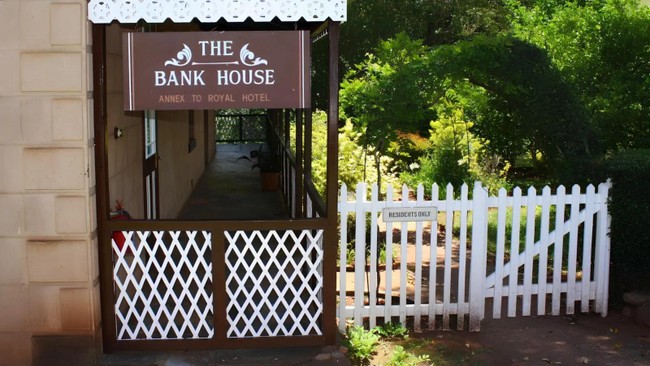
Pilgrim’s Rest’s 132-year-old Royal Hotel stands empty, the latest casualty in more than a decade of problems that have seen businesses close and jobs disappear from the historic tourism town.
Recent media reports say the latest attempt to secure an operator for the Royal Hotel has failed, with none of the bids meeting tender requirements. But the empty hotel is only the latest in a series of problems stretching back more than a decade.
The Royal has been part of Pilgrim’s Rest since the gold-rush era. According to Artefacts, an online repository of South African architectural and historical information, George Edward Roy, who arrived on the Pilgrim’s Rest goldfields as a 19-year-old in 1877, built the hotel in 1894.
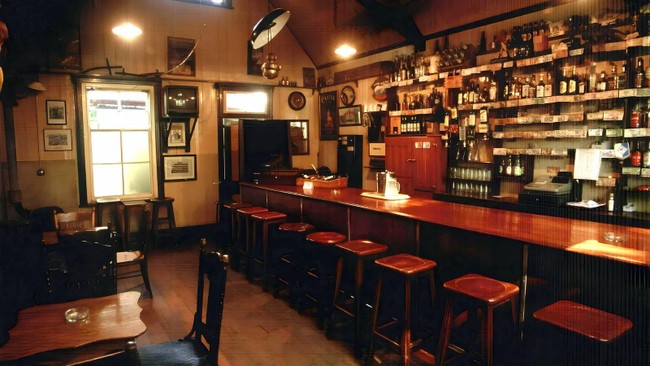
Even its pub has travelled a long way to get there – Artefacts says it was originally the Roman Catholic chapel of St Cyprian’s School in Cape Town before being dismantled, transported via Maputo and reassembled as part of the Royal Hotel.
Major battle
Pilgrim’s Rest’s problems with its state-owned business properties go back much further. A major battle erupted in 2012 after the provincial government put leases for businesses operating from its properties out to tender.
Existing traders were told to leave, including people who had operated businesses in Pilgrim’s Rest for years, prompting some to go to court to stop their eviction. The North Gauteng High Court halted the evictions pending a review of the tender process.
The dispute subsequently attracted the attention of then-Public Protector Thuli Madonsela, whose investigation resulted in the Poisoned Processes report. She found the process used to award shop leases was unlawful and improper and had been characterised by “gross irregularities and maladministration”.
Among the problems were shortcomings in the bid committee process, incorrect scoring and a failure to establish whether prospective tenants would be able to run sustainable businesses.
By 2018, reports described businesses standing empty and jobs disappearing amid continuing uncertainty over leases.
Leave now
Existing tenants had been given 30 days to leave, which Madonsela found was insufficient for longstanding businesses to wind up their affairs and make fair arrangements for employees.
Madonsela found the process had prejudiced business owners and the Pilgrim’s Rest community and affected the sustainability of the heritage and tourism destination. Government subsequently undertook to cancel the affected contracts and start again.
Yet the town continued to struggle. By 2018, reports described businesses standing empty and jobs disappearing amid continuing uncertainty over leases.
The town’s caravan park, once used by visitors, had been without a tenant since 2015 and was falling into disrepair despite repeated attempts by the provincial government to find an operator. The tenders were non-responsive.
In April this year, residents again complained that businesses were closed because of delays in awarding leases, while the provincial government said it was working to revitalise the town.
Royal struggles
The Royal Hotel had problems of its own before its current closure. By 2021, there were warnings that dozens of jobs were at risk after the hotel recorded losses of R770,702 and R3.14 million in successive financial years.
Kruger on Sabie took over the hotel in September 2022 and retained its workers, but a labour dispute subsequently developed. According to earlier reports, the operator wanted to introduce a shift system after concluding it could not afford the existing staffing arrangement. The relationship broke down and Kruger on Sabie left.
By December 2024, the provincial government said the Royal had 35 permanent employees who had been left running the business after the previous tenant allegedly ceased operating the hotel without paying employees or giving them notice, before Kruger on Sabie took over and later also left the operation.
The December 2024 announcement appeared to resolve the problem. Following negotiations involving the Department of Public Works, Roads and Transport, Kruger on Sabie, the Mpumalanga Regional Training Trust and organised labour, government said the department would renovate the Royal while Kruger on Sabie would return to run it, with operations due to resume on 1 March 2025.
The hotel’s pub was originally the Roman Catholic chapel of St Cyprian’s School in Cape Town before being dismantled, transported via Maputo and reassembled as part of the Royal Hotel.
They didn’t
The hotel was still closed when SABC News visited Pilgrim’s Rest in April this year. Residents told the broadcaster that businesses had closed, unemployment was high and fewer tourists were visiting.
The department said it was in the process of appointing an operator, but the latest bid round has produced no qualifying bidder – eight years after the caravan park tender also drew only non-responsive bids.
SACCAWU Mpumalanga’s Godfrey Talana said he was not aware of the Royal Hotel dispute when contacted by IOL on Monday but indicated that a report on the matter may be forthcoming.
The Royal is also not the only property the government is trying to fill. It has sought operators for other business premises in Pilgrim’s Rest as it tries to revive the town’s tourism economy, while acknowledging a shortage of tourist accommodation.
Thirteen years after the Public Protector warned that the handling of Pilgrim’s Rest properties was harming businesses, the community and the sustainability of the town as a tourist destination, government is still trying to find tenants for its properties.
IOL BUSINESS
Get your news on the go. Download the latest IOL App for Android and IOS now.