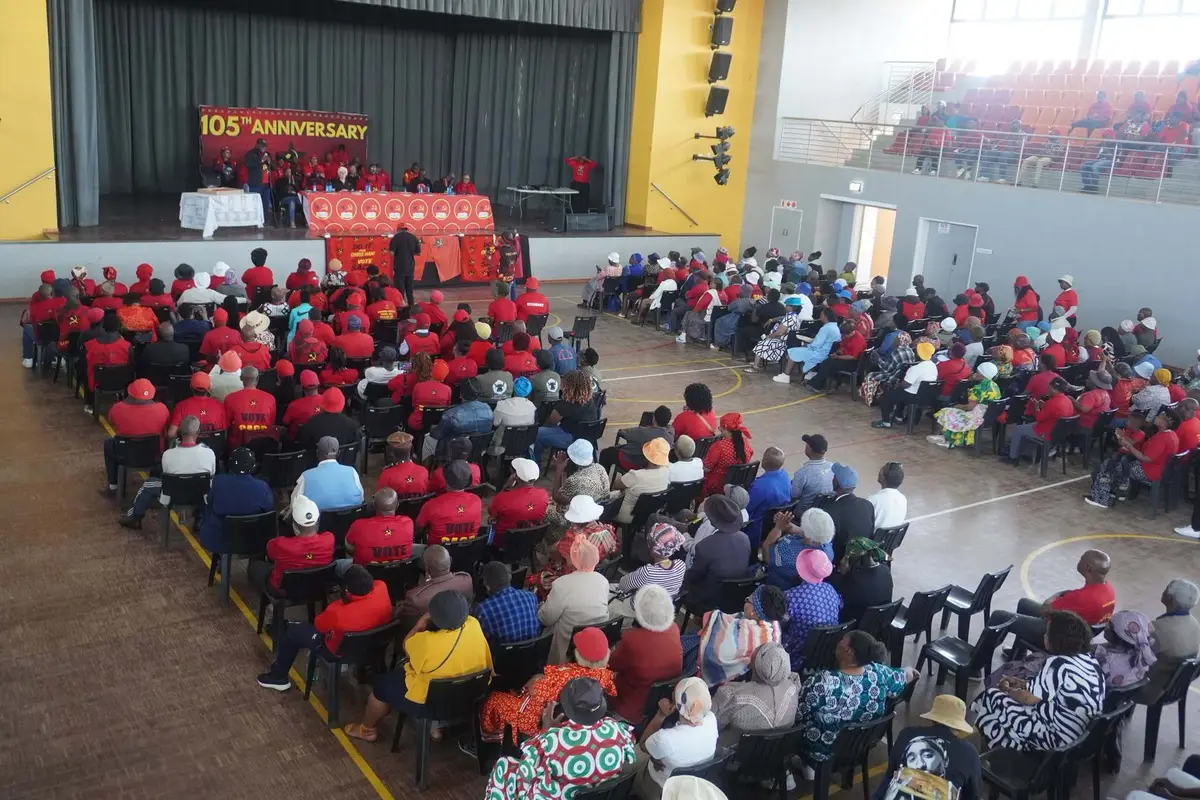
JOHANNESBURG – COSATU’s 15th National Congress has been postponed following delays and infighting over the status of the federation’s deputy president, Mike Shingange.
The trade union federation says it will explain the reasons for the postponement during a media briefing on Wednesday.
Shingange was expected to contest for the position of COSATU president. However, his candidacy was put on hold after he was suspended by his union, the National Education, Health and Allied Workers’ Union (NEHAWU).
Sowetan’s choice of the top three reads you should not miss today (Supplied)
Ekurhuleni killings: family’s shock at learning their daughter was a victim
Itumeleng Kekana, 32, was remembered by her family as a loving mother and humble sister. Picture: (supplied )
The Kekana family never imagined their daughter, Itumeleng, 32, would become one of the seven women allegedly killed by a possible serial killer terrorising communities in Ekurhuleni.
Itumeleng, originally from Qwa Qwa, was the second woman to be found dead on August 3 after she disappeared in Kempton Park on July 17.
For weeks her brother Themba Kekana and her boyfriend desperately searched for Itumeleng, hoping to bring her home alive. Instead, they found themselves identifying her partially naked body after it was discovered near a river on the R21 17 days after she went missing.
Cosatu congress stalls as leadership fights, postponing important policy discussions
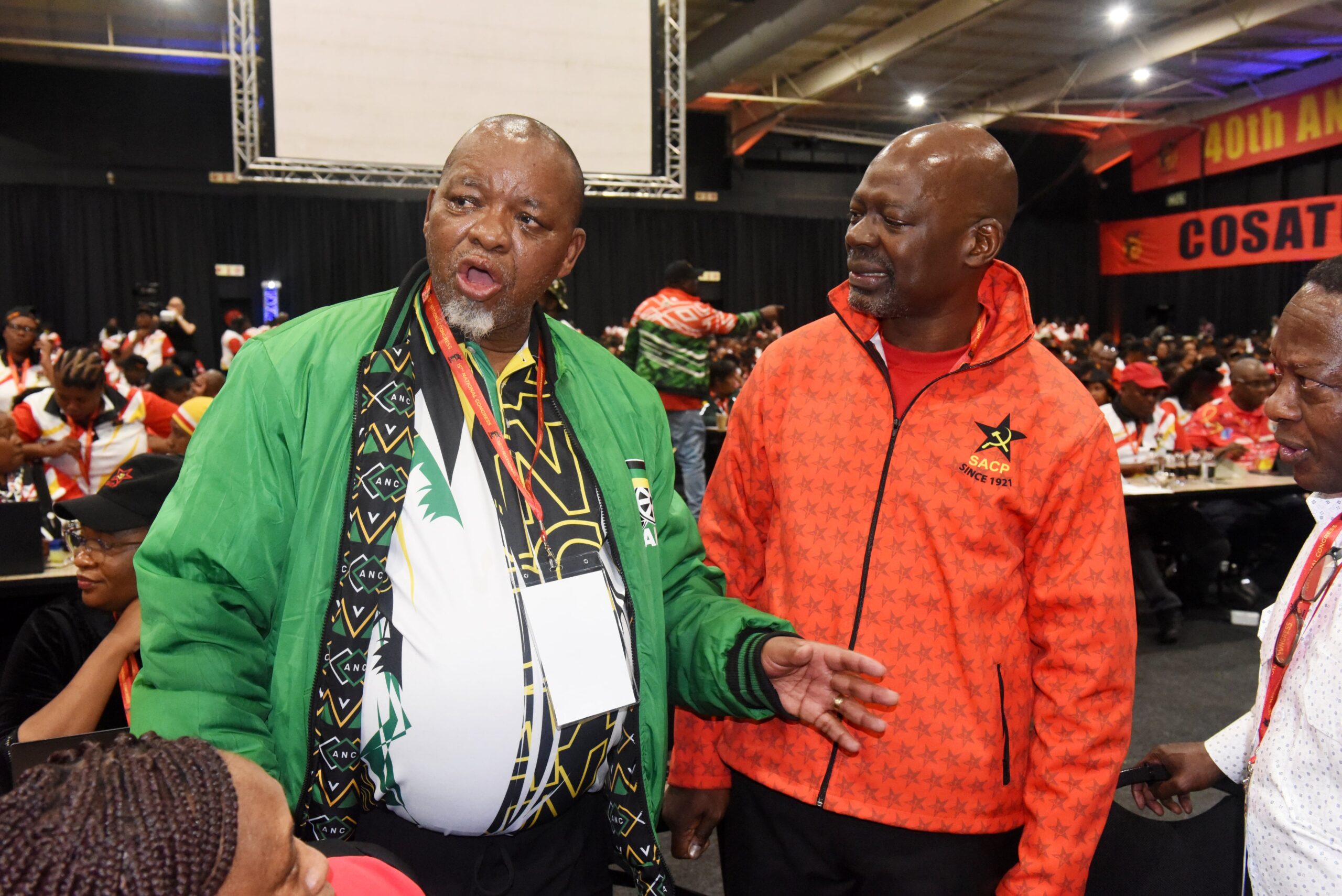
ANC national chairperson Gwede Mantashe and SACP general secretary Solly Mapaila at Cosatu’s 15th national congress at Gallagher Conference Centre in Midrand. Picture: (Freddy Mavunda)
The second day of Cosatu’s four-day national congress had not started by late Tuesday due to procedural stalemates and factional disputes surrounding delegates’ credentials and leadership suspensions.
The delay centred on Cosatu first deputy president Mike Shingange. Based on support apparent from the conference floor, Shingange looked to be a serious contender to lead the labour federation as president.
Shingange took his fight to lead Cosatu to the labour court after he was suspended for allegedly defying his union, the National Education, Health and Allied Workers’ Union, over his presidential bid.
The provincial transport department said the storm was triggered by a cut-off low-pressure system that affected several road networks and human settlements.
The department said it was receiving updates ahead of a flood response plan.
Cosatu’s congress failed to get off the ground this week, with 1,820 delegates sent home after a bitter leadership fight brought the federation to a standstill.
The congress was adjourned after two days of deadlock over the suspension of Cosatu’s first deputy president, Mike Shingange, by Nehawu on the eve of the gathering. Shingange was suspended on Saturday after defying an instruction from the union not to sign his nomination form, which would have prevented him from contesting for the Cosatu presidency.
According to delegates, Nehawu had decided to back another candidate to replace Zingiswa Losi as president, with Losi now running for the position of general secretary. But Shingange refused to stand down and went ahead with his bid for the presidency. His suspension immediately became the flashpoint at the congress, with delegates demanding that he be allowed to participate despite being suspended by his union.
The dispute dragged on for 48 hours, effectively paralysing the congress. Affiliated unions withheld the credentials of their candidates, making it impossible to establish whether the congress had the required quorum to continue. Cosatu’s constitution says that if a quorum cannot be established within three hours of the start of congress, the gathering must stand down and be reconvened by the president within a month.
Losi announced the decision in a closed session after the media were ordered out of the venue. The Sunday Times has, however, obtained a 10-minute video of Losi’s address to delegates, recorded by sources who were in the meeting.
Losi described the situation as “a difficult and painful moment in the life of the federation” and said the decision to adjourn was taken in terms of section 3.4 of Cosatu’s constitution.
Indeed, Cosatu is bigger than any one of us, let us protect it, let us unite it, let us hand it to the next generation stronger than we find it.
— Zingiswa Losi, Cosatu president
“Comrade leadership, this decision has not been taken lightly. We want to be absolutely clear that this is not a victory for one side or a defeat for another. There are no winners when Cosatu is divided,” she said. “Our responsibility at this moment is bigger than any individual, than any position or any difference amongst ourselves. Our responsibility is to protect Cosatu.”
Losi said the month-long break should give the Cosatu leadership and its affiliates time to “lower the temperatures” and have frank discussions about the future of the federation.
“The CEC will urgently meet to address the matters before us and make the constitutional, political and logistical preparations for this congress to reconvene,” she said. “But comrades, when we return we must return differently. We must be prepared to listen to one another, we must be able to engage, disagree without treating each other as enemies. The comradeship is not only demonstrated when we agree. It is tested mostly when we disagree.”
Losi reminded delegates that workers had not sent them to congress to fight each other, but to tackle the problems confronting workers and South Africans every day, mainly unemployment, poverty, exploitation, retrenchments and the rising cost of living. “And those are our burdens. Those are our enemies, not one another,” she said.
She said the leadership would ultimately be judged not by who shouted the loudest or who won the leadership battle, but by how it responded when the federation found itself in crisis.
“The question therefore comrades is, when Cosatu faced a difficult moment, did we have the courage and the wisdom to put the federation above ourselves? Let us therefore leave here as comrades, let us lower the temperatures, let us talk to one another, let us listen to one another, let us rebuild trust.
“And when we reconvene, let us return united, disciplined and ready to complete the work workers sent us here to do. Indeed, Cosatu is bigger than any one of us, let us protect it, let us unite it, let us hand it to the next generation stronger than we find it.”
Alliance politics overshadow urgent calls for union renewal and worker representation
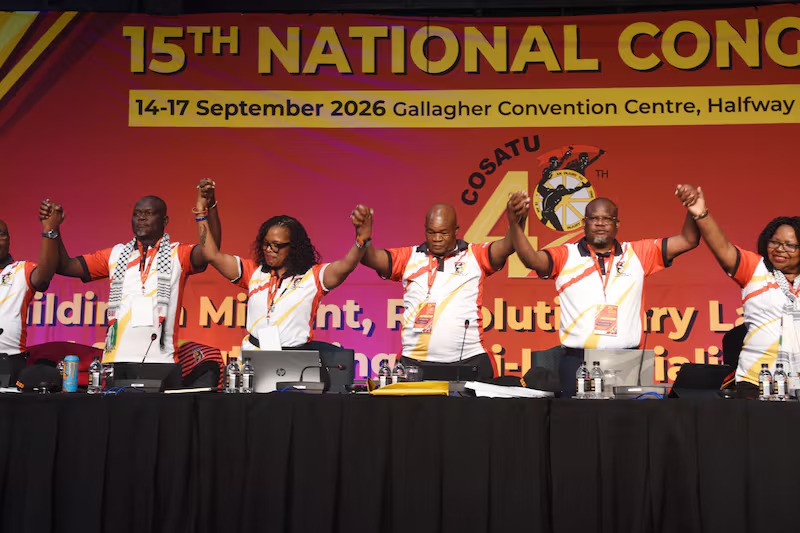
Cosatu’s leadership including president Zingiswa Losi, first deputy president Mike Shingange and first general secretary Solly Phetoe at the national congress in Midrand, Johannesburg, on September 14 2026. Picture: Business Day/ (Freddy Mavunda)
The Congress of South African Trade Unions (Cosatu) went into its 15th national congress promising a debate about the future of the working class.
But so far, the danger is that the workers themselves are being crowded out by a familiar contest over political power, leadership positions and the bitter battle about who it will support between ANC and SACP in the upcoming municipal elections.
That would be a serious failure of purpose, given that Cosatu championed workers’ rights as South Africa transitioned from apartheid to a constitutional democracy in the 1990s.
The congress, which runs until Thursday, is taking place at a consequential moment. The SACP has decided to contest the 2026 local government elections independently, while the ANC remains determined to preserve its political dominance.
Cosatu has been caught between the two, leaving the federation with the difficult question of where it stands electorally and, more fundamentally, what the future of the tripartite alliance looks like.
The political report before the congress makes clear just how central this question has become. It describes the alliance as requiring fundamental reconfiguration following the ANC’s electoral decline in 2024 and its subsequent decision to form a government of national unity with the DA.
It also records the failure of the ANC and SACP to agree on an electoral programme for the 2026 local government elections following the SACP’s decision to contest independently.
That is an important debate. It should not, however, become the only debate.
There is an irony here. Cosatu’s own political report repeatedly argues that alliance reconfiguration should be about putting working-class interests at the centre of policy rather than merely changing meetings, structures or electoral arrangements. It explicitly warns against reducing reconfiguration to the mechanics of the alliance.
Yet the congress risks doing precisely that, as by day two of the four-day meeting neither the political nor the organisational report of Cosatu had been discussed.
The leadership contest has already consumed attention. The opening day was delayed by a dispute over credentials, while questions surrounding the status of first deputy president Mike Shingange became entangled with the contest for the federation’s top positions. The leadership elections are important, but Cosatu should be wary of allowing the congress to become primarily an exercise in deciding which faction controls the federation.
The organisational report presents a far more urgent set of questions.
Cosatu itself acknowledges that unemployment, retrenchments, company closures and economic stagnation have weakened workplace organisation and union membership. It identifies precarious employment, casualisation, outsourcing and labour broking as growing obstacles to organising workers. It acknowledges declining worker participation, organisational fatigue, financial pressures and fragmentation within the labour movement.
Those are not secondary matters. They are the reason Cosatu exists.
The report is blunt about the need for organisational renewal. It says the challenge is not simply to preserve Cosatu’s existing structures but to rebuild worker power under changing economic conditions. Its proposed priorities include rebuilding workplace organisation, revitalising locals, organising precarious workers, improving leadership accountability and modernising organising methods.
This should be the centre of the congress. South Africa’s workers are facing an economy in which permanent employment is giving way to fragmented and insecure forms of work. Cosatu’s own assessment notes that although the majority of union members remain in the private sector, organised labour has become concentrated in the public sector, while union density in the private sector remains considerably lower.
At the same time, the federation’s political report acknowledges uneven implementation of previous resolutions. It lists declining membership, financial instability, inconsistent reporting, uneven organisational capacity, weaknesses in recruitment and workplace organisation and ideological confusion arising from coalition politics among its challenges.
This is where the congress should be judged. Cosatu has no shortage of analysis. Its documents contain detailed positions on austerity, industrialisation, collective bargaining, social protection, public services, unemployment, political education and the changing world of work.
The political report itself notes that the 14th national congress resolved to strengthen organisational renewal, recruitment, collective bargaining, economic transformation, the alliance and campaigning capacity.
The test now is whether those ideas translate into decisions that workers will actually experience.
There is still time for the congress to correct course. The resolutions have yet to emerge in full, and they will provide the clearest measure of whether Cosatu has used its congress to confront the problems facing its members or merely to arbitrate the political dispute between its alliance partners.
The federation should leave Midrand with more than a new leadership collective and a position on whether to favour the ANC or the SACP. It needs a programme capable of rebuilding union power among young, precarious and unemployed workers; defending collective bargaining; confronting the cost of living; reversing declining membership; and holding its own leadership structures accountable for implementing the resolutions they adopt.
Cosatu’s political report says that the greatest lesson of its 40-year history is that working-class advances depend on organisation, unity and political clarity. That is precisely the standard by which this congress should be judged.
The ANC and SACP can fight their political battles. Cosatu’s job is to make sure that, when the fighting is over, it has not forgotten the workers it was created to represent.
Spokesperson Zanele Sabela said the ANC and SACP question was going to be debated at the congress, which had since collapse
The fracture between the ANC and the South African Communist Party (SACP) has spilled over into the Congress of South African Trade Unions (Cosatu) conference, according to senior sources.
On Tuesday, day two of the congress descended into chaos when a delegate who had been calling for the congress to be postponed called others “ancestors” and “illiterate”, sparking a heated exchange of insults in plenary.
The Mail & Guardian understands that former leaders of all the unions, including ANC national chair Gwede Mantashe and SACP general secretary Solly Mapaila, convened a meeting during lunch to find a solution. However, they could not agree, forcing the congress to be postponed to a later date.
On Tuesday, around 1pm, the congress was forced to adjourn for lunch. The leaders returned to plenary around 6pm, only to tell delegates that they could not agree on a way forward, forcing the postponement.
The stumbling block was that the current first deputy president of Cosatu and president of the National Education, Health and Allied Workers’ Union (NEHAWU), Mike Shingange, had been precautionarily suspended by his home union.
His precautionary suspension has raised questions over his eligibility to stand for the presidency of Cosatu. However, Cosatu general secretary Solly Phetoe told the congress that Shingange had not been removed as a NEHAWU shop steward.
Phetoe said that Shingange’s suspension was based on the NEHAWU constitution, not the Cosatu constitution.
“Therefore, Comrade Mike is still the first deputy president of Cosatu. This was presented to the leadership.”
Current Cosatu president Zingiswa Losi wants to stand for general secretary, a move that those aligned with Shingange do not want.
Losi is viewed as aligned with the ANC, while Shingange is viewed as being much closer to the SACP.
Outside the venue, posters reading “Vote ANC” and “Vote SACP” were seen hanging, raising questions about whether Cosatu would pronounce its support for the ANC or the SACP ahead of the upcoming local government elections.
In late 2024, the SACP announced that, for the first time since the advent of democracy, it would contest elections on its own.
Sources told the publication that the split between the SACP and the ANC had played a part in the infighting among delegates.
One senior source said they had reached a compromise that Shingange should stand despite the controversy surrounding his name. However, his supporters wanted to collapse the congress.
“The issue is that they do not want Zingisa on the ballot at all and we cannot allow that. They also want to collapse the congress because they know they do not have the numbers.”
Another source said there were certain leaders who wanted power by any means, even if it meant that they would collapse the alliance.
“If there were no issues between the ANC and the SACP, I don’t think this would be happening. It is really sad to watch. Some leaders just want power to the point that they are willing to do whatever it takes.”
The M&G also understands that the ANC did not want to take a position on the matter but wanted Cosatu to resolve its own internal crisis.
Speaking to M&G, Cosatu spokesperson Zanele Sabela said the ANC and SACP question was going to be debated at the congress, adding that ever since the SACP decided to contest elections independently, Cosatu had been asked these questions.
Sabela said the Cosatu leadership had been clear that this was not the kind of decision that leaders could make alone but that it needed to be taken to congress, as it is the highest decision-making structure.
“This was going to be deliberated under the political report. The members were going to decide where we were going,” she said.
“Going to the congress, everyone who is not Cosatu or an affiliate assumed that the main question which would be discussed was the ANC and SACP. There is more to the congress than that.”
“Essentially, it is about worker issues. Workers are facing really difficult times out there, unemployment is quite high and our economy has not grown by more than 1% over a decade.”
Sabela said that, over and above the election of office bearers and the ANC-SACP question, they needed to talk about the issues facing workers. She added that she was not sure how anyone who said the congress was about the ANC and SACP, had come to that conclusion.
The reason the former leaders were called to intervene was because they might have had better ways or strategies to help the leadership find common ground and ensure that the stalemate was broken, given their past experiences, Sabela explained.
Key affiliates follow suit over the suspension of First Deputy President Mike Shingange, leaving the Midrand gathering in limbo as behind-closed-doors negotiations attempt to salvage the event.
MIDRAND — The COSATU 15th National Congress at Gallagher Estate in Midrand faces an imminent collapse after the National Union of Mineworkers (NUM) led a decisive charge to withdraw its credentials. This critical development threatens the federation’s ability to form the mandatory two-thirds quorum required to proceed with voting for new office bearers.
The NUM was not alone in its withdrawal. Several other major affiliates, including SAMWU, DENOSA, SACCAWU, SAMATU, SAEPU, and SASBO, also refused to submit their credentials to the gathering. Under established congress rules, delegations that do not provide their credentials are officially deemed absent, directly jeopardizing the viability of the event.
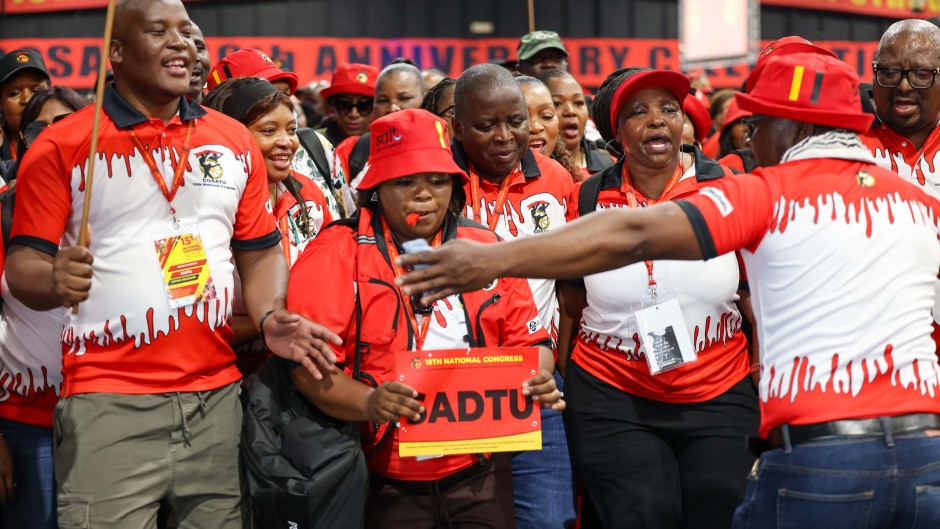
Proceedings, which were delayed until approximately 12:00 noon following unsuccessful attempts by current COSATU leadership to quiet the singing and dancing of delegates to get started, quickly hit a roadblock. The first item on the agenda was the formal announcement of the federation’s credentials, which immediately triggered the mass refusal by key affiliates.
At the heart of the NUM’s withdrawal is deep concern over the sudden suspension of COSATU First Deputy President Mike Shingange. Shingange was suspended by his home union, the NUM, in his capacity as its president just on the eve of the congress. Union representatives emphasized that in a democratic political process, the suspension of a nominated individual immediately before a major congress is a highly worrying factor. The NUM noted that after extensive engagements, it had previously made the formal decision to support Shingange’s bid to become president of the federation, making the last-minute suspension a direct disruption to democratic processes.
As of 4:00 p.m., the COSATU Congress remained in limbo and had not properly started. Union leaders were reportedly on an extended lunch break behind closed doors, engaging in urgent negotiations in a final attempt to revive the congress, resolve the credential disputes, and prevent a complete organizational collapse.