Healthcare staffing shortages continue to place immense pressure on nurses with some general ward nurses responsible for more than 40 patients per shift Image Credits: Reuters
The Democratic Nursing Organisation of South Africa (DENOSA) in Gauteng has given the provincial Health Department until next month to address nursing staff shortages, reduce the number of acting managerial positions and improve health infrastructure.
The union also wants hospitals across the province to be adequately supplied with medical equipment and medication to enable healthcare workers to deliver quality services.
DENOSA Gauteng Chairperson Bongani Banda says failure to address the concerns by the deadline will lead to protests to ensure that the union’s demands are met.
“In many healthcare facilities, a single nurse in a general ward is responsible for more than 40 patients per shift. A single midwife may attend to around eight women or more in labour, while the situation is even worse in clinics. This is due to inadequate staffing levels,” says Banda.
He says regarding leadership instability, there is a continuing high vacancy rate in key executive management positions, such as Chief Executive Officer (CEO), with many individuals serving in an acting capacity.
The clothing bargaining council says a government pilot project is being used to keep inspectors out
The National Bargaining Council for the Clothing Manufacturing Industry says the labour department has unlawfully granted “amnesty” to certain non-compliant clothing factories. Illustration: Bronwyn Webb
The National Bargaining Council for the Clothing Manufacturing Industry says some Newcastle factory owners have refused its inspectors access, claiming they are protected by an 18-month labour department pilot project.
This follows the council taking legal action against clothing manufacturers it claims are contracting with non-compliant “sweatshops”.
The council wants the Labour Court to declare that the department cannot suspend or defer compliance with the council’s collective agreement.
The National Bargaining Council for the Clothing Manufacturing Industry says the Department of Employment and Labour has unlawfully granted “amnesty” to some clothing manufacturers it claims are contracting with non-compliant “sweatshops”.
The council has launched an urgent application in the Labour Court in Durban, seeking an order that the department has no right to grant any grace period for compliance through its national advocacy pilot project in Newcastle, called “Decent Work in the Chinese Business Community, KwaZulu-Natal Province”.
It further seeks orders that any policy which interferes with its powers be declared unlawful. It also wants the 25 factories cited in the application to be bound by the main collective agreement and must allow the council’s investigators access to their premises.
The application is to be heard on 6 October with the department and the 25 cited factories to file opposing papers by 18 September. We will publish a report once the opposing papers have been filed.
In her affidavit, the council’s KZN general secretary, Chantal Naidoo, said it wants to “protect the integrity of its powers and functions”, particularly the power to monitor and enforce compliance with basic conditions of employment, including minimum wage agreements.
“That power is the council’s alone: no other body may enforce the main collective agreement and no other body may suspend, defer or excuse compliance with it,” she said.
Naidoo said the council had become aware that a group of 31 factories in Newcastle, known as G31, believed they were currently excused from compliance. This was based on their reading of the department’s Newcastle project, which suggested that full compliance would only be expected at the end of a proposed 18-month intervention period.
Naidoo said the council was not opposed to the project which had “laudable aims”.
“The crux of its challenge is that the project has been interpreted as relaxing, rather than strengthening compliance in respect of a selected group of factories to the exclusion of other textile manufacturers and in a manner which interferes with the exercise by the council of its powers to enforce compliance with basic conditions of employment.”
She said because of this, council officials had been refused entry into premises by owners who “appear to believe that a grace period … places them above the law and beyond the council’s reach”.
The department invited the council to a meeting in March 2026 when a “phase-in period” of 18 months was mooted for the G31 factories, but this was not agreed to by the council representative.
Later that month, 30 other clothing factories in Newcastle wrote to the department complaining that they had not been invited to the meeting and objecting to the “selective grace period” offered to the G31 factories.
Deputy minister Jomo Sibiya said that employers participating in the project would be “ringfenced for the purpose of implementing strategic compliance”, and that “while these companies would still be expected to comply with the Labour Laws, they would be assisted to do so in the manner that would be outlined in the project document”.
Naidoo said the meaning of Sibiya’s letter was unclear, but to the extent that it purported to grant amnesty to the G31 factories, was unlawful. Only the council has that power.
The impact on the ground for council inspectors was immediate, she said. A substantial number of factories evaded inspections and denied access to inspectors. In one case, inspectors were turned away by an “armed and aggressive” security guard.
At a meeting in June, the department indicated that it would issue a “compliance certificate” to the participating factories.
The council’s representative again made it clear that this was not lawful. However, later that month, the department sent out an implementation plan, indicating that resolutions had been adopted at the meeting.
Naidoo said no final decisions had been taken at the meeting.
The council sent letters of objection to the department but there was no resolution to the issue. “It is clear that the G31 factories are using the project as a tool to shield themselves from inspection and that they will do so to evade other compliance mechanisms invoked by the council unless and until this court intervenes to clarify the legal position,” Naidoo said.
“The more a culture of impunity is permitted to take root and become entrenched, the greater the challenge to reverse the trend and attain proper compliance. Impunity for the G31 [factories] will also have a detrimental effect on the culture of compliance of those who are currently compliant. Non-compliance by some creates an uneven playing field for others and renders them less competitive.”
Earlier this year, the council took legal action against two suppliers of fashion apparel in South Africa, Drake Clothing and Gemelli.
The council alleges that the companies are contracting with “sweatshops” that masquerade as co-operatives. Both companies are opposing the applications, which are still in the legal process.
JOHANNESBURG – Twelve SAPS members were killed in the line of duty between April 2025 and March 2026.
Those fallen heroes were remembered in Pretoria on Sunday.
Popcru’s Mosadiwamaje Mokokong said an attack on a police officer is an attack on the state.
“This is a crisis. Hence, as a union coming from our recent Central Executive Committee, we again reaffirmed our long-standing resolution that says the government must declare a deliberate killing of a police officer as treason.
“We cannot afford to have the criminals that goes out and kill law enforcement officers because in our view, when you attack and kill a police officer you are not just killing an individual employee, but this according to us, is an attack on the authority and the capacity of a democratic state so hence we have made that call to say can we declare this is a treason those that are killing the police officers.”
DENOSA Backs eSwatini Democracy Struggle, Stands With Workers
By Thabo Mosia
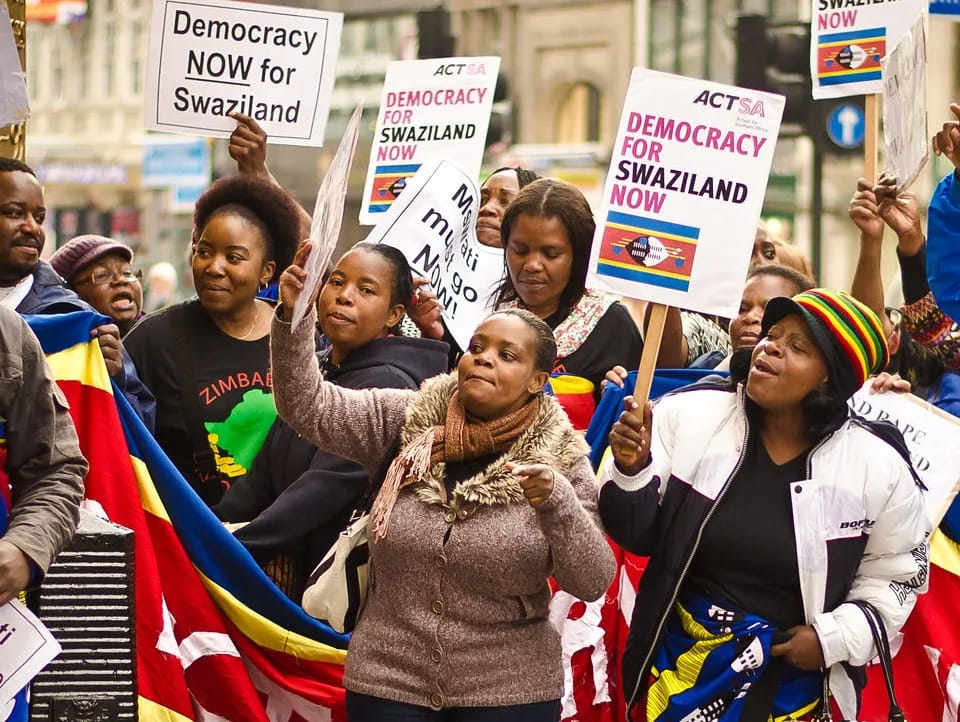
Pretoria – The Democratic Nursing Organisation of South Africa has joined Cosatu and other unions in backing the people of eSwatini, and will walk with the Global Week of Action march on Friday, 4 September 2026, from Madiba Park at the Union Buildings to the Swazi High Commission.
The statement, issued on Thursday, is written as a nurses’ union speaking to nurses’ work: the right to organise, to bargain and to raise problems at work without fear.
Why a South African nursing union is on this route
DENOSA says solidarity is not a favour to a neighbour. South African workers were helped by unions abroad during the fight against apartheid. That debt, the union says, now runs the other way.
“South African workers know the importance of international solidarity because our own struggle for democracy was strengthened by workers, unions and progressive organisations across the world. It is therefore our responsibility to stand with workers and communities elsewhere who continue to demand the right to organise, to speak freely, to participate in the political affairs of their country and to enjoy the fundamental rights and freedoms that should be guaranteed to all people.”
For health workers the link is practical. A clinic cannot bargain if the law treats a union meeting as a threat. Patients suffer when staff cannot speak about shortages or safety.
“As a trade union representing nurses and healthcare workers, DENOSA also understands that workers’ rights, democracy and quality public services are closely connected. Health workers need an environment in which they can organise freely, participate in collective bargaining and raise concerns about the conditions under which they work and provide care without fear or intimidation.”
What the march is walking toward
eSwatini remains Africa’s only absolute monarchy. Political parties have been banned since the 1973 King’s Decree. Pro-democracy protests in 2021 were met with force. Scores of people were killed. Lawyers, journalists and union leaders have faced the Suppression of Terrorism Act. The Trade Union Congress of eSwatini has reported banned gatherings, including a blocked May Day event in 2026. SADC called for political dialogue after 2021, then later took the country off its formal agenda. Emaswati unions still press cases at the International Labour Organization on freedom of association and collective bargaining.
Friday’s column will hand a memorandum at the High Commission in Arcadia. Similar Pretoria pickets have been held before. The demand has not changed: a government chosen by voters, and space for unions to exist in the open.
DENOSA called on SADC, the African Union and the international trade union movement to keep backing democracy, human rights and workers’ rights in eSwatini.
“The struggles of workers do not end at national borders. When workers anywhere are denied their rights and freedoms, the broader labour movement has a responsibility to speak out and stand with them.”
“An injury to one is an injury to all.”
What solidarity can and cannot do
A march in Pretoria does not write a new constitution in Mbabane. It keeps the file open in a week when eSwatini’s own public servants are still fighting salary-review appeals and unions at home face permits that vanish at the last hour.
Nurses on the South African side of the border already treat Emaswati patients in public hospitals. The union’s argument is that the same worker who clocks in at a ward should not have to watch a colleague across the frontier lose the right to a union card. That is the line from Madiba Park to the High Commission on Friday.
Central News Special Edition | Issue 157: Download the Latest Print and E-Edition | Two More Emfuleni Employees Arrested, Taking Total In Electricity Probe To Seven In Alleged Electricity Fraud Scheme
Central News also offers Sponsored Editorial Content, Podcasts , Radio / Social Media Simulcast, Video Production , Live Streaming Services, Press Conferences, and Paid Interviews (Video/Audio) etc.
We guarantee exceptional exposure, reach, and engagement, with an excellent return on investment.
Advertisement:
To place your advert on our platforms (Print Newspaper or Digital Platforms) : Please email : sales@centralnews.co.za
2 September 2026 – The South African Democratic Teachers’ Union (SADTU) in the North West said it is deeply concerned about the reported incident at Batlhaping Secondary School in Taung involving a learner allegedly directing insulting and disrespectful language towards an educator. SADTU said it is seriously disturbed by the escalating levels of learner indiscipline and the growing incidents of verbal abuse, threats, intimidation and physical attacks against educators in schools.
SADTU provincial secretary, George Themba said they cannot accept a situation where educators report for duty every day uncertain about whether they will be safe in the classroom. Themba said educators cannot be expected to perform their professional responsibilities effectively while being subjected to threats, insults, intimidation or violence.
“The safety and dignity of educators must be treated as a fundamental condition for quality education. We are particularly concerned that incidents of serious learner misconduct are sometimes allowed to continue without decisive intervention.
“Where an educator is assaulted or threatened, there must be an immediate and appropriate response. Violence against educators must never be normalised or treated as merely a disciplinary matter,” he said.
Themba further said where criminal conduct has occurred, the relevant law- enforcement agencies must be involved. He added that SADTU therefore calls on the North West Department of Education and the North West MEC for Education, Dr Desbo Mohono to urgently strengthen measures aimed at protecting educators and restoring discipline in schools.
“We demand stronger implementation of school safety and learner-discipline policies, with clear consequences for serious misconduct. Immediate intervention in cases involving threats, intimidation or physical attacks against educators.
“Proper support for principals and School Governing Bodies (SGBs) to manage serious disciplinary cases. Improved collaboration between schools, parents, the Department of Education, South African Police Services (SAPS) and other relevant stakeholders,” said Themba.
He said appropriate psychosocial and professional support for educators who experience violence or trauma in the workplace. Themba said the monitoring of schools where serious disciplinary and safety challenges have been identified.
“Greater accountability for parents and guardians who fail to support reasonable disciplinary measures or who themselves threaten and intimidate educators. A comprehensive review of measures aimed at preventing weapons, drugs and other dangerous substances from entering school premises.
“We emphasise that SADTU does not advocate for the violation of learners’ rights. Learners have rights, but rights come with responsibilities. The protection of learners cannot be interpreted in a manner that leaves educators exposed to abuse, intimidation or violence,” he said.
Themba said a balanced approach must protect everyone in the school community. He said parents also have a critical role to play.
“Schools cannot carry the responsibility for discipline alone. Parents and guardians must reinforce respect, responsibility and acceptable behaviour among learners.
“Equally, educators must continue to uphold professional standards and exercise their authority responsibly. The crisis of learner indiscipline must also be understood within the broader challenges facing education, including overcrowding, social problems, substance abuse, inadequate psychosocial services and pressure on educators,” said Themba.
He said these challenges require a whole-of-society response, rather than placing the entire burden on teachers. Themba said SADTU North West remains committed to defending the rights and interests of educators, while championing a public education system that is safe, disciplined and conducive to effective teaching and learning.
“Teaching cannot be an attractive and respected profession when educators are expected to work in unsafe environments. An attack on an educator is not only an attack on an individual—it is an attack on the teaching profession and the right of every learner to quality education.
“SADTU calls upon the Department of Education to act decisively, urgently and consistently. The time has come to move beyond statements of concern towards concrete interventions that restore discipline, protect educators and reclaim schools as safe spaces for teaching and learning,” he said.
Cosatu’s upcoming national congress may ignite crucial talks on worker ownership and pension transparency; the writer encourages workers to demand transparency about how their money is invested by the PIC. File picture: (Thulani Mbele)
Story audio is generated using AI
The forthcoming Cosatu national congress could provide an important platform for beginning a serious conversation about worker ownership, pension governance and the accountability of the institutions managing workers’ capital.
The most troubling feature of the current Public Investment Corporation (PIC) controversy may not be the resignations, the disputes between board members and the shareholder minister, or even the competing interpretations of the PIC’s governance framework.
It is how little the workers whose money is being managed appear to feature in the public debate. The PIC manages almost R4-trillion in assets. Behind those numbers are millions of workers and beneficiaries whose retirement security depends on the prudent management of their accumulated savings.
Yet much of the discussion about the PIC is conducted as though it were an internal dispute between politicians, lawyers, board members, executives and businesspeople. Workers are treated as spectators. They should not be.
The PIC’s money is not simply another pool of state money. It represents the accumulated wealth of workers and the future retirement security of millions of South Africans.
That should make the governance of the PIC a matter of intense worker interest. Unfortunately, worker activism around pension assets remains relatively weak compared with Canada, Australia and Denmark.
Workers are understandably preoccupied with wages, employment, working conditions and the immediate pressures of daily life. Pension investments can appear distant and technical. Questions about asset allocation, unlisted investments, investment mandates, board appointments and governance structures can seem like matters best left to professionals.
That is a mistake. A pension fund is deferred wages. The money being invested today represents income that workers have earned but have agreed to receive later in life. Decisions about that money therefore deserve the same level of attention that workers give to their wages and working conditions.
The PIC should be understood in precisely these terms. The recent controversy demonstrates why. Much of the debate has focused on personalities: who the whistleblower report was directed to, who resigned, who was suspended, who supported whom, who had authority to make a particular decision and whether the proper governance procedures were followed.
Those questions are important, but they are not the whole story. The bigger question is: who has influence over workers’ capital? The PIC inevitably attracts powerful interests.
Businesses want capital. Investment managers want mandates. Some businesspeople work with and have relationships with executives and politicians within and outside the state. The shareholder has legitimate oversight responsibilities. Board members and executives exercise substantial institutional power, which is often co-opted by external actors.
Wherever there is a large concentration of capital, there is also a risk of undue influence. The answer cannot be to remove the PIC from the market. The institution must invest. It must engage businesses, investment managers and other market participants.
The answer is to ensure that those relationships do not become mechanisms through which investment decisions are captured. This is where workers have a vital role.
Workers should demand transparency about how their money is invested. They should ask how boards are appointed and held accountable. They should insist that investment decisions are made according to clearly defined criteria. They should demand that conflicts of interest are disclosed and managed. They should expect whistleblower allegations to be taken seriously and investigated fairly.
And they should refuse to be divided and a shareholder to decide who their representative should be. They should ask their representatives in organised labour a simple question: What are you doing to protect our pension capital?
The labour movement has historically understood the importance of collective organisation in the workplace. The same principle should apply to workers’ capital.
A worker who negotiates collectively for better wages but pays little attention to the management of their pension savings is protecting only part of their economic future.
Over a working lifetime, pension contributions can accumulate into substantial amounts. The investment returns on those contributions can determine whether a worker retires with financial security or financial vulnerability.
That makes pension governance an economic struggle. The labour movement should therefore begin treating pension assets as part of its broader programme of worker empowerment.
This does not mean that unions should dictate individual investment decisions. Nor does it mean that investment professionals should be replaced by mere political representatives.
It means that workers must demand accountable institutions and informed representation.
The institutional independence at the PIC matters so much. The board must be able to exercise its responsibilities without undue political or commercial pressure. Management must be accountable for investment decisions. The shareholder must exercise legitimate oversight without turning oversight into operational interference.
And workers must be able to hold all of them accountable. The Mpati commission provided important lessons about the need to strengthen the governance of the PIC and address the concentration of power and potential conflicts within the institution.
Those lessons should not be treated as another report to be filed away. They should become part of a broader conversation about who controls workers’ capital. The recent whistleblower controversy provides another lesson.
Some have argued that whistleblower allegations should have been ignored because the PIC is systemically important and because the allegations may have emerged in the context of commercial disputes between Acapulco and Harith in which the PIC CEO is alleged to have been conflicted.
But the PIC’s systemic importance is precisely why credible allegations must be assessed. Ignoring allegations can create the perception that an institution is unwilling to confront wrongdoing or is protecting powerful interests. That can damage institutional credibility and investor confidence.
The appropriate question is not whether allegations should be believed automatically. They should not. Nor should allegations be dismissed automatically because of who raised them.
The question is whether they deserve to be investigated through a fair, independent and properly governed process. Workers should demand nothing less.
There is also an important lesson in the disputes surrounding senior appointments at the PIC. Appointments are not merely administrative matters when they determine who controls the allocation of enormous pools of capital.
The debate over the chief investment officer (CIO) function was therefore about more than individual candidates. The restructuring of the CIO function was intended to address concerns about the concentration of investment authority and to align the institution with principles emerging from the Mpati commission.
The broader principle is that the allocation of investment power must be structured to reduce the possibility of undue influence.
That is a workers’ issue. If workers are serious about protecting their retirement savings, they must become more active participants in the institutions that manage those savings.
This is where organised labour has an opportunity.
The labour movement should not see the PIC merely as another institution of the state. It should see it for what it is: an institution managing the accumulated wealth and future retirement security of millions of workers.
Worker activism around pension assets should therefore become a permanent feature of South Africa’s labour politics. Workers should know where their money is invested.
They should understand who makes the investment decisions. They should know how those decision-makers are appointed and held accountable. They should demand transparency when things go wrong.
The ultimate safeguard of workers’ money cannot be institutional design alone. It must also be worker power.