
Teacher salaries must be cut in half
Economist Dawie Roodt said that teacher salaries in South Africa should be halved to double the number of teachers and demand higher performance standards.
Economist Dawie Roodt said that teacher salaries in South Africa should be halved to double the number of teachers and demand higher performance standards.

As winter tightens its grip on East London, a heartbreaking reality continues to unfold in the city’s central business district. Men and women, driven by unemployment, poverty, and difficult life circumstances, have turned the streets into their homes. (ALAN EASON)
The Eastern Cape once again recorded the highest official unemployment rate among SA’s provinces, with the number of unemployed people rising by 147,000 in the second quarter of this year.
The province’s official unemployment rate surged to 47.5% between April and June, leaving nearly one in every two economically active people without work.
According to the latest Quarterly Labour Force Survey released on Tuesday, the rate increased by 2.9 percentage points from 44.6% in the first quarter, the steepest quarterly increase among the nine provinces.
It was also eight percentage points higher than the 39.5% recorded during the same period last year, representing the largest deterioration nationally.
The number of unemployed people in the Eastern Cape rose from 1.07-million in the first quarter of 2026 to 1.22-million in the quarter under review.
The number of unemployed people was 263,000 higher than a year ago, representing an increase of 27.5%.
Mdantsane-born Xabiso Stemele (not his real surname) knows the realities of losing a job.
He has been unemployed since January, after a company he had worked for in Cape Town for six years retrenched some of its staff.
“I had worked in that company’s human resources unit for six years.
“Those were the best years of my life as I was able to financially support my family, which now fully depends on the old age grant my grandfather receives.
“As I was starting to construct a backyard flat for myself at home, the talk of restructuring surfaced in our company, and unfortunately I was one of those who were later served with retrenchment letters.
“For the past eight months now, I have been back home as I could no longer afford to pay rent, fend for my family and survive in the big city while unemployed and looking for a job.
“It has been a humiliating situation to depend on my grandfather’s social grant.
“However, I have not given up hope that I would one day find something here in the province,” Stemele said.
The unemployment crisis remained particularly severe outside the province’s two metropolitan areas.
The official unemployment rate in the Eastern Cape’s non-metro areas rose from 53.4% to 56.5%.
The number of unemployed people increased by 105,000 to 918,000, while employment declined marginally by 1,000 to 707,000.
Buffalo City Metro’s unemployment rate increased from 28.7% to 30.5%.
Employment grew by about 7,000 to 268,000, but the number of unemployed people increased by 12,000 to 118,000.
Nelson Mandela Bay recorded a sharper increase, from 29.8% to 33.1%.
It added about 7,000 jobs, taking total employment to 371,000, but its unemployed population grew by 29,000 to 183,000.
At industry level, finance added about 18,000 jobs, while manufacturing and construction each gained about 17,000.
These gains were offset by losses of about 16,000 jobs in transport, 12,000 in trade and 5,000 each in community and social services and private households.
Compared with the second quarter of 2025, trade employment fell by about 37,000, transport by 30,000, manufacturing by 20,000 and private household employment by 18,000.
Premier Oscar Mabuyane said unemployment was one of the problems “that we still need to find a formula to solve”.
He said the province had been hit hard by challenges in the auto sector, which he described as the “backbone in the province”.
While welcoming the 13,000 jobs created during the quarter, he said the increase was too small to address the unemployment challenge.
“But with the work that we’re doing in mobilising investors, bringing people into our province, it’s exactly that issue that we need to address.
“If we can perform better as government, we will be able to create a better conducive environment for the private sector to be on board.”
Young people continued to bear the brunt of the crisis.
More than half, or 51.1%, of Eastern Cape residents aged between 15 and 34 were not in employment, education or training during the second quarter.
This represented about 1.28-million young people, an increase of 26,000 from the previous quarter and 131,000 from a year ago.
DA MPL Andrew Whitfield said the latest statistics exposed the depth of the Eastern Cape’s economic crisis.
He said the province urgently needed to get municipalities working so they could attract investment and create jobs.
“The Eastern Cape does not have a shortage of people willing to work.
“It has a shortage of jobs, investment and functioning local economies capable of creating opportunity.”
Whitfield said the figures could not be separated from the province’s outward migration crisis.
“Working towns and cities attract investment. Investment allows businesses to expand, and expanding businesses create jobs,” he said.
EFF provincial secretary Simthembile Madikizela said his party was “outraged, but not surprised” by the figures.
He said the unemployment rate “reflects the devastating consequences of decades of ANC misgovernance, economic stagnation and failure to industrialise the province”.
Black Business Forum president Luthando Bara said the loss of so many jobs should be treated as an economic emergency requiring urgent and co-ordinated action.
“These figures cannot become statistics that we simply acknowledge every quarter.
“Behind them are households that have lost incomes, young people entering the labour market with diminishing prospects, and businesses operating in communities where disposable income continues to decline.”
A KuGompo City-based recruitment agency official, who asked not to be named, said there were many unemployed people suitable for entry-level positions, but skilled candidates were harder to find.
She said there was also a shortage of companies hiring.
“I think a lot of companies are cutting costs. When one person resigns, they don’t want to hire a replacement.
“They’re just going to find people internally who they can split the work between.”
Nationally, the official unemployment rate increased from 32.7% to 33.6%.
Employment declined by 16,000, while the number of unemployed people increased by 345,000 to about 8.5-million.
Cosatu provincial chair Gura Maleki said the statistics were “highly disturbing, with the youth hardest hit”.
“Loss of jobs in the two metros have a ripple effect in the economy of surrounding towns and far-flung areas, as a result, working class communities are plunged into deeper poverty, and that is a real concern,” Maleki said.
Source: https://www.dailydispatch.co.za/news/2026-08-12-eastern-cape-records-steepest-rise-in-unemployment/

Premier Foods (FB Page)
The prospective closure of Premier Foods’ fruit processing plant in Tulbagh has raised concerns well beyond the loss of factory jobs. Producers warn it could leave hundreds of them scrambling for alternatives just months before the next harvest.
Premier has begun a Section 189 consultation process on the proposed closure of Fruit Products Western Cape (FPWC). The company says the business is no longer economically sustainable because of rising production costs and declining global demand. About 90% of the factory’s canned fruit is exported.
The company responded to GroundUp with a statement saying it is working with farmers, the government, the Competition Commission, and other stakeholders to minimise the impact on employees, farmers, and the Tulbagh community.
“Basically half the capacity for the industry will disappear,” said Jacques Jordaan, chief executive of the Canning Fruit Producers’ Association (CFPA).
According to Jordaan, South Africa has two main canning facilities: the FPWC plant in Tulbagh and Langeberg Foods in Ashton. Closing Tulbagh would remove almost half of the country’s canning capacity.
The announcement comes shortly before the deciduous fruit harvesting season begins in November and producers have already incurred most of their annual production costs – pruning, fertilising, irrigating and controlling pests.
Jordaan says between 200 and 220 producers supply the Tulbagh factory, many of whom produce fruit varieties specifically bred for canning rather than the long-shelf-life varieties required for the fresh export market.
Without the canning facility, producers will have to remove orchards and invest in alternative crops and in new packhouses and distribution infrastructure.
The association says producers operate under rolling, long-term supply agreements that provide for a two-year notice period, allowing time to adapt if processing capacity changes.
In a letter to producers, dated 29 July, the company confirmed it would pay outstanding balancing payments (“agterskotte”) for fruit supplied during the 2025/26 season at the end of October, in accordance with existing contracts.
The letter included projected final payments for apricots, peaches and pears while explaining that Premier had decided to exit the soft-fruit canning industry after deteriorating international market conditions.
“It’s not an honour to honour a contract. They have received the fruit, worked the fruit, and now they pay for it,” Jordaan said. “At this stage there have been no commitments to the future seasons. Premier had commitments. It cannot just walk away from them.”
Premier attributed its decision to global oversupply, higher tariffs in the United States, uncertainty surrounding the African Growth and Opportunity Act (AGOA), exchange-rate pressures, and consolidation within the canned fruit industry. It points to the closure of one of the United States’ two major fruit canning operations earlier this year.
“Canning fruit internationally is under pressure,” Jordaan agreed. But he argues that South Africa remains internationally recognised for the quality of its canned fruit and should be competing at the premium end of the market.
The announcement has also prompted questions about why the company would close a facility that had recently benefited from substantial investment.
According to Jordaan, more than R200-million has been invested in the Tulbagh operation over the past three years, making it difficult for producers to understand why Premier now believes the plant has no viable future.
“It feels like Premier just took over and now says they are going to exit,” he said.
Earlier this year, Premier completed its acquisition of the Rhodes Food Group, adding the Tulbagh processing operation to its portfolio. Last year, Langeberg Foods took over the former Tiger Brands canning factory in Ashton. Premier says it intends to work with Langeberg Foods to process future harvests rather than continuing operations in Tulbagh.
Jordaan says shifting all processing to Langeberg Foods cannot be achieved within a few months and would create significant commercial and financial risks.
The first round of Section 189 consultations took place on Thursday.
COSATU Western Cape provincial secretary Malvern de Bruyn said organised labour refused to engage on retrenchments during the first meeting, insisting that discussions should focus on saving jobs instead.
“Why throw in the towel right at the beginning?” De Bruyn asked.
“Our position remains that we want a halt to the Section 189 process and look for a business rescue alternative … They were able to save the Ashton factory, why can’t they do the same here?”
He said COSATU was not directly involved in negotiations but played a role through its affiliate Southern African Clothing and Textile Workers’ Union (SACTWU).
“Over 150 farms will be affected by this decision, so thousands more workers will be indirectly affected and could also lose their jobs. The farm owners will also suffer because of this inhumane decision,” he said.
“We are hopeful because we’ve got 60 days in which to find an agreement.”
The Competition Commission is also scrutinising the proposed closure.
De Bruyn said the Section 189 consultation process should be suspended while the Commission investigates whether the proposed retrenchments comply with public-interest conditions attached to Premier’s acquisition of Rhodes Food Group, including undertakings relating to employment. He said similar retrenchments following mergers had occurred elsewhere, citing PepsiCo’s acquisition of Pioneer Foods.
In the coming days, COSATU will consult with its national leadership on whether to seek an interdict to halt the retrenchment process.
The Commission did not respond to GroundUp’s questions.
The next round of Section 189 consultations is scheduled for 26 August. Labour must submit questions to the company by 14 August, with the company expected to respond by 21 August.
For producers, however, time is running out. With the next harvest only months away, producers say they need certainty about who will process their fruit, whether existing contracts will be honoured beyond this season, and how South Africa’s remaining canning capacity will absorb volumes previously handled by Tulbagh.
This story first appeared in @GroundUp
Source: https://www.algoafm.co.za/business/south-africa-s-fruit-canning-industry-under-threat

Plans to restructure Eskom are under way. File picture: (ESOlex)
Story audio is generated using AI
The government’s decision to approve the first phase of Eskom’s restructuring could eventually lead to the privatisation and increased private-sector control of the electricity grid, according to the National Union of Mineworkers (Num).
President Cyril Ramaphosa has approved the first phase of the Eskom restructuring task team report, which recommends establishing an independent transmission system operator (TSO) separate from Eskom.
The project has been under discussion since the late 1990s and was rejected by Cosatu in 2014.
Ramaphosa said the restructuring is intended to encourage competition, attract investment and strengthen energy security. The proposed TSO would run the transmission system independently from Eskom’s generation section and other functions.
This is against a backdrop of mounting municipal debt to Eskom of R118bn that severely threatens its financial sustainability and the entity’s own debt of almost R300bn.
The union believes splitting Eskom’s transmission business from the rest of the utility could weaken Eskom’s control over the electricity network and open the door for more private companies to play a bigger role in supplying power. The union said this could eventually lead to higher electricity costs, reduced public control over a key national service, and uncertainty over jobs in the electricity sector.
Num general secretary Mpho Phakedi said the union was not opposed to improving Eskom but rejected reforms that could weaken public ownership.
“Electricity is a strategic national asset. Eskom workers have carried the burden of keeping the grid stable, and their livelihoods must be protected.”
Phakedi said workers should not lose their jobs or see their employment conditions weakened as a result of the restructuring, and the Num is demanding guarantees that this will not happen.
The union also wants organised labour to be involved in decisions affecting Eskom employees.
“Labour must not be treated as passive observers in decisions that affect thousands of livelihoods,” Phakedi said.
The union wants the government to prioritise Eskom’s municipal debt revenue collection and governance before implementing major structural changes.
It also opposes transferring strategic assets, infrastructure, employees or operational functions from the National Transmission Company of South Africa to a new TSO without comprehensive consultation with organised labour.
Sowetan
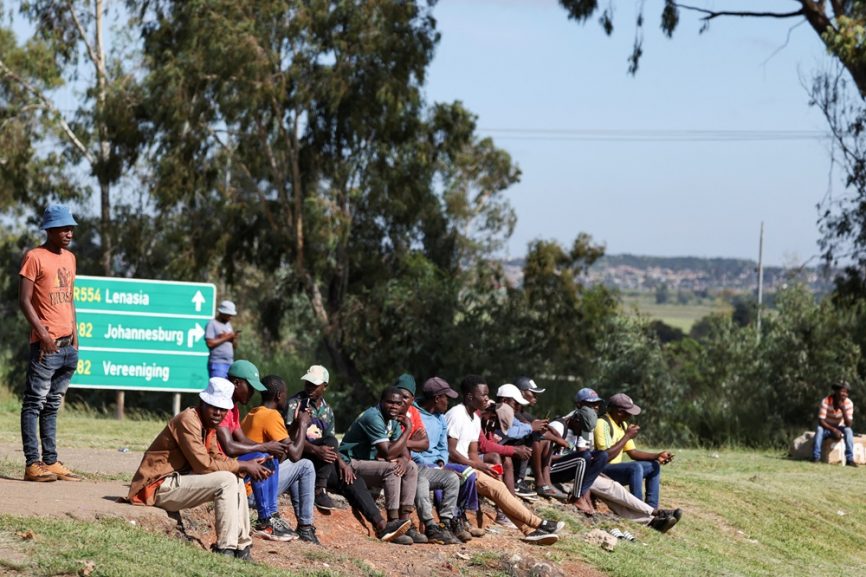
Job seekers wait beside a road for casual work offered by passing motorists in Eikenhof, south of Johannesburg, South Africa, February 26, 2025.
Image Credits :Reuters
The Congress of South African Trade Unions (Cosatu) says the country’s unemployment rate is alarming. The labour federation was reacting to the latest Quarterly Labour Force Survey, which shows the official unemployment rate has risen to 33.6%.
Data indicates that an additional 345 000 persons are unemployed.
Cosatu’s Parliamentary Coordinator Matthew Parks says these figures are more than just statistics and its only getting worse.
“It’s a crisis and I think for far too long, we’ve allowed ourselves to normalize it. We have a crisis of 43% unemployment. It’s been increasing continuously for much of the past decade. And in fact, it’s doubled since over the last 20 years. For young people, it’s even worse it’s over 62%.”
“So you have 12 million people who just can’t find work. About five million of them are young people. This creates a real crisis for them. We’re in danger of creating a permanent class of unemployed persons,” adds Parks.
VIDEO | Unemployment Rate | Unemployment crisis in SA continues:
Cosatu adds that although the increase in the unemployment rate is not unexpected, government should not normalise the crisis.
Parks says the decrease in those employed creates further strain for those who are working due to the amount of people depending on one source of income.
“It also creates a crisis for those 17 million people who do have jobs because the money, the very medial wages are stretched even further trying to support unemployed relatives. And to be fair, look, this is not unexpected, given the war in the Middle East, and in fact, the massive spike in international oil prices.”
“What we’ve seen in South Africa, fuel prices skyrocketing with petrol up by 25%, diesel by 50%. But what we can’t continue to do is just to ignore this crisis,” explains Parks.
Audio file below is reporting more on the story:
Source: https://www.sabcnews.com/sabcnews/cosatu-describes-sas-unemployment-rate-as-alarming/