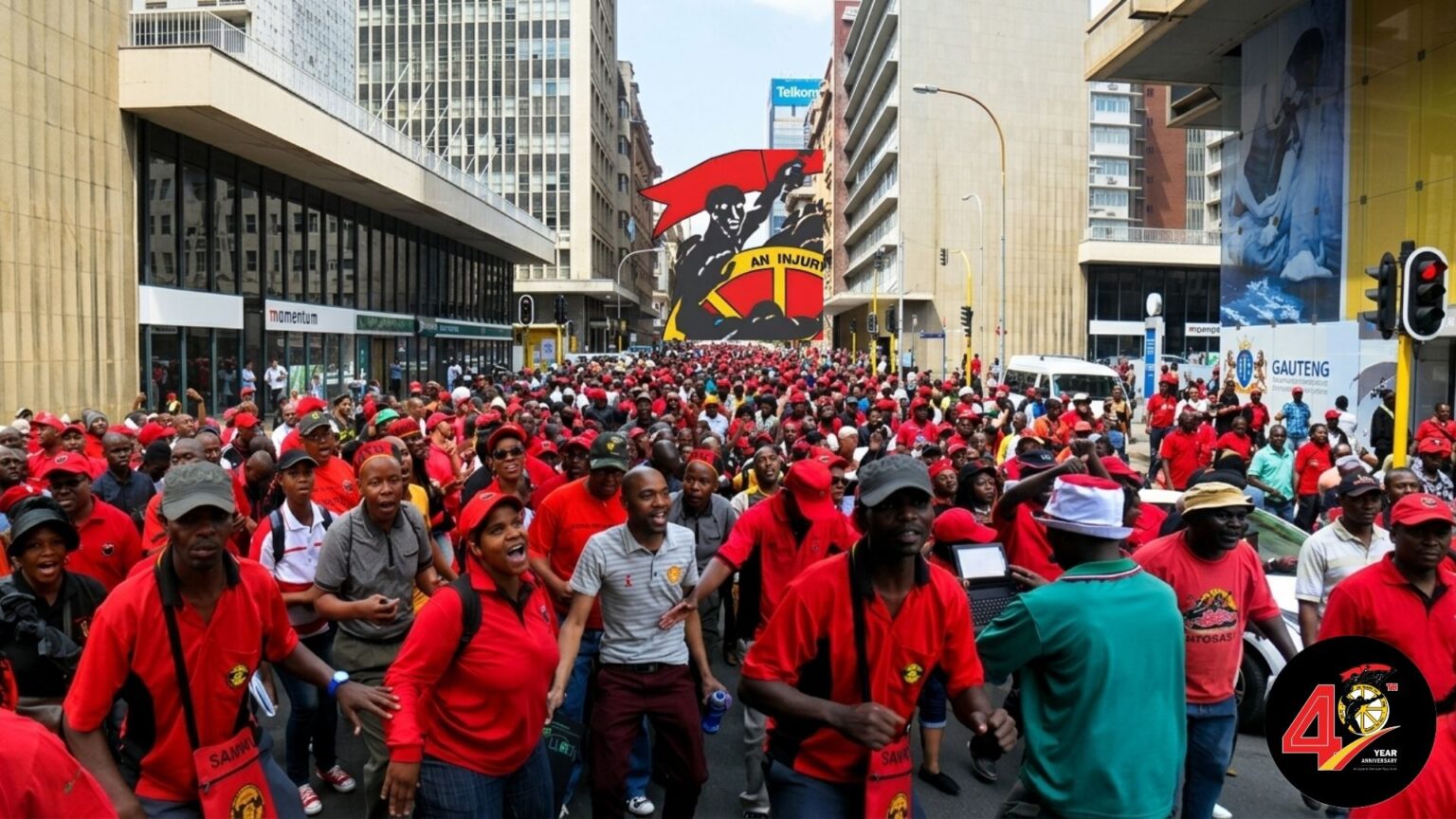
The number of employed South Africans fell to 16.8 million, while the number of unemployed people rose to 8.1 million. Youth unemployment climbed to an alarming 45.8%, with nearly 4.7 million young South Africans unable to find work. Image: Henk Kruger/Independent Newspapers
South Africa’s unemployment crisis worsened sharply in the first quarter of 2026, exposing deep structural weaknesses in an economy that continues to struggle to generate enough growth, investment and business confidence to absorb millions of job seekers.
The latest Quarterly Labour Force Survey released by Statistics South Africa showed the official unemployment rate climbed to 32.7% in the first three months of the year from 31.4% in the previous quarter after the economy shed 345,000 jobs.
Economists said the latest figures highlight not only the country’s weak economic growth trajectory, but also a labour market that is becoming increasingly exclusionary as more discouraged people abandon the search for work altogether.
KPMG lead economist Frank Blackmore said the sharp deterioration in employment reflects the intense pressure facing both households and businesses.
“This echoes the pressures that both consumers and businesses face: rising costs, high inflation, elevated interest rates, and, fundamentally, insufficient economic growth,” Blackmore said.
“We need to increase that growth, and to do so, we need to attract international investment and invest more ourselves, which will require, you know, a lot of different initiatives based on the policy space and attracting investment space, for us to get the type of growth rates we need to dent this unemployment seriously,” Blackmore said.
Nearly half a million people joined the working-age population over the past year, yet the economy lost 33,000 jobs during the same period.
Statistician-General Risenga Maluleke said the reason for this was the large number of school leavers who matriculated the previous quarter and could not, for some reason or the other, further their education at tertiary institutions.
The survey showed the number of people outside the labour force rose by 164,000 to 17.3 million during the quarter. This includes discouraged work seekers who no longer believe jobs are available.
North-West University Business School chief director, Prof. Joseph Sekhampu, said South Africa’s labour market is no longer defined only by unemployment, but increasingly by “withdrawal”.
“The issue is no longer only the scarcity of jobs, but the growing detachment of many South Africans from the expectation that sustained participation in the labour market will produce meaningful opportunity,” Sekhampu said.
“Withdrawal, in this context, reflects not a preference for inactivity, but a rational adaptation to persistently weak prospects of labour market entry,” he said.
The bleak employment picture comes as economic growth remains sluggish, with businesses battling weak consumer demand, high borrowing costs, electricity constraints, logistics bottlenecks and global geopolitical risks.
Job losses were broad-based across the economy. Community and social services suffered the biggest decline, shedding more than 206,000 jobs, while construction lost 110,000 jobs and transport employment declined by nearly 30,000.
Although manufacturing, mining and agriculture recorded modest gains, economists warned that these increases remain too small to materially change the overall employment outlook.
FNB and WesBank senior economist, Thanda Sithole, said unemployment could worsen further if global pressures intensify.
“Elevated levels of unemployment remain a critical challenge and could be exacerbated by the prevailing Middle East turmoil, which is likely to complicate consumption and production conditions as prices rise,” Sithole said.
Higher oil prices linked to geopolitical tensions are expected to place additional pressure on inflation, fuel costs and consumer spending, further weakening already fragile business conditions.
South Africa’s inability to create jobs consistently is also linked to low fixed investment and weak economic expansion.
The Congress of South African Trade Unions (Cosatu) said it will be tabling formal proposals on a stimulus package mobilising every possible public and private financial resource to Nedlac and Parliament.
“We cannot continue to normalise 1% economic growth and dangerously high levels of unemployment, poverty and inequality,” said Cosatu Parliamentary coordinator, Matthew Parks.
“The extent of this crisis requires a bold and aggressive stimulus package to kickstart the economy, rebuild public and municipal services, make capital affordable and accessible for SMMEs and industrial sectors, and extend relief for the unemployed by expanding public employment programmes.”
The Congress of South African Trade Unions (COSATU) vehemently rejects the blatantly unconstitutional composition of Parliament’s Impeachment Committee established to consider the Section 89 Report on President Cyril Ramaphosa.
Parliament as per the Constitutional Court directive has established a committee to consider the Section 89 Report. The Committee unlike other Parliamentary Committees must accommodate all 18 parties represented in the legislature.
Whilst COSATU appreciates Parliament’s desire to manage the number of Members of Parliament in the Committee, its decision on how parties will be represented on it is simply unconstitutional.
The Committee has been capped at 31 Members in an effort to include all 18 political parties, including those with negligible representation in Parliament. However, this has been done at the expense of the largest party in Parliament, the African National Congress (ANC), which in proportion to its representation is entitled to at least 12 Members or 40%, instead it has been allocated 9 or 30%.
This directly undermines the electorate which saw fit in the 2024 national elections to provide the ANC with 40% of the seats in Parliament. Any attempt to dilute the will of the electorate in the composition of Parliamentary Committees not only undermines its own rules but is in direct conflict with the Constitutional requirement of proportional representation in Parliament and its Committees. It is a shocking attempt to negate the will of the public and is ripe for legal challenge. It is rank political amateurishness at best, and constitutional vandalism at worst.
COSATU urges Parliament to avoid playing fast and loose with its constitutional obligations, lest it be hauled before court once again. The Impeachment Committee must reflect the outcomes of the 2024 elections and the representation of various parties in Parliament, this includes the 40% representation the ANC is legally entitled to. If this means the Committee must be enlarged, so be it.
If Ramaphosa leaves, there’s no obvious ANC contender to take his place. (123RF)
There is no obvious successor if Ramaphosa goes. Where are the young leaders? Is South Africa a cult?
You see the problem, don’t you? The problem is not that President Cyril Ramaphosa’s position is so precarious that every hit he takes makes the collective hearts of business leaders — and South Africans who care — jump into their mouths.
It is that the source of South Africa’s rising confidence over the past six months has been built not around a core set of leaders, not around an organisation, but around one man.
Look around Ramaphosa and it’s very depressing. When Ramaphosa leaves, who does business work with and who do the parties to the GNU collaborate with? Where are the ambitious rising stars who can take over from him and inspire confidence?
The crisis triggered by last week’s Constitutional Court ruling that impeachment proceedings be launched following Ramaphosa’s Phala Phala scandal illustrates how poor the ANC and South Africa have been at succession planning.
The court ruling presents a conundrum for the DA and others in the GNU: can they work with Paul Mashatile, Ramaphosa’s controversial deputy? Are the DA, the IFP, Rise Mzansi and the other parties in the GNU prepared to be led by such a man? If not him, then who?
It is worth saying upfront that at a policy level, I have never known Mashatile to spout populist sentiments. On almost every key issue — except the NHI, on which ANC leaders toe the party line — he has consistently stood by market-friendly and very sober positions.
But the man has attracted controversy.
His history as an MEC and premier in Gauteng is littered with stories of how “the Alex mafia” was built around him, and how it divvied up government contracts for cronies and frontmen. He has denied wrongdoing, but the whispers persist due to frequent flashes of his unexplained wealth.
Most concerning is Mashatile’s closeness to Jacob Zuma in the period between 2007 and 2017. He was front and centre in the “premier league” — the faction of four premiers of Gauteng, North West, Mpumalanga and Free State — who schemed with Cosatu and the SACP to sack Thabo Mbeki and bring Zuma to power. If, for the sake of power, Mashatile was prepared to look aside as Zuma and his cronies captured the state, what is he prepared to do now to be in power?
This is all to say the Ramaphosa crisis shows just how bare the ANC and South Africa’s leadership cupboard is.
One of the most shocking revelations of the past week came when DA leader Geordin Hill-Lewis told journalist Clement Manyathela that members of the business community and the ANC had called him throughout last weekend, asking that the DA vote not to impeach the president, even if the impeachment committee finds against Ramaphosa. To his credit, Hill-Lewis disagreed with them. Are we so desperate that we are prepared to trample on our constitution to protect a leader we happen to admire in many respects?
We are here now because the conduct of ANC politicians since the mid-2000s has made politics the arena of the corrupt and the disreputable. The best of our young people are not in the ANC Youth League, they are working hard at an accounting firm or trying to start a business in the townships. Enter politics? They will laugh you out of court if you make such a suggestion. Politics is where you go if you have an appetite for bribery and other types of corruption. Politics is where you go if you have no ethical or moral compass.
This is particularly painful given the selflessness of those who came before the current lot of sorry excuses we have for leaders.
Walter Sisulu, the longtime secretary-general of the ANC who recruited Nelson Mandela and propelled him into leadership, was a property investor. He gave it up to fight for a democratic South Africa. Mandela and Oliver Tambo were successful lawyers.
Now we are led by people who own multimillion-rand houses whose origins they cannot explain.
Whatever the next step may be for Ramaphosa and for South Africa, we need to have a conversation about the next layer of our leadership. We can’t have this intolerable situation where everything hangs on the fate of one man. That makes South Africa a cult. We need proper alternatives.
The union has outlined its plan of action, accusing the retailer of undermining collective bargaining processes. The retailer has proposed an overhaul of its store labour model through a retrenchment process.
The union has threatened to down tools, calling on management to halt retrenchments and return to the negotiating table.
The union’s Cyril Mbenza says the workers are weighing their options, with a threat to down tools.
“When talking to workers, workers are angry, and when talking to even the affiliate, I mean, to Cosatu, you can see that, I mean, the federation itself is not happy about this, and workers at large. Nationally, we are in talks about this. That is how far we’ve gone, and the feedback that we get from the workers is that we need to fight, and we will use all our might, everything we have to protect our rights and to protect, basically, those benefits that we fought for.”
WATCH | SACCAWU has rejected Pick n Pay’s proposed overhaul of its store labour model, warning that the retailer’s Section 189 process could push workers out despite assurances that no jobs will be cut. pic.twitter.com/vnz571aNO4
Cosatu has bemoaned the composition of Parliament’s impeachment committee investigating President Cyril Ramaphosa over the Phala Phala scandal, while the MK Party claims the process is biased in favour of the ANC.
Trade union federation Cosatu believes the composition of Parliament’s impeachment committee is unconstitutional.
The committee will consist of 31 MPs from 16 parties, with the ANC allocated a majority of nine members, while the DA has five, the MK Party three, and the EFF two.
The remaining 12 seats will be shared among smaller parties.
The directive establishing the committee was issued by the National Assembly Speaker, Thoko Didiza, under Section 89 of the Constitution.
This follows a Constitutional Court ruling, which revived the Section 89 inquiry into the alleged cover-up of the theft of a large amount of foreign currency at President Cyril Ramaphosa’s Limpopo farm in 2020.
The apex court ruled that the legislature acted unconstitutionally when it voted not to adopt the report and set up an impeachment committee.
It ordered Parliament to establish an impeachment committee for Ramaphosa to answer to prima facie evidence about foreign currency stolen from his Phala Phala farm.
Cosatu’s Matthew Parks says Parliament’s decision on how parties will be represented on the committee is unconstitutional.
ALSO READ: Roodt says rand resilient despite Ramaphosa impeachment process
He says the committee includes political parties with negligible representation in Parliament.
“ This has been done at the expense of the largest party in Parliament, the African National Congress, which, in proportion to its representation, is entitled to at least twelve members or 40%.
“Instead, it has been allocated nine or 30%. This directly undermines the electorate, which saw fit in the 2024 national elections to provide the ANC with 40% of the seats in Parliament.”
However, the MK Party, the official opposition in Parliament, told the SABC that it believes the committee is rigged in favour of the ANC and its government of national unity allies.
“We also do not want a repeat of what happened in 2022, where the ANC used its majority to protect Ramaphosa,” said the MK Party’s Visvin Reddy.
“I still don’t understand why ANC leaders want to protect this man. He’s a liability.”