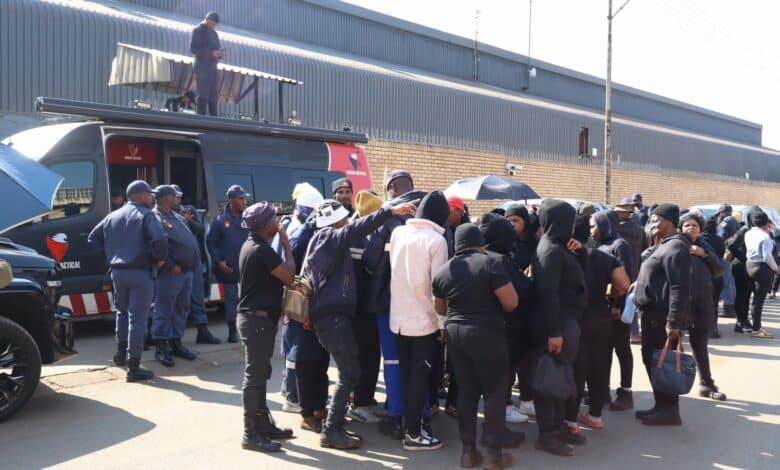
Employees gathered outside the entrance to Casa-Mia Biscuit Manufacturing, demanding improved working conditions and submitting a memorandum of demands to management.
Employees are demanding improved working conditions, alleging excessive working hours, inadequate benefits and unfair treatment by management.
Employees of Casa-Mia Biscuit Manufacturing staged a protest outside the company’s premises at 43 Jesmond Avenue, Nancefield, on Monday, July 13, alleging unfair labour practices.
When Soweto Urban arrived at the scene, workers were protesting peacefully outside the factory. However, a Vision Tactical security official alleged that some protesters had damaged the entrance gate.
The workers agreed to speak to the media on condition of anonymity, saying they feared victimisation.
One worker from Slovo Park, who said he has been employed by the company for more than two years, alleged that employees work 12-hour shifts from 6am to 6pm, seven days a week, with only a 30-minute lunch break and one 15-minute tea break.
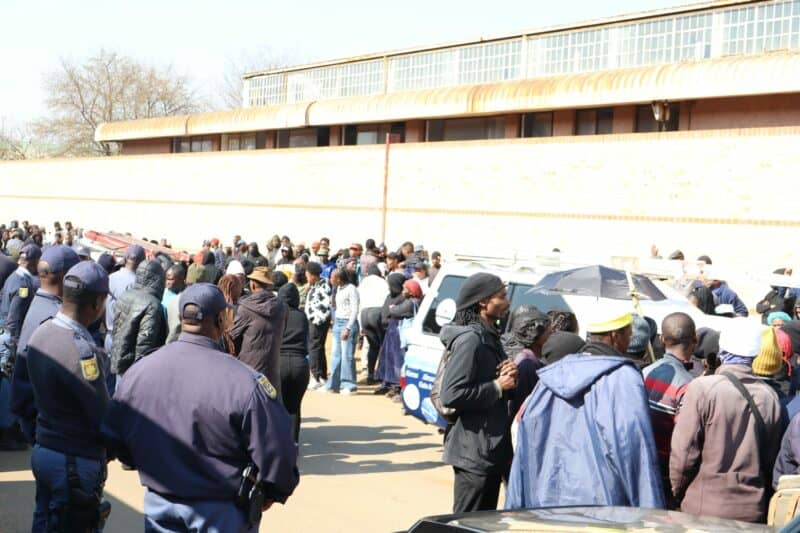
Police officers and private security personnel monitored the protest outside Casa-Mia Biscuit Manufacturing in Nancefield as workers demonstrated over alleged unfair labour practices.
He further alleged that their hourly rates are not stipulated in their employment contracts.
“The contract states that we will work 12 hours on weekdays. However, since I started, I have been working from Monday to Sunday without any rest days,” he said.
Another worker from Pimville alleged that employees are denied labour benefits they believe they are entitled to.
“We do not have UIF and a provident fund. We just work. I’ve been with the company for over a year. Our agreement was 12 hours from Monday to Friday, but we are forced to work on weekends as well.”
The same worker also alleged that South African employees had been dismissed and replaced with migrant workers because, according to him, they were less likely to complain about working conditions.
“They are treating us like we are foreigners.”
A group of workers told Soweto Urban they were demanding what they believe are fair labour practices.
“We want our lunch break increased to one hour and our tea break to 30 minutes. We want to know how much our hourly rate is. We stand on our feet for 12 hours and, on top of that, our supervisors mistreat us. We do not have employment contracts; we were made to sign only a job description form.”
The workers also alleged that they receive payslips only on request.
“It takes at least three weeks to get your payslip after requesting it. When you take that payslip to the bank or to apply for credit at a shop, they tell you it appears to be a draft and cannot be accepted.”
They further alleged that they are required to perform duties outside their job descriptions.
“We do not get paid our full amounts, there is no night shift allowance, and we do not have annual leave or sick leave. We are verbally suspended without receiving written warnings. UIF is deducted on our payslips; however, we believe we are not registered with the Department of Employment and Labour.”
Another worker alleged that they were dismissed after missing work to visit a clinic, despite submitting a doctor’s sick note.
The workers submitted a memorandum of demands, which was received and signed by Casa-Mia HR representative Poppy Ramosina.
Ramosina told the workers she would present the memorandum to management.
An increase in hourly wages or a minimum daily wage of R400, as well as a night shift allowance
Registration for UIF
Regular payslips
A review of working hours
Medical aid
Pension fund benefits
Rest days and paid leave
Permanent employment contracts
Personal protective equipment
Paid sick leave upon submission of a valid medical certificate
The workers said they would not return to work until they received a formal response to their demands.
They said they expected management’s response on Wednesday, July 15.
Soweto Urban attempted to obtain comment from Casa-Mia. However, security personnel denied the media access to the premises while Ramosina was escorted inside. Casa-Mia had not responded to Soweto Urban’s request for comment at the time of publication.
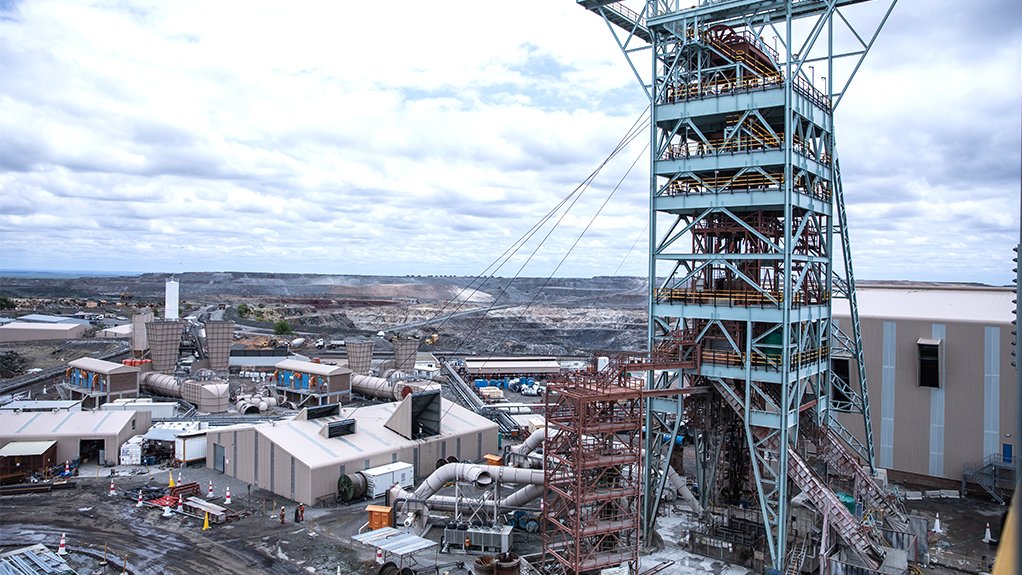
The NUM says this decision threatens the livelihoods of 1 134 permanent employees at the Ventia mine and a further 80 employees at DBSSSA.
The union says it is deeply disturbed by how the management at De Beers communicated this decision, adding that the company attempted to portray it as a sudden and unavoidable crisis when, NUM argues, the company had long been aware of the challenges facing the diamond industry.
“Workers cannot be treated as disposable tools that are discarded whenever companies face economic pressures. De Beers has known about the challenges confronting the diamond market for a long time.
“It is therefore disingenuous to present this announcement as a sudden crisis. Workers and their trade union should have been engaged honestly and transparently long before a Section 189A notice was issued,” says NUM national health and safety secretary and diamond sector chief negotiator Masibulele Naki.
He added that workers should not be the first to face wage cuts or layoffs, especially given that staff salaries are not the reason for the company’s financial struggles.
The NUM has demanded that De Beers and DBSSSA urgently consider viable alternatives such as retraining and skilling programmes, temporary job preservation measures, a reduction in non-essential expenditure and a comprehensive review of executive and management costs.
The NUM also calls on South Africa‘s departments of Mineral and Petroleum Resources and Employment and Labour, organised labour and all key stakeholders to intervene urgently to protect jobs at Venetia and DBSSSA.
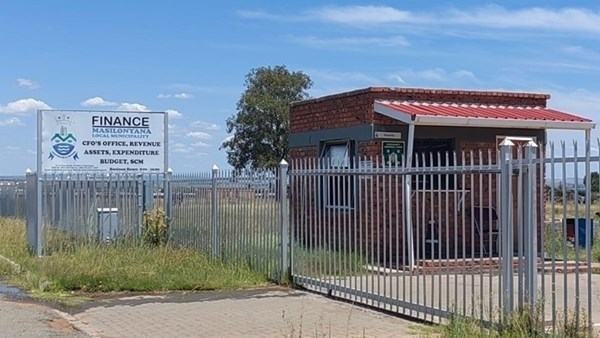
Masilonyana municipality was previously shutdown by angry residents of Theunissen. Photo supplied
Workers at the cash-strapped Masilonyana municiaplity in the Free Sate remain in financial distress after the municipality failed to pay salaries.
Masilonyana workers are still waiting for their June salaries after the National Treasury withheld the Theunissen-based municipality’s equitable share allocation.
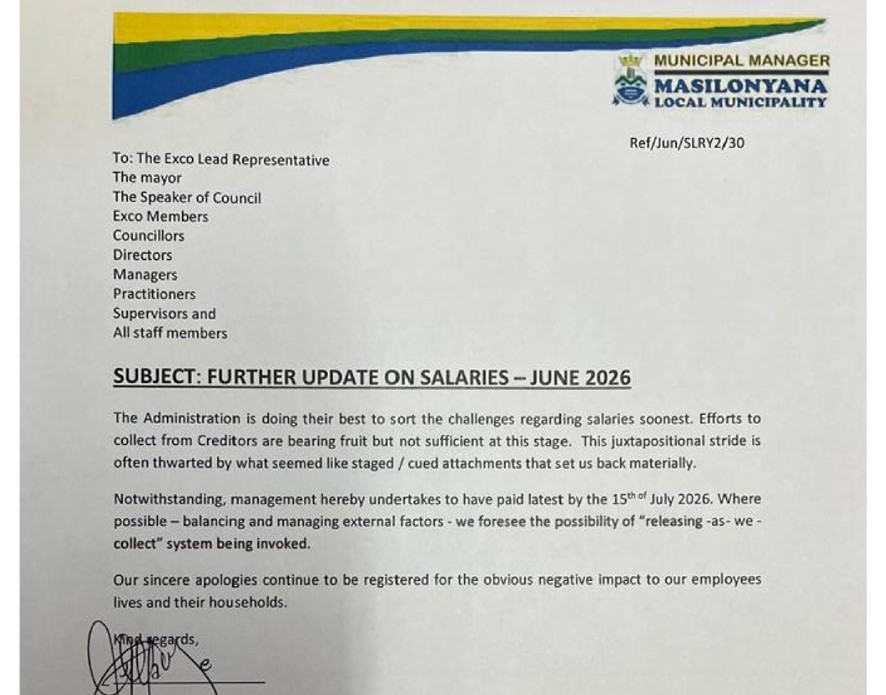
In a letter to employees, municipal manager Mojalefa Matlole acknowledged the delay and said the administration was trying to resolve the crisis. He told workers salaries would be paid by no later than Wednesday(15/7).
Where possible, the municipality may release payments earlier as revenue is collected.
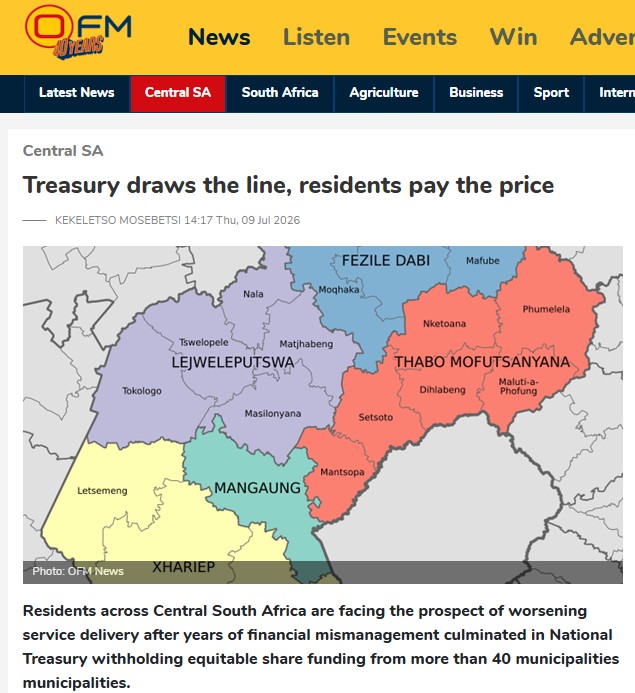
National Treasury decided to withhold equitable share funding from 69 municipalities for failing to comply with key provisions of the Municipal Finance Management Act.
In the Free State, the 13 affected municipalities include Mangaung, Mohokare, Xhariep, Masilonyana, Matjhabeng, Dihlabeng and Ngwathe. In North West, Madibeng, Ditsobotla, City of Matlosana, Maquassi Hills and JB Marks are among more than a dozen affected, while in the Northern Cape the list includes Kamiesberg, Khâi-Ma, Renosterberg, Siyathemba, Kai !Garib and Magareng.
Treasury said the decision followed months of engagement. The municipalities received written notices about their financial management failures and were given a chance to explain why their allocations should not be withheld.
Masilonyana has battled repeated salary delays in recent years. In 2023, workers were paid late in September, October and November.
At one point, employees received R1,000 food vouchers at a local supermarket after the municipality could not pay salaries.
The municipality’s finances have come under pressure because it spends about R15m a month on salaries while collecting only between R1.8m and R2m in monthly revenue. Its collection rate is estimated at only 20% of rates and taxes.
Financial mismanagement has also affected payments to creditors, including Sars and employee pension funds. Parliament’s standing committee on public accounts (Scopa) previously heard Masilonyana allegedly owes about R75m to third parties, despite deductions having been made from workers’ salaries.
The municipality’s bank accounts have also been attached several times, disrupting cash flow and delaying salaries. Service delivery has also suffered, with some communities reportedly facing long water and electricity outages.
During Scopa proceedings, EFF MP Ntombovuyo Veronica Mente-Nkunaquestioned whether Masilonyana was still functioning as a municipality, saying its salary bill and available cash showed it could not operate properly.
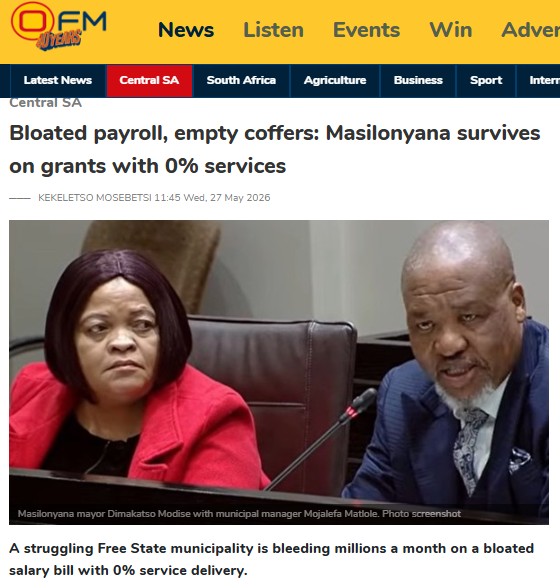
Mayor Dimakatso Modise previously admitted the municipality had been using equitable share funding, meant mainly for basic services, to pay salaries. Matlole told Scopa the municipality decides how to split the equitable share between salaries, Sars, pension funds, Eskom and other creditors whenever the allocation is received.
Masilonyana’s annual salary bill is about R168m, higher than its annual equitable share allocation of R157m. Former CFO Amos Makoae also told Scopa officials had allegedly bypassed the municipality’s financial system for years by processing transactions manually.
Makoae was later removed after the Free State High Court found his appointment unlawful.
OFM News/Kekeletso Mosebetsi dg
• Have a news tip to share? Phone or whatsapp the OFM News Hotline: 066 487 1427.
The company has also started Section 189 retrenchment proceedings, placing over a thousand workers at risk of job losses.
NUM says the move is a severe blow to employees, families and surrounding communities and that the company should have consulted workers earlier.
NUM National Health and Safety Secretary and Diamonds Sector Chief Negotiator, Masibulele Naki says, “It was deliberate for Venetia management not to communicate with the National Union of Mineworkers- which is the only majority union organising in the Venetia mine. Because in the past, from our last wage negotiations- we were aware of the situation that is facing the diamond industry- even in all of Africa.”
“That’s why the workers compromised at that particular time, that instead of signing some of the offers, we signed less- it was negotiated in those basis. Then we agreed on continuous engagement, and evaluation of the situation, but they decided to pause,” explains Naki.
Below is the full interview with NUM’s Masibulele Naki:
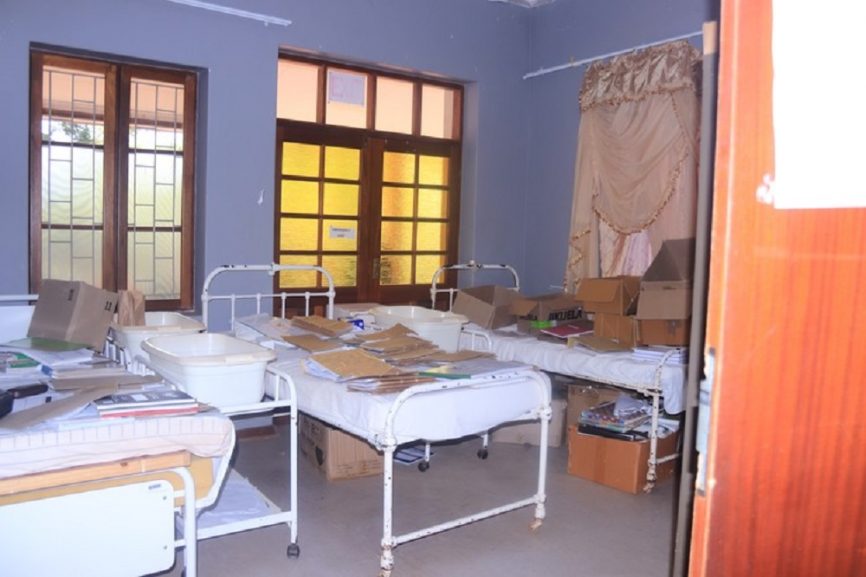
Patient beds are covered with boxes and files. Image Credits : Ground Up
The Democratic Nursing Organisation of South Africa (DENOSA) says the Health Ombud’s report has put some of the concerns it raised on the working conditions for workers in the public hospitals to rest.
The report, which looked into the deaths of several health care-workers in KwaZulu-Natal, found no evidence linking their deaths to workplace bullying, among others.
It has, however, uncovered persistent staff shortages, deteriorating infrastructure and poor workplace support.
DENOSA’s chairperson in KwaZulu-Natal, Sibonelo Gumede, says, “We are pleased from the report of the ombudsman that dealt specifically with the case of Mazwi, the doctor who died in Prince Mshiyeni. And the reports now, it makes it clear. We’re still studying the report, but the report makes it clear that the rumors that went about that he, as an employee, was denied coming back has been ruled (on) and set aside.”