Although more than 1.08-million households, or 5.3% of all households in South Africa, were victims of housebreaking in 2025/26, making it the most common household crime during the period, less than half reported the incidents to police because they believed they would not do anything about them.
Statistics South Africa’s latest annual governance, public safety and justice survey — published on Tuesday — is yet another indictment of the police service, which has been under the spotlight over the past year after witness testimony at the Madlanga commission and before an ad hoc parliamentary committee implicated several officers in corrupt and criminal activity.
The Stats SA report points to residents often opting not to open cases after falling prey to housebreaking, theft and street robbery, among other crimes in 2025/26, though reporting rates were significantly higher for serious crimes such as murder, sexual offences and car theft.
“The majority of households indicated the reason they did not report housebreaking incidents to the police was that the police would not do anything about it,” statistician-general Risenga Maluleke told a media briefing at the launch of the study.
“In the year under review, 24.4% indicated that the police would not do anything about it. About 21.8%, which is a decrease from the previous year of 25.1%, indicated that the police could not do anything, or there was a lack of proof.”
Stats SA also surveyed individuals on their experiences of crime, finding that while theft of personal property was the most common offence in 2025/2026, with 1.4-million incidents, only 37% of the victims reported some or all incidences to the police.
You cannot fight crime when police stations lack working vehicles, rape kits, body armour, regular training or secure cells, or when detectives are overwhelmed by the number of cases they are tasked to investigate.
— Cosatu parliamentary co-ordinator Matthew Parks
Reportings were, however, higher for hijacking at 77%, sexual offences at 67%, and other forms of assault at 55%.
“The other experiences of crime [reported] by individuals were below the 50% mark, those being street robbery, consumer fraud and theft of personal property,” Maluleke said.
The Stats SA report comes days after the latest quarterly police crime statistics on Friday showed that South Africa recorded 343 fewer murders in the first three months of the 2026/27 financial year, with the murder rate declining 5.9%.
Attempted murder cases, however, rose 8.7% to 6,958 during the quarter compared with the same period the previous year, while cases of assault with intent to inflict grievous bodily harm increased by 2.5% to 38,589, and common assault was up 2% to 42,491.
Carjacking declined by 18.2%, house robberies fell 17.6% and business robberies declined by 11.8% to 2,733.
On Tuesday, labour federation Cosatu said crime remains unacceptably high and called for additional support and resources for the SAPS, the National Prosecuting Authority, the judiciary and correctional services, in particular through hiring detectives, prosecutors, magistrates and other frontline personnel.
It also flagged the need for investment in skills and training, modern forensic laboratories and databases, state-of-the-art communications equipment, working vehicles and secure police stations, courts and prisons.
“You cannot fight crime when police stations lack working vehicles, rape kits, body armour, regular training or secure cells, or when detectives are overwhelmed by the number of cases they are tasked to investigate,” Cosatu parliamentary co-ordinator Matthew Parks said in a statement.
Zingiswa Losi is the president of Cosatu. Picture: File.
The Congress of South African Trade Unions (Cosatu) will soon be hosting its 15th national congress where workers from the clothing factories of Salt River to the mines of Thabazimbi, will reflect on the many dire challenges facing the working class and most importantly to adopt resolutions and campaigns the Federation must wage to defend workers’ hard-won rights and improve their working and living conditions.
Critics, usually ill-informed, are often quick to write off unions, yet fail to appreciate the many gains that workers enjoy today in South Africa are the product of generations of struggles led by the trade union movement, in particular Cosatu.
Cosatu and its affiliates’ roles are to defend workers at the workplace, to improve their working and living conditions, and because we are a progressive labour movement founded upon the principles of socialism, to drive society’s transformation.
A key component of the Congress is for Cosatu to report to its members on the strides it has achieved over the past four years, the challenges and the path ahead. Contrary to the ponderings of the army of armchair coaches, there is much Cosatu has achieved and much more still to be done.
We are proud that despite sluggish economic growth, our unions have been able to secure positive wage increases to protect workers’ wages from inflationary erosion and enable them to live a better life.
It was Cosatu that drove the Two Pot Pension Reforms, the single most important pension amendments in decades, that has released over R80 billion into the pockets of more than 4 million highly indebted workers whilst simultaneously boosting long-term savings with industry experts estimating that these reforms will double the number of workers able to retire in comfort.
We are now engaging Treasury on the next phase of pension reforms to ensure that workers, especially those who lose their jobs, are able to access greater relief and that we find ways of reducing the painful tax burden upon workers.
Over the past few years, Cosatu and its affiliates have intervened when strategic companies and sectors have been on the verge of collapse.
These interventions in partnership with affected businesses and farmers, and the African National Congress led administrations, have ranged from Edcon employing thousands of workers in the retail sector and many more along the clothing factories to more recently to stave off Tiger Brands’ previous planned closure of its canning operations in Ashton and currently to stop the intended shutdown of Premier Group’s canning factory in Tulbagh which would be an unprecedented economic catastrophe for that community.
Ahead of its 15th national congress, Cosatu president Zingiswa Losi outlines the federation’s claimed achievements on wages, pensions, jobs and social protection, while acknowledging South Africa’s continuing unemployment, poverty and inequality. Picture: File
Some critics lament that Cosatu is merely concerned with the immediate interests of its members yet it was the Federation who first proposed in 2019 and drove the R253 billion debt relief package for Eskom to enable it to focus on maintenance and infrastructure investments as the fastest way to end the loadshedding crisis that threatened to collapse the economy.
Today South Africa has not only ended loadshedding but soon will close the chapter on load reduction. Cosatu today is working closely with Eskom and industry to provide relief for smelters suffocated by the high levels of electricity tariffs, the next key step to unlocking badly needed economic growth.
It was Cosatu that drove with the support of the ANC in Parliament, the overhauling of the Public Investment Corporation Act to put in place critical transparency, accountability and investment guidelines to protect workers and pensioners’ hard earned money and to ensure that the largest investment fund in the continent, is utilised to grow the economy and create jobs, and not feather the nests of a corrupt few.
Cosatu with the active support of then Deputy President Cyril Ramaphosa, helped put in place the National Minimum Wage Act in 2019. Over the past few years, we have been able to ensure that it has increased the wages of 1 million domestic workers, 1 million farm workers and another 4 million workers in our hospitality, construction, security, transport and other sectors by 100%, 66% and 50% respectively. Our challenge now is to ramp up compliance by all employers.
The past term saw the conclusion of efforts to manage and overcome the global pandemic, COVID-19. Cosatu, working closely with government and business, helped oversee one of the world’s most successful health and safety and economic and social relief packages, saving millions of lives and livelihoods.
This social compact saw over R65 billion released from the Unemployment Insurance Fund to help 5.7 million workers in the private sector take care of their families. It saw the introduction of the SRD Grant that today helps 8 million destitute South Africans feed their families and lays the foundation for a Basic Income Grant.
The Federation has similarly worked closely with government and business to ensure that South Africa remains a member of the African Growth and Opportunities Act and that the Act itself is extended as it has helped create thousands of jobs across our manufacturing and agricultural sectors.
Similarly, we are engaging at Nedlac on the roll out of the African Continental Free Trade Area as this is key to turning Africa around and to protecting and nurturing local jobs and industries.
We continue to work closely with government to lay the foundations for the National Health Insurance as the most effective path towards achieving universal healthcare.
In 2022 proposals to gut our labour laws and set back workers’ hard-won rights were tabled at Nedlac. Cosatu acted and not only ensured that these were stopped but in fact that workers’ rights will be strengthened and extended to vulnerable workers from our film industry to uber drivers.
We are proud of the progressive role that Cosatu has played over its 40 years. Important victories have been won that have immeasurably improved the lives of millions. However, much more remains to be done, in particular to tackle our unacceptably high unemployment, inequality, poverty, crime and corruption levels.
Cosatu will continue to lead these struggles.
Zingiswa Losi is the president of Cosatu.
** The views expressed do not necessarily reflect the views of the National Media Group.
More than 1.8 million social grant beneficiaries have migrated from SASSA gold cards to Postbank’s new black cards, with the bank reporting that more than 80% of its targeted migrations have been completed ahead of the 31 August deadline.
In a statement on Friday, Postbank said that the migration process was progressing smoothly, with no significant challenges reported.
The bank said beneficiaries who have already migrated were experiencing the ease and convenience of the new cards and benefiting from the card enhancements.
The accessibility of card replacement sites, particularly those located at retailers where beneficiaries regularly shop, has also been welcomed, Postbank said.
This has made it easier for beneficiaries, including those in rural areas, to access migration services as part of their normal shopping routines.
The bank said the transition had been carefully planned and supported by extensive operational preparations and a comprehensive public awareness campaign to ensure beneficiaries were informed about the changes and the importance of migrating within the stipulated period.
Postbank said provinces that had initially recorded lower migration numbers, including the Eastern Cape, Western Cape, KwaZulu-Natal and Gauteng, had increased their conversion volumes this week.
Social grant beneficiaries receiving child support grants, who are typically young and mobile mothers, account for up to 90% of beneficiaries who have not yet completed their migration to black cards.
Postbank Chief Commercial Officer Thami Cele said the bank’s migration plan remained on track.
“The Postbank’s established card migration plan remains on track and is being implemented as planned. We are encouraged by the latest visible strong response from beneficiaries and the progress we have made.
“As a state-owned bank, our priority is always to ensure that every social grant beneficiary makes a transition to the new cards and does not experience any inconvenience. We are particularly pleased that most of the elderly and disability grants category groups have completed their migrations, and we now urge all beneficiaries who have not yet migrated to take advantage of the remaining time and complete the process without further delay,” Cele said.
Extended operating hours
Postbank will extend the operating days of its card replacement sites to include Saturday and Sunday from 09H00.
Beneficiaries who have not yet migrated are encouraged to use the additional operating days to complete the process before the deadline.
However, Postbank said beneficiaries who miss the 31 August deadline will continue receiving their social grants, with their accounts remaining active after the deadline.
The bank will also keep its card replacement sites open after 31 August to assist beneficiaries who still need to migrate.
Postbank urged beneficiaries not to wait until after the deadline and to make use of the remaining time and extended weekend operating days.
The migration can be completed at Postbank sites located inside selected retailers, including Shoprite, Checkers, Usave, Pick n Pay, Boxer and Spar stores.
Beneficiaries can dial *120*355# from any cellphone to locate their nearest card migration site.
The migration process is free of charge and beneficiaries only need to present a valid ID or temporary ID. No forms are required.
Cards can be collected from any province, regardless of the province in which the beneficiary’s SASSA grant was approved.
The black cards work immediately upon issue, with no need for beneficiaries to visit a SASSA office.
Postbank also said any balance on a beneficiary’s gold card would automatically be reflected and remain accessible. For more information, beneficiaries can contact Postbank on 0800 5354 55. – SAnews.gov.za
The Congress of Trade Unions of South Africa (COSATU) has left the decision on whether to support the African National Congress (ANC) or the South African Communist Party (SACP) in the upcoming elections to its unions.
The trade union federation held its Central Executive Committee meeting ahead of its 15th National Congress next month.
The COSATU congress is tasked with electing a new leadership and coming up with resolutions on political developments that affect workers.
Cosatu President Zingiswa Losi says the alliance partners, the ANC and SACP, going into the local government elections separately must not serve to divide workers.
“On this question, we are not going to rush ourselves because our political parties that we are in alliance with have resolutions and they are going to elections. COSATU must be thorough first the unity of the workers must be sacrosanct, the unity of affiliates is important, so every union has a responsibility to canvass this discussion within itself and the unions, and we’ve set ourselves a path that takes us to the 15th national congress where this discussion will be on the congress debate floor.”
Cosatu says it can’t be business as usual in the country when workers continue to bear the brunt of unemployment, poverty, inequality, rising living costs and the deterioration of public services compounded by corruption.
Cosatu 1st deputy President Mike Shingange says they are also worried about migration developments in the country.
“It is because we’ve got fewer police in this country, because the policy of our state is that there was a few police, public servants, to be in every corner, to police. We only have 2 300 labour inspectors in this country, which means all the workplaces can’t be inspected by a labour inspector on a daily basis, because we don’t have enough labour…the border management changes that we have established, only operating at 25% capacity. So, it can’t police all the borders. The Home Affairs that is supposed to have more migration officers to inspect immigration, they are only at 40% capacity. So, that on its own, it’s a problem of our own government, not to have enough capacity to fight crime on this term of migration.”
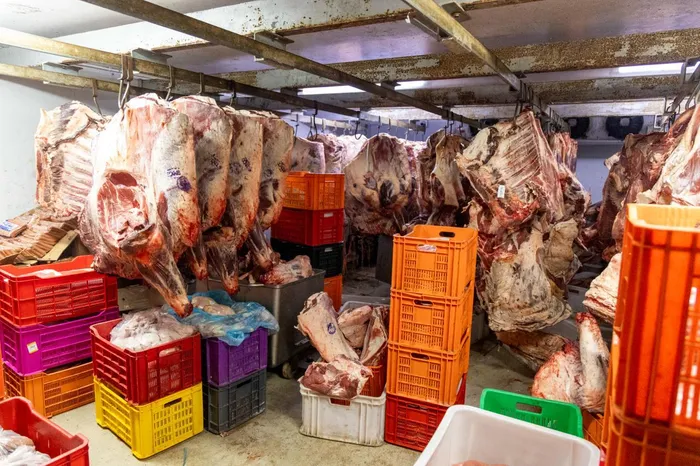
Meat products found improperly stored during the inspection at a Johannesburg CBD butchery. Image: Supplied
A Johannesburg inner-city butchery has been shut down after a joint government inspection uncovered a string of labour, health and safety violations, including workers being paid below the national minimum wage, unsafe working conditions and food safety concerns.
Employment and Labour Minister Nomakhosazana Meth, accompanied by Johannesburg Executive Mayor Dada Morero, led a multi-disciplinary compliance operation in the city centre on Friday as part of a broader government crackdown on businesses flouting labour laws and municipal by-laws.
The inspection team found serious contraventions at Siesta MTN Butchery, prompting labour inspectors to issue several prohibition notices under the Occupational Health and Safety Act.
Officials identified blocked walkways, exposed electrical distribution boards, inadequate changing facilities for workers and a lack of proper seating, with cashiers reportedly using crates while on duty.
Inspectors also found workers were being paid below the minimum wage and that the employer was not contributing to the Unemployment Insurance Fund (UIF), placing the business in breach of labour legislation.
The operation further uncovered health and safety concerns, including workers initially operating without the required personal protective equipment (PPE), meat products being defrosted on the floor and domestic animals, including cats, being kept inside the building.
As a result of the findings and additional breaches of environmental health regulations, the City of Johannesburg ordered the immediate closure of the butchery.
Speaking during the operation, Meth stressed that compliance with South African labour laws was non-negotiable.
“The laws of the Republic are not a nice-to-have. We all have the responsibility to comply with the law. We want businesses to continue operating and contribute to the economy, however they must comply with the laws of the Republic,” she said.
Meth said the department’s inspections were aimed at both enforcement and education, helping employers understand their legal obligations while protecting workers’ rights.
“Our approach is what we call a carrot and stick approach. We empower and educate businesses, identify areas where they need to improve and issue notices where necessary,” she said.
The inspection team also visited Boxer Superstore, where officials engaged management and workers while assessing compliance with labour legislation, including the Basic Conditions of Employment Act.
Addressing concerns about the employment of foreign nationals, Meth urged businesses to make greater use of South Africa’s available workforce, noting that the department maintains a database of more than seven million registered job seekers.
“We are saying to businesses, open up the space for South Africans. But we are not xenophobic. Foreign nationals who are legally in South Africa have the right to be employed. However, people who are in South Africa legally as visitors or students cannot simply take up employment without the necessary legal permission,” she said.
City officials also inspected whether businesses complied with building regulations and possessed approved building plans.
Morero said the city would continue targeting non-compliant businesses while assisting those willing to meet legal requirements.
“This joint operation with the Department of Employment and Labour is part of our ongoing commitment to reclaim and restore order in the Johannesburg inner city. We will not turn a blind eye to businesses that put workers’ safety and dignity at risk, or that operate outside the law,” he said.