SAFTU General Secretary Zwelinzim Vavi. Image: EWN
SAFTU said that migrants must not be scapegoated for failures they did not create.
Organised labour unions have formally rejected claims that foreign nationals are the cause of South Africa’s economic crisis.
The National Economic Development and Labour Council (NEDLAC), comprising Congress of South African Trade Unions (COSATU), Federation of Unions of South Africa (FEDUSA), South African Federation of Trade Unions (SAFTU), and National Council of Trade Unions (NACTU), briefed the media on Wednesday about the growing tensions around migration in South Africa.
This is after tensions heightened and more protests popped up across the country in the lead-up to the 30 June ultimatum issued by anti-migrant and vigilante groups, demanding all undocumented foreign nationals leave the country.
SAFTU argued that while there are legitimate grievances, systematic factors like corruption, deindustrialisation, and exploitative employers who hire undocumented migrants for cheap labour are to blame.
Secretary General Zwelinzima Vavi said that migrants must not be scapegoated for failures they did not create.
Listen to Organized labour pushes back as migrant blame intensifies amid economic strain. Click here.
Organised labour pushes back as migrant blame intensifies amid economic strain
“People have a right to be angry when they are facing the circumstances of today. Eighteen million people plus unemployed, 60% plus of the young people below the age of 25 are roaming the streets, losing hope, being sucked into antisocial behaviours.
“[But] the wrong people are being fingered. The anger is directed away… it should be directed to the employers who are exploiting the situation.”
Vavi highlighted the government’s failure to address the root causes of the crisis.
“Home Affairs has as low as 40% of the staff that it needs to effectively monitor our border and its migration policy. So, our people have a right to be angry about porous borders.
“Regrettably, it is not the migrant that has created these conditions. So, even if you were to effectively manage our borders, the reality is that the factories that have been closed will not reopen.”
Vavi emphasised that the unions are worried as the 30 June deadline looms closer.
“We are worried that there seems to be a coordination. There is money involved. These people have the money to transport people from hostels all over the republic.
“They have T-shirts to print, and more importantly, there is a political hand from the very same forces that generated the July 2021 unrest, who are now marching together,” he said.
JOHANNESBURG – There has been a positive reaction to the announcement of a rescue package aimed at saving sugar giant Tongaat Hulett.
The last-minute lifeline comes after business rescue practitioners confirmed a deal with the Industrial Development Corporation (IDC) and the Vision Group.
The Congress of South African Trade Unions (COSATU), which welcomed the announcement, said the move could result in more than 200,000 jobs along the value chain being saved.
In a statement on Wednesday, COSATU Parliamentary Coordinator Matthew Parks said the potential liquidation of the massive South African company and cornerstone of the KwaZulu-Natal and Mpumalanga economies would have been a blow the country simply could not afford.
“Whilst the details of the turnaround package announced by the Industrial Development Corporation (IDC) and Vision must still be broken down in full, this announcement gives hope and comfort to the 250,000 workers and their families, communities and SMMEs along the entire value chain,” he said.
Parks said it is critical that the turnaround plan be premised on saving all 250,000 jobs, especially as the country continues to battle a high unemployment rate.
The Portfolio Committee on Trade, Industry and Competition also welcomed the announcement.
The committee’s Media Officer, Faith Ndenze, said: “At a time when uncertainty threatened the future of Tongaat Hulett and the broader sugar industry, the IDC stepped forward to facilitate a solution that prioritises industrial capacity, economic stability and job preservation.”
COSATU says the deal protects an estimated 250,000 jobs across the sugar value chain and provides a path toward the company’s long-term recovery.
Tongaat Hulett / Image / hulettssugar.co.za
Cosatu says the potential liquidation of Tongaat Hulett would have been a major blow the country simply can’t afford.
The Durban High Court on Wednesday allowed the company to withdraw its liquidation application.
Rescue plan revived
The move follows an agreement between the Industrial Development Corporation and the Vision Consortium to implement the sugar producer’s business rescue plan.
The liquidation application was filed earlier this year after the rescue plan stalled due to funding challenges.
The IDC has also extended its funding facility to September next year, providing Tongaat Hulett with the liquidity needed to continue operating while the turnaround plan is rolled out.
Cosatu’s Matthew Parks says the agreement means around 250-thousand jobs across the sugar value chain have been saved.
“It is essential that the sugar master plan continues to ensure that the necessary supportive measures to nurture and sustain this important industry are in place, including protecting local growers and emerging farmers from cheap illegal imports.
“Cosatu looks forward to engaging with the IDC and Vision on its vision and plan for Tongaat Hulett and ensure that the needs of workers and their families and communities are placed at the heart of its restructuring and revival.”
Sugar industry relief
The SA Canegrowers Association has welcomed the development, saying it removes the immediate threat of liquidation.
Higgins Mdluli, the organisation’s chairperson says more than 17 500 sugarcane growers rely on Tongaat Hulett’s operations.
While SA Farmers Development Association’s Siyabonga Madlala says it marks a new chapter for the company, its employees and growers who supply its mills.
“We are very much excited to have been part of the difficult times and that we have stood firm and believed in the rescue of Tongaat Hulett. And finally, we believe we are now moving towards a sustainable future. We thank the IDC for their support until this far.”
Meanwhile, Parliament’s portfolio committee on Trade, Industry and Competition says the rescue of Tongaat Hulett must be accompanied by accountability for the events that led to the company’s collapse.
South Africa’s major labour federations have warned against rising xenophobic sentiments and attacks on migrants, insisting that foreign nationals should not be blamed for the country’s worsening economic challenges. In a joint statement issued through the National Economic Development and Labour Council (NEDLAC), the Congress of South African Trade Unions (COSATU), the Federation of Unions […]
The post Don’t blame migrants for economic crisis, SA labour unions warn anti-migrant groups appeared first on Tribune Online.
The ruling is likely to have broader implications for service station operators, convenience store franchises and bargaining councils, particularly where multiple businesses operate from the same premises but maintain separate operational structures. Image: Supplied
The Labour Court has overturned a bargaining council demarcation ruling that placed employees working at a Pick n Pay Express convenience store located on a BP service station property under the jurisdiction of the Motor Industry Bargaining Council (MIBCO), finding that the store operates as a separate business and is not an ancillary activity of the filling station.
In a judgment delivered on Monday, Judge Robert Lagrange ruled in favour of Merriman BP Service Station, setting aside an earlier arbitration award that had determined that employees at the convenience store fell within MIBCO’s registered scope.
Merriman BP Service Station operates both a BP-branded fuel station and a Pick n Pay Express store in Stellenbosch. While both businesses are owned by the same company and operate from the same premises, the employer argued that they function independently and should not be treated as a single operation for bargaining council purposes.
The ruling is likely to have broader implications for service station operators, convenience store franchises and bargaining councils, particularly where multiple businesses operate from the same premises but maintain separate operational structures.
The case centred on the interpretation of MIBCO’s scope of registration, particularly whether a convenience store operating on the premises of a fuel station could be regarded as an “ancillary activity” of the filling station and therefore subject to the bargaining council’s jurisdiction.
The Motor Industry Bargaining Council had previously maintained that the convenience store fell within its scope because it formed part of the service station environment. An arbitrator agreed with that interpretation in a 2020 demarcation ruling.
However, the Labour Court in Cape Town found that the arbitrator committed material errors in interpreting the relevant provisions governing MIBCO’s scope.
Judge Lagrange noted that the key question was whether the activities of the Pick n Pay Express store were genuinely ancillary to the service station business or whether they operated as a separate enterprise.
The court found that there was insufficient evidence to support the conclusion that the store formed part of the filling station’s operational activities.
“The lack of anything more than being on the same premises and owned by the same company, without evidence of any operational integration, is not enough to bring the Express store within the scope of the ancillary activity of the filling station,” the judgment stated.
The court emphasised that although the two businesses may benefit from being located together and share a customer base, that relationship alone does not make one an ancillary activity of the other.
Judge Lagrange said the evidence demonstrated that the fuel station and convenience store were operationally independent, each running its own business activities despite common ownership.
“The fact that they are complementary to each other does not mean the Express store is subsumed as an incidental or ancillary activity of the filling station business,” he said.
The judgment also criticised the arbitrator’s reasoning, describing the analysis as superficial and based on a flawed interpretation of the bargaining council’s scope provisions.
According to the court, the arbitrator incorrectly focused on whether the convenience store supported the filling station rather than determining whether the store’s activities actually formed part of the service station’s business operations.
Had the correct legal interpretation been applied, the court found that the arbitrator would have been compelled to conclude that the convenience store operated independently and therefore fell outside MIBCO’s jurisdiction.
Judge Lagrange noted that there may be circumstances where a convenience store can be considered an ancillary activity of a filling station, particularly where the operations are closely integrated. However, he found that such circumstances did not exist in the Merriman case.
Given that the court was in as good a position as the arbitrator to decide the matter based on the evidence presented, it elected not only to set aside the award but also to substitute it with its own ruling.
The court ordered that the November 2020 demarcation award be reviewed and set aside and replaced it with a finding that employees engaged in the Pick n Pay Express store do not fall within the scope of the Motor Industry Bargaining Council.
No order as to costs was made, with the court finding that both parties had a legitimate interest in obtaining legal certainty on the issue.
Legal Aid South Africa has suspended remote working arrangements, cancelled leave and ordered non-striking employees back to offices as it prepares for potential disruption from industrial action by members of the South African Legal Workers Union (SALAWU). Image: Nomonde Zondi
Legal Aid South Africa has suspended remote working arrangements, cancelled leave and ordered non-striking employees back to offices as it prepares for potential disruption from industrial action by members of the South African Legal Workers Union (SALAWU).
Documents in IOL’s possession show the organisation has activated a wide-ranging contingency plan that includes additional attendance monitoring, the suspension of flexible work arrangements and the revocation of some previously approved leave.
The measures come as SALAWU has said there will be protected strike action, which will take place on 17 and 18 June. The strike follows months of failed attempts to resolve disputes through the Commission for Conciliation, Mediation and Arbitration.
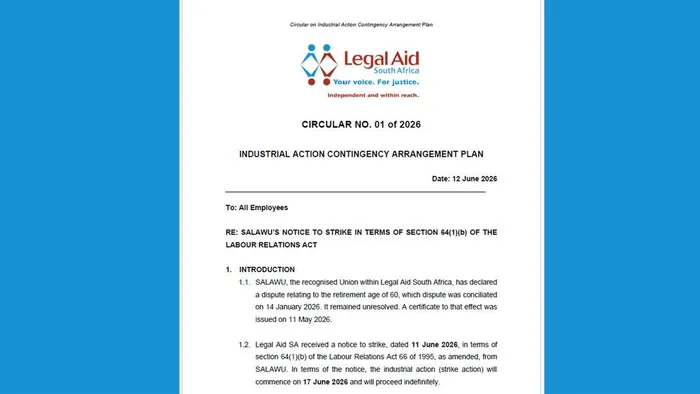
While the union has publicly described the action as a two-day strike, an internal contingency circular signed by chief executive officer Mantiti Kola states that industrial action will commence on 17 June and “will proceed indefinitely”.
Legal Aid South Africa provides legal representation and legal services to people who cannot afford private legal assistance, including in criminal, civil and land matters.
Disruptive action
The circular further warns that the strike “has the potential to disrupt Legal Aid SA’s delivery of services to clients and other stakeholders”.
The industrial action stems from a dispute over Legal Aid South Africa’s retirement policy. SALAWU has argued that employees are being forced to retire at 60 instead of 65 and has broadened its grievances to include staffing levels, workloads, salary benchmarking, employee benefits and morale.
Legal Aid South Africa, however, sought to reassure clients and stakeholders that services would continue. In a statement issued ahead of the strike, the organisation said it had activated business continuity measures.
“While Legal Aid SA anticipates that some employees may participate in the industrial action, the organisation has activated appropriate business continuity and service continuity measures to minimise disruption to services. These measures are intended to ensure that clients continue to receive legal assistance and representation,” it said.
IOL has a copy of a Legal Aid document indicating that strike action could go on indefinitely. Image: Legal Aid internal document
Respecting the constitution
Legal Aid South Africa added that it respected “the constitutional rights of employees to participate in this lawful and protected industrial action” while remaining committed to safeguarding access to justice for vulnerable and indigent people.
The organisation also officially acknowledged that SALAWU had “raised concerns relating to the retirement age provision contained in the organisation’s Terms and Conditions of Employment Policy”.
However, the contingency plan reveals the extent of preparations underway behind the scenes. Under the plan, employees who decide not to participate in the strike needed to have signed a non-participation register by 10am on 15 June.
“Any employee who fails to complete the non-participation register within the prescribed period will be considered to be participating in the industrial action,” the staff circular said.
In addition to the organisation’s existing biometric attendance system, non-striking employees will also be required to sign a manual attendance register three times a day. The circular states that employees must sign the register before or at 08:00, between 13:00 and 14:00 and again at or after 16:00.
You can’t be flexible
Flexible working arrangements have also been suspended.
“To ensure better co-ordination of the available resources in every office, the Flexible Work Arrangement Policy is suspended, effective Monday, 15 June 2026, until further notice,” the circular states.
Employees currently working from home due to office space constraints have been instructed to report to local, satellite or court-based offices. “The Head of Office/Provincial Executive should determine the office where the employee will report,” the contingency plan stated.
“In anticipation of staff resources being limited, no employee shall be allowed to take annual leave for the duration of the strike, unless exceptional circumstances exist that warrant the taking of annual leave,” the circular states.
Previously approved leave falling within the strike period has also been revoked unless alternative arrangements are approved by management.
Employees participating in the industrial action have further been instructed to return all files to their “line managers or delegated officials”.
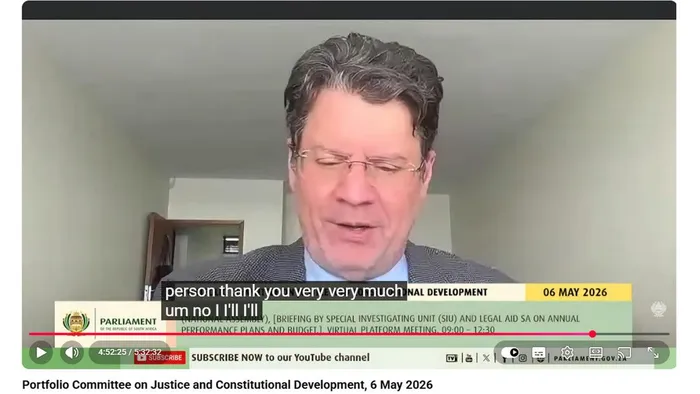
Andries Nel, deputy minister of Justice and Constitutional Development, during a Portfolio Committee on Justice and Constitutional Development 6 May 2026 meeting discussing Legal Aid. Image: YouTube screenshot
Staffing concerns
The contingency measures come against a backdrop of broader concerns about staffing and capacity within the organisation.
During a meeting of Parliament’s Portfolio Committee on Justice and Constitutional Development last month, Legal Aid South Africa warned lawmakers that budget constraints were affecting its ability to fill vacancies and maintain staffing levels.
The issue has featured prominently in SALAWU’s criticism of the organisation.
The union has argued that frozen vacancies have resulted in excessive workloads and chronic understaffing, while pointing out that other institutions within the justice cluster continue to fill positions.
It has also criticised delays in salary benchmarking, reductions in performance incentives and what it describes as a deterioration in employee benefits and morale.
Making staff poorer?
The retirement-age dispute remains at the centre of the industrial action.
According to SALAWU, employees expected the retirement age to revert to 65 and have argued that retirement at 60 places employees at a financial disadvantage by reducing future earnings and affecting retirement and medical benefits.
Five employees retired in January 2026, while a further 25 employees are expected to retire before the end of the current financial year.
Legal Aid has said the retirement age of 60 was formally approved by the board in 2018 and later approved by both the ministers of justice and finance in 2020, following consultation processes with employees.
Legal Aid’s website says it is a “top employer” for this year. Image: Legal Aid SA website
Constructive
Legal Aid South Africa said it would continue engaging with the union through established labour relations channels.
“The entity will carefully consider all matters formally presented in the memorandum and will engage constructively with the Union through the appropriate labour relations mechanisms,” it said.
The organisation added that its objective was “not simply to respond to disputes as they arise, but to continue building an environment where issues can be addressed constructively and in the best interests of both employees and the organisation”.
Legal Aid was offered an opportunity to comment on the additional information in IOL’s possession but had not done so by the time of writing.