

Legal Aid South Africa has suspended remote working arrangements, cancelled leave and ordered non-striking employees back to offices as it prepares for potential disruption from industrial action by members of the South African Legal Workers Union (SALAWU).
Image: Nomonde Zondi
Legal Aid South Africa has suspended remote working arrangements, cancelled leave and ordered non-striking employees back to offices as it prepares for potential disruption from industrial action by members of the South African Legal Workers Union (SALAWU).
Documents in IOL’s possession show the organisation has activated a wide-ranging contingency plan that includes additional attendance monitoring, the suspension of flexible work arrangements and the revocation of some previously approved leave.
The measures come as SALAWU has said there will be protected strike action, which will take place on 17 and 18 June. The strike follows months of failed attempts to resolve disputes through the Commission for Conciliation, Mediation and Arbitration.
While the union has publicly described the action as a two-day strike, an internal contingency circular signed by chief executive officer Mantiti Kola states that industrial action will commence on 17 June and “will proceed indefinitely”.
Legal Aid South Africa provides legal representation and legal services to people who cannot afford private legal assistance, including in criminal, civil and land matters.
Disruptive action
The circular further warns that the strike “has the potential to disrupt Legal Aid SA’s delivery of services to clients and other stakeholders”.
The industrial action stems from a dispute over Legal Aid South Africa’s retirement policy. SALAWU has argued that employees are being forced to retire at 60 instead of 65 and has broadened its grievances to include staffing levels, workloads, salary benchmarking, employee benefits and morale.
Legal Aid South Africa, however, sought to reassure clients and stakeholders that services would continue. In a statement issued ahead of the strike, the organisation said it had activated business continuity measures.
“While Legal Aid SA anticipates that some employees may participate in the industrial action, the organisation has activated appropriate business continuity and service continuity measures to minimise disruption to services. These measures are intended to ensure that clients continue to receive legal assistance and representation,” it said.
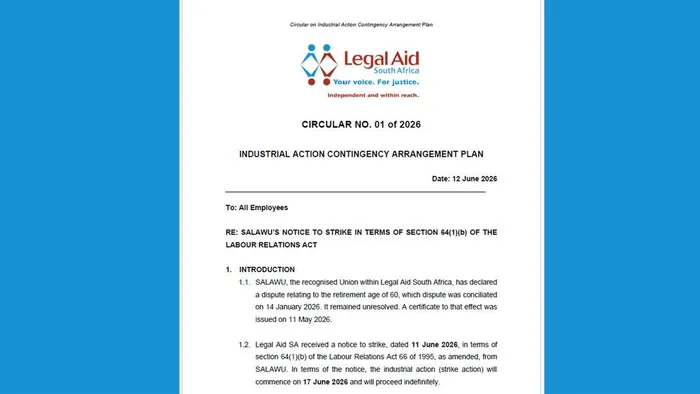
IOL has a copy of a Legal Aid document indicating that strike action could go on indefinitely. Image: Legal Aid internal document
Respecting the constitution
Legal Aid South Africa added that it respected “the constitutional rights of employees to participate in this lawful and protected industrial action” while remaining committed to safeguarding access to justice for vulnerable and indigent people.
The organisation also officially acknowledged that SALAWU had “raised concerns relating to the retirement age provision contained in the organisation’s Terms and Conditions of Employment Policy”.
However, the contingency plan reveals the extent of preparations underway behind the scenes. Under the plan, employees who decide not to participate in the strike needed to have signed a non-participation register by 10am on 15 June.
“Any employee who fails to complete the non-participation register within the prescribed period will be considered to be participating in the industrial action,” the staff circular said.
In addition to the organisation’s existing biometric attendance system, non-striking employees will also be required to sign a manual attendance register three times a day. The circular states that employees must sign the register before or at 08:00, between 13:00 and 14:00 and again at or after 16:00.
You can’t be flexible
Flexible working arrangements have also been suspended.
“To ensure better co-ordination of the available resources in every office, the Flexible Work Arrangement Policy is suspended, effective Monday, 15 June 2026, until further notice,” the circular states.
Employees currently working from home due to office space constraints have been instructed to report to local, satellite or court-based offices. “The Head of Office/Provincial Executive should determine the office where the employee will report,” the contingency plan stated.
The contingency measures also affect employee leave.
“In anticipation of staff resources being limited, no employee shall be allowed to take annual leave for the duration of the strike, unless exceptional circumstances exist that warrant the taking of annual leave,” the circular states.
Previously approved leave falling within the strike period has also been revoked unless alternative arrangements are approved by management.
Employees participating in the industrial action have further been instructed to return all files to their “line managers or delegated officials”.
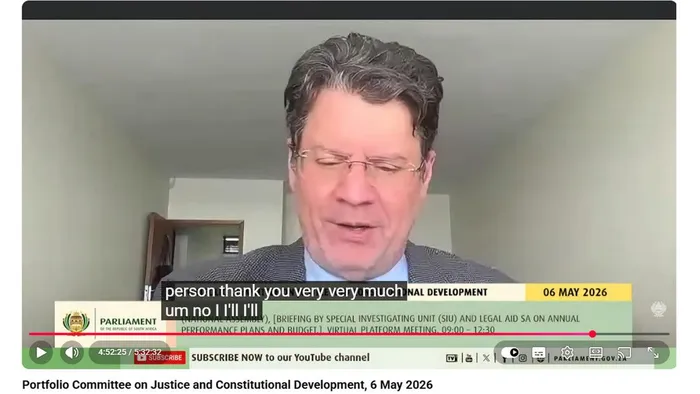
Andries Nel, deputy minister of Justice and Constitutional Development, during a Portfolio Committee on Justice and Constitutional Development 6 May 2026 meeting discussing Legal Aid. Image: YouTube screenshot
Staffing concerns
The contingency measures come against a backdrop of broader concerns about staffing and capacity within the organisation.
During a meeting of Parliament’s Portfolio Committee on Justice and Constitutional Development last month, Legal Aid South Africa warned lawmakers that budget constraints were affecting its ability to fill vacancies and maintain staffing levels.
The issue has featured prominently in SALAWU’s criticism of the organisation.
The union has argued that frozen vacancies have resulted in excessive workloads and chronic understaffing, while pointing out that other institutions within the justice cluster continue to fill positions.
It has also criticised delays in salary benchmarking, reductions in performance incentives and what it describes as a deterioration in employee benefits and morale.
Making staff poorer?
The retirement-age dispute remains at the centre of the industrial action.
According to SALAWU, employees expected the retirement age to revert to 65 and have argued that retirement at 60 places employees at a financial disadvantage by reducing future earnings and affecting retirement and medical benefits.
Five employees retired in January 2026, while a further 25 employees are expected to retire before the end of the current financial year.
Legal Aid has said the retirement age of 60 was formally approved by the board in 2018 and later approved by both the ministers of justice and finance in 2020, following consultation processes with employees.

Legal Aid’s website says it is a “top employer” for this year. Image: Legal Aid SA website
Constructive
Legal Aid South Africa said it would continue engaging with the union through established labour relations channels.
“The entity will carefully consider all matters formally presented in the memorandum and will engage constructively with the Union through the appropriate labour relations mechanisms,” it said.
The organisation added that its objective was “not simply to respond to disputes as they arise, but to continue building an environment where issues can be addressed constructively and in the best interests of both employees and the organisation”.
Legal Aid was offered an opportunity to comment on the additional information in IOL’s possession but had not done so by the time of writing.