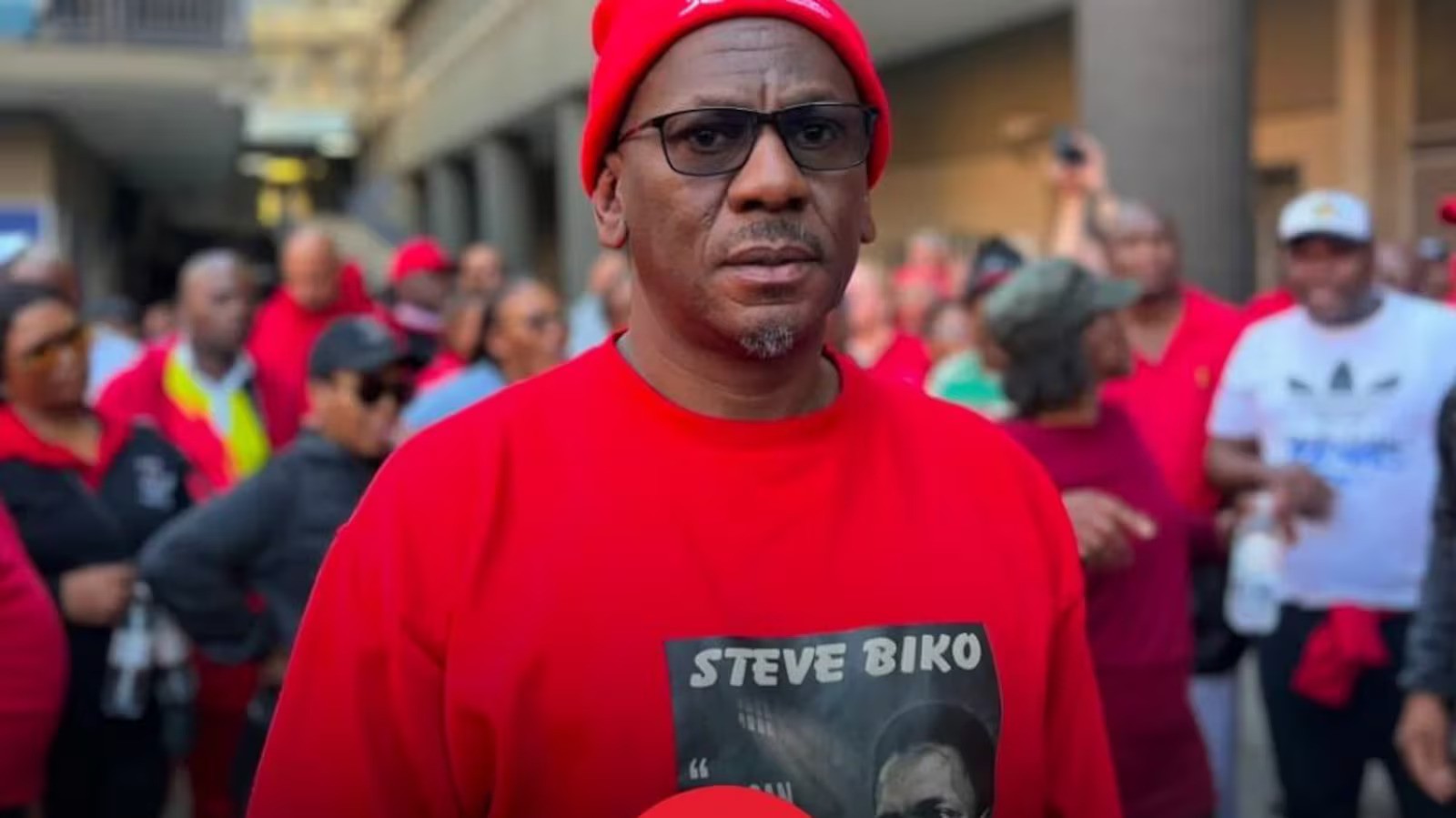
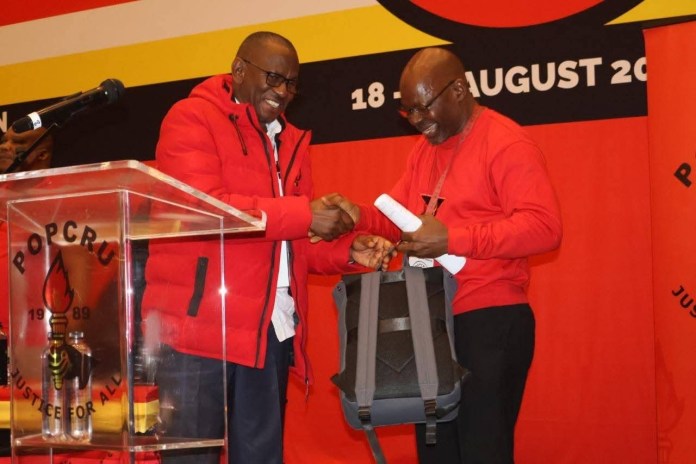
Popcru president Thulani Ngwenya and SACP general secretary Solly Mapaila at the Popcru CEC meeting in August 2026. / Popcru
Dive Deeper
The South African government, chiefly the National Treasury, has come under heavy attack for advancing budget cuts that are hollowing out the public service.
This was the common thread at the ongoing Police and Prisons Civil Rights Union (Popcru)’s central executive committee (CEC) meeting taking place at the Birchwood Hotel in Boksburg, east of Gauteng.
Speaker after speaker, including Popcru president Thulani Ngwenya, South African Communist Party (SACP) general secretary Solly Mapaila, and Congress of South African Trade Unions (Cosatu) president Zingiswa Losi were all singing from the same hymn book.
According to the three, the budget cuts in public service were a ruse to tilt the scales in favour of business, which was now getting into the space of providing services that historically were reserved only for the public sector.
A case in point is the provisions of identity documents and passports through some banking institutions, which meant fewer jobs for workers within the Department of Home Affairs.
According to statistics presented by Ngwenya, as a result of austerity measures, the number of prison wardens has almost halved in the past 16 years, from 40,000 in 2009 to 26,000 now, while the number of inmates continues to rise. This in a space where private players like security firm G4S having entered.
Driving the point further, Mapaila pointed to the South African Democratic Teachers Union (Sadtu)’s recent revelations that there were 27,000 outstanding posts within the basic education sector, which breeds fertile ground for more private schools to enter the space.
Ngwenya said time for tiptoeing around the issue of the negative impact of budget cuts was over as it was time to face who they perceive as an enemy in this regard – National Treasury.
Ngwenya said:
“Our enemy as workers is National Treasury. Your ammunition and AK47s must be directed to the National Treasury, not wrong places. National Treasury is busy implementing neoliberal policies that are against the working class.”
“What makes matters worse is that the minister at National Treasury is a worker (former Numsa general secretary Enoch Godongwana). He is one of the people who were teaching us about how bad GEAR was. Today he is one of those telling us that we do not understand”, he continued.
“When there are budget cuts and critical posts are left vacant, those are policy choices which should never be blamed on “lazy” public servants. Some functions are outsourced that could be performed by the state.”
Ngwenya said the “policy choices” of the government of the day to centralise its strategy on budget cuts should never be a burden of public servants who automatically become overworked.
Mapaila accused the ANC-led government of making it their “policy choice” to embark on austerity way before the birth of the government of national unity in which known liberal parties also have a stake.
According to Mapaila, the policy choice of the ANC to pursue neoliberal decisions, including budget cuts, had led to, among other anomalies, understaffed police stations, broken police vehicles, overcrowded prisons, collapsing infrastructure and public service centres carrying impossible loads.
“These are outcomes of budget cuts – austerity imposed by a capitalist government. The weakening of the state is not neutral; it is a capitalist project that shifts its crisis on to the workers and the poor,” said Mapaila. He added that the government was demanding workers to do more, with less, while growth is being witnessed in the same areas in the private sector.
Losi hammered the final nail in the budget cuts’ coffin when he said South Africa can kiss building a developmental state goodbye if austerity measures are the order of the day.
“The ultimate end is that the state itself, its capacity, becomes weak. And therefore, comrades, a developmental state cannot be built through austerity. A capable state cannot be built by continuously reducing its capacity,” she said.
“That is why Cosatu said we need a developmental budget, a people’s budget – that invests in people, that invests in infrastructure and that invests in industrialisation and the frontline public services.
Summary
The South African government, led by the National Treasury, is being criticized for budget cuts that are weakening the public service, according to Popcru and allied unions at a meeting in Boksburg.
Budget cuts have resulted in a significant reduction of prison wardens from 40,000 in 2009 to 26,000 currently, despite rising inmate numbers, and have opened space for private firms like G4S.
The Department of Home Affairs is outsourcing services such as identity documents and passports to banks, leading to fewer jobs in the public sector.
The South African Democratic Teachers Union revealed 27,000 outstanding posts in basic education, which is encouraging growth of private schools.
Cosatu president Zingiswa Losi stated that austerity measures undercut building a developmental state because they weaken the state’s capacity by continuously reducing its resources.
The Police and Prisons Civil Rights Union (POPCRU) has threatened to down tools at prisons countrywide if the Department of Correctional Services fails to provide concrete answers to its long-standing grievances.
The union is demanding progress on several issues, including staff shortages and shift patterns, promotions, and the absorption of former G4S workers into the department.
POPCRU has given the department until Friday to provide answers.
The dispute comes as pressure continues to mount on South Africa’s correctional system.
The department has acknowledged severe overcrowding, reporting 166,924 inmates against 107,346 available bed spaces at the end of December 2024.
This is equivalent to 56% overcrowding.
In May 2026, Correctional Services Minister Pieter Groenewald said overcrowding had risen to 58%.
POPCRU spokesperson Richard Mamabolo said correctional officers are also being placed at risk by inconsistent shift patterns and declining staff numbers.
“Our members keep on dying. Our members’ conditions of living keep on declining, and of course, most of them have not been promoted for a long time.”
The union staged a sit-in at the department’s head offices in Pretoria on Wednesday and is now waiting for the department’s response.
Mamabolo warned that if those demands are not met, the union could escalate the dispute.
“If it means going out to ensure that all regions, all institutions are affected, that is exactly what we will do,” he said.
The G4S dispute is also among the union’s key concerns.
The department took over the Mangaung Correctional Centre after the 25-year public-private partnership ended, with the Labour Court ordering the absorption of affected workers.
However, the department has raised concerns about the resources needed to employ them.
Mamabolo rejected that argument, saying the government previously spent substantial amounts running the facility under the public-private partnership.
“There’s no way they can say that they don’t have resources to fund these workers,” he said.
“We would not in any way be relevant to a union that would let workers lose their jobs on the basis that some entity has been changed or ownership of an entity has been changed, and of course, it’s a government mandate from the constitution, which the DCS is supposed to avoid.”
POPCRU president Thulani Ngwenya speaks about the union’s sit-in as members sing and rally outside the Department of Correctional Services headquarters in Pretoria.
The union has criticised duplicated policing functions and called for greater involvement of frontline officers in decision-making.
Popcru says a leaner police headquarters could free up resources and strengthen crime-fighting efforts at station level. Picture: Gallo Images/Frennie Shivambu
Thulani Ngwenya, president of the Police and Prisons Civil Rights Union (Popcru), is calling for the police head office to be trimmed and devolving policy implementation to police stations to enable effective policing to fight crime.
Addressing the union’s central executive committee meeting in Boksburg yesterday, Ngwenya said the police head office is too top-heavy and must be cut to a few individuals, not only to save costs but also to increase the number of boots on ground.
“We are calling for trimming the police head office. We are telling them, ‘there are too many of you’, ” said Ngwenya.
“The police must get out of the head office and fight crime in the streets. Those in uniform must gain their experience in the streets. The head office is top-heavy. We have been saying that and we are still saying it today. We don’t need people at the head office. What are they doing there?”
“The fewer the police at head office, the better. People deserve a safer South Africa and that is possible if the implementers are filtered down to the police stations.”
Ngwenya condemned duplication of activities within the SA Police Service (Saps), with many policing investigative units performing the same tasks, which caused tension and infighting among members.
“We are saying as Popcru nothing about us without us,” said Ngwenya.
Popcru is a Cosatu affiliate and the oldest police union, founded by Lieutenant Gregory Rockman on 5 November, 1989.
At the time, Rockman came under heavy attack by the apartheid authorities for introducing trade unionism among members of what was known as SAP.
A call to challenge the status quo
Ngwenya paid tribute to the role played by 1976 youth and women who fought against pass laws in 1956.
He said if the youth and women of the time were steadfast in opposing apartheid policies, nothing should prevent the women and youth of today from emulating them in challenging the status quo.
He condemned the killing of police officers and urged the youth to participate in efforts to stop the carnage.
The youth must reject the glorification of criminals who are given fancy nicknames and treated as heroes for their crimes and killing police, added Ngwenya.
He asked what the ANC Youth League and Young Communist League, a youth wing of the SACP, were doing to challenge the status quo, as the 1976 generation had.
“What more must happen before the youth take a firm stand against violence targeting the police?” Ngwenya asked.
He said the Southern African Development Community, which met in Durban recently, must stop meeting and making decisions about workers without their input.
“No decision must be taken about us without us,” Ngwenya said, adding the Zambian government is in the process of implementing a South African-style two-pot system and austerity measures that are detrimental to workers’ interests.
Striking PIKITUP casual workers have confirmed that they have called off their protest action at waste depots, following the waste management company’s announcement on Thursday that collection services at all 12 depots had been restored.
WATCH | Johannesburg’s waste management entity, Pikitup, has confirmed that the protest at its depots has ended. The entity says waste collection services have been restored across all 12 depots. For more news, visit https://t.co/N9V5BF4stZ. pic.twitter.com/F9X0mLYRsc
The protest disrupted waste collection in parts of Johannesburg with Randburg, Marlboro and Avalon among the most impacted.
The casual workers were demanding to be employed permanently among other demands.
PIKITUP casual worker representative Themba Magoda says, “The feedback from yesterday’s meeting between casual workers, Pikitup and COJ we have reached an agreement with PIKITUP. We agreed that there won’t be any protests happening in PIKITUP depots with casual workers and PIKITUP agreed they will carry on with the recruitments.”
Video | Pikitup Strike | Rubbish piling up across Johannesburg as Pikitup casual workers down tools
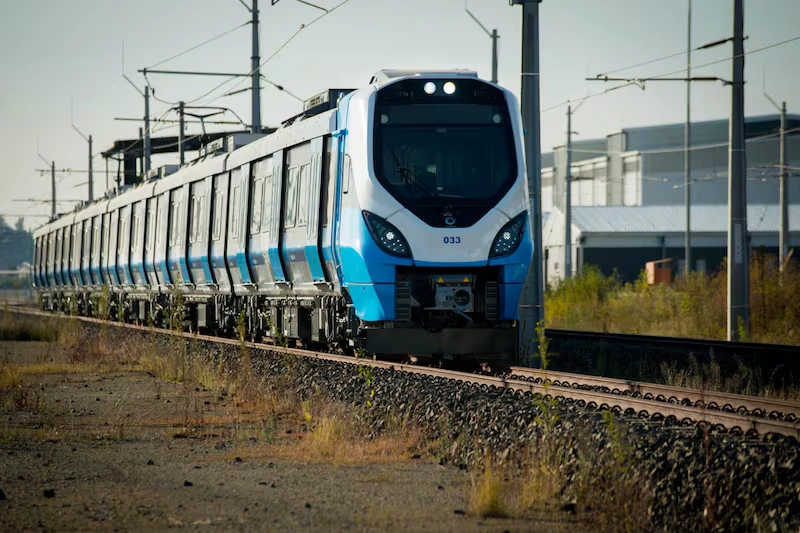
The Passenger Rail Agency of South Africa has found alternative work for 102 workers who were due to be retrenched, while 43 others have taken early retirement packages. (Picture: Prasa)
Story audio is generated using AI
The ministerial task team appointed by transport minister Barbara Creecy in June to explore alternatives to retrenchments affecting 580 workers at the Passenger Rail Agency of South Africa (Prasa) has resulted in 43 workers taking early retirement packages.
Another 102 staff have been matched and placed in vacancies across the rail operator’s departments and divisions.
Transport department national spokesperson Collen Msibi said 208 protection services employees had been “ring-fenced pending the conclusion of engagements with Transnet regarding the transfer of stations and related assets”.
A formal notice for the transfer of assets has been issued, “and the parties are working to conclude the process as soon as possible. The task team’s mandate has been extended until the end of August to explore alternatives to the remaining 227 employees”.
The United National Transport Union (Untu) and the South African Transport and Allied Workers Union (Satawu), the two largest unions at Prasa, had criticised the planned retrenchments which Prasda said was due to “severe financial and operational constraints” at its long-distance passenger rail operations.
Both unions have been approached for comment on the latest development but have yet to respond.
Sowetan’s sister newspaper Business Day reported last month that in a document sent to employees Prasa said certain rail corridors had remained inactive for extended periods, leaving employees unable to perform productive work while continuing to receive full remuneration.
“After exhausting all reasonable alternatives, retrenchment was adopted as a last resort,” Prasa said.
Business Day understands that the Shosholoza Meyl service has not been operating at full capacity as a result. Prasa was allocated R5.8bn in February as part of the government’s efforts to modernise the passenger rail operator’s fleet and improve commuter rail services.
The programme is intended to boost annual passenger trips from 77-million to between 250-million and 450-million over the medium term.
Finance minister Enoch Godongwana has said the special appropriation included R1.8bn earmarked for Prasa to help meet its contractual obligations under its agreement with Gibela. The rail transport consortium comprising Alstom and uBumbano Rail was established in 2013, as a ring-fenced company to execute Prasa’s rolling-stock fleet-renewal programme.
Labour union Untu recently provisionally withdrew its application to halt the retrenchment process from the labour court roll to give the task team time to explore alternatives to retrenchments.
Prasa, which has a track network of more than 2,280km, has been plagued by ageing infrastructure, vandalism, unreliability and ineffectiveness, fraud, corruption and safety concerns.
The entity launched a general overhaul programme in 2022 at a cost of R7.5bn, of which R3.48bn had been spent by the end of March 2025.
The overhaul was established to refurbish and extend the service life of Prasa’s legacy rolling stock fleet — the older Metrorail coaches and mainline passenger services locomotives that serve millions of commuters in South Africa’s metropolitan regions.

 The Police and Prisons Civil Rights Union (POPCRU) has threatened to down tools at prisons countrywide if the Department of Correctional Services fails to provide concrete answers to its long-standing grievances.