by Dev_SACCAWU | Labour Market News

The Congress of South African Trade Unions (Cosatu) has welcomed the appointment of a new board for the South African Post Office (SAPO), describing it as an important step towards rebuilding one of the country’s most recognisable public institutions.
The federation said the appointment answers long standing calls from Cosatu, its affiliate the Communications Workers’ Union (CWU), and SAPO employees for “fresh, competent and committed leadership” capable of steering the struggling entity back to stability.
According to Cosatu, years of weak leadership and the organisation’s inability to adapt to changing trends in the postal and communications sectors have left the Post Office on the brink of collapse.
“For far too long SAPO has been allowed to deteriorate to a state of near collapse,” the federation said.
“The absence of dedicated and fit for purpose leadership has been at the centre of this painful decline in addition to SAPO’s failing to keep pace with structural shifts in the postal and communications sectors.”
The trade union federation was particularly critical of the business rescue process that began in 2023, arguing that it had failed to produce meaningful results while placing a heavy burden on workers.
Cosatu said the tenure of the Business Rescue Practitioners had delivered “nothing to show beyond retrenching thousands of SAPO employees and plunging their families into absolute poverty and despair, closing hundreds of branches and thus further shrinking its customer base and potential to recover.”
It further criticised the fact that workers had gone years without inflation linked wage adjustments, while alleging that the practitioners had ensured “to pay themselves sumptuous fees.”
Recent warnings that SAPO could face liquidation have heightened concerns over the future of the state owned enterprise. Cosatu, however, said liquidation was not an option.
“Cosatu will never agree to the liquidation of SAPO. The only liquidation that must take place is that of the BRPs,” the federation said.
“It is time that the Department approached court to remove the BRPs and provide the Board with the necessary space and support to ensure SAPO is stabilised and set back upon the path to sustainability.”
The federation believes there is precedent for a successful recovery, pointing to the turnaround efforts underway at other state owned enterprises such as Transnet and Metrorail.
“The turnaround of other embattled state owned enterprises from Transnet to Metro Rail proves that they can be fixed and once again contribute to stimulating economic growth and creating jobs with competent management, the removal of criminal and corrupt elements, filling frontline vacancies and recruiting critical skills, and investing in the company’s infrastructure and capacity.”
Cosatu also highlighted legislative changes that it believes could provide SAPO with new revenue streams. The SAPO and Postbank Amendment Acts, passed by the sixth Parliament, allow the Post Office to expand into the lucrative courier market while positioning it as a one stop centre for public services.
At the same time, the legislation enables Postbank to develop into a fully licensed state bank focused on serving working class and rural communities that often struggle to access mainstream banking services.
“The SAPO and Postbank Amendment Acts passed by the 6th Parliament provide a turnaround plan for both institutions, by allowing SAPO to enter the highly lucrative courier business and to become a one stop shop for citizens to access public services and enabling the Postbank to become a fully licensed state bank aimed at working class and rural residents all too often redlined by the private banking sector,” Cosatu said.
Looking ahead, the federation said it would seek urgent engagements with the Ministry and Parliament’s Portfolio Committee on Communications and Digital Technologies to secure commitments around job protection, outstanding payments to workers and the implementation of a comprehensive recovery strategy.
“It is critical that Treasury provide the necessary financial support to enable such a turnaround to be implemented as a matter of the highest priority,” Cosatu said.
Source: https://africannewsagency.com/cosatu-backs-fresh-south-african-post-office-leadership-to-revive-struggling-entity
by Dev_SACCAWU | Labour Market News

Cosatu has welcomed the appointment of a board for the South African Post Office. (ALAN EASON)
Labour federation remains strongly opposed to plans to liquidate the SA Post Office
Labour federation Cosatu has welcomed the board appointment for the South African Post Office after three years in a yet-to-be-finalised business rescue process that has seen about 600 post offices closed.
Business Day reported in March that organised labour had rejected proposals by the business rescue practitioners to liquidate the troubled SA Post Office, saying the move would result in 5,700 workers losing their jobs and push nearly 100,000 dependants deeper into poverty.
Minister of communications & digital technologies Solly Malatsi was questioned by MPs and the rescue practitioners after a letter revealing plans to seek the SA Post Office’s liquidation was leaked.
This was after Haroon Laher of Fasken, the rescue practitioner tasked with the SA Post Office’s business rescue, wrote to Malatsi and his deputy Mondli Gungubele, saying liquidation would be the only way forward unless the government injected cash into the SA Post Office.
The business rescue process has cost R12.6m in rescue fees, R220.1m in consultants and specialists, and R27.9m in external advisory since the 2023/2024 financial year. In March the business rescue practitioners said an additional R3.8bn was needed to finish the rescue process.
In his budget vote in May, Malatstsi allocated R595m.
Last week, the government announced the appointment of the new board for the SA Post Office. Its members are Regina Sizakele Madlala (chair), Margarete Mosibudi Phiri (deputy chair), Vuyo Mafata, Tanya van Meelis, Mantombi Lekhuleni, Mthokozisi Daluxolo Xulu, Mduduzi Justice Kennedy Bophela, Charley Fred Chain, David Mangena and Khonanjalo Buthelezi.
Cosatu parliamentary co-ordinator Matthew Parks said: “For far too long the SA Post Office has been allowed to deteriorate to a state of near collapse. The absence of dedicated and fit-for-purpose leadership has been at the centre of this painful decline in addition to failing to keep pace with structural shifts in the postal and communications sectors.”
Parks said matters had been made worse by the “disastrous tenure of the business rescue practitioners” appointed through a court agreement with the creditors and the department of communications and digital technologies in 2023.
Parks said the business rescue practitioners had “nothing to show beyond retrenching thousands of SA Post Office employees and plunging their families into absolute poverty and despair, closing hundreds of branches and thus further shrinking its customer base and potential to recover”.
“Workers have been left for years without seeing their meagre wages being adjusted for inflation, yet the business rescue practitioners have made sure to pay themselves sumptuous fees. Recent rash threats by the business rescue practitioners to liquidate the SA Post Office have pointed to the urgent need for the appointment of a board that can take charge of the entity and put in place a viable path to recovery,” Parks said.
“Cosatu will never agree to the liquidation. The only liquidation that must take place is that of the business rescue practitioners. It is time that the department approached the courts to remove the business rescue practitioners and provide the board with the necessary space and support to ensure the SA Post Office is stabilised and set back upon the path to sustainability.”
Parks said the turnaround of other embattled state-owned enterprises, from Transnet to Metro Rail, “proves they can be fixed and again contribute to stimulating economic growth and creating jobs with competent management, the removal of criminal and corrupt elements, filling frontline vacancies and recruiting critical skills, and investing in the company’s infrastructure and capacity”.
“The SA Post Office and Postbank Amendment Acts passed by parliament provide a turnaround plan for both institutions by allowing the SA Post Office to enter the highly lucrative courier business and to become a one-stop shop for citizens to access public services and enabling the Postbank to become a fully licensed state bank aimed at working-class and rural residents all too often redlined by the private banking sector,” he said.
“Cosatu will seek urgent engagements with the ministry and parliament’s portfolio committee on communications and digital technologies to provide comfort to workers that their jobs will be secured, money paid and a turnaround plan put in place. It is critical that the National Treasury provide the necessary financial support to enable such a turnaround to be implemented as a matter of the highest priority.”
Source: https://www.businessday.co.za/news/2026-06-08-why-cosatu-is-backing-sa-post-office-board-appointment
by Dev_SACCAWU | Labour Market News

Razell Mohamed of Gqeberha will defend her South African female junior heavyweight title against Rita Mrwebi of Gauteng. (FACEBOOK/RAZELL MOHAMED)
Champ all set to square off against Gauteng challenger Rita Mrwebi this weekend
Gqeberha’s Razell Mohamed is raring to go in the second defence of her SA female junior heavyweight crown when she squares off against Gauteng challenger Rita Mrwebi this weekend.
This electrifying title bout headlines the triple-header Zibondiwe Ziyabila eGqeberha boxing event, brought to life by Zantsi’s Showtime Productions, the MBDA, and the NMBM, lighting up the Nelson Mandela Bay Stadium on Saturday.
Other fight headliners will see Walmer’s professional female boxer Nozipho Bell face Zimbabwean Chiedza Homakoma for the vacant WBF intercontinental junior welterweight championship.
Meanwhile, Knysna’s Mbuyiseli Ndukwaka will challenge KuGompo City’s Hlumelo Gingana for the vacant IBO Africa Lightweight title.
Mohamed’s last fight at home saw her successfully defend her SA cruiserweight title, beating Limpopo’s Rolen Mulebo by a unanimous points decision in August 2022.
The boxer, who is a schoolteacher at Ankervas Primary in Rocklands, first claimed the vacant title when she beat Lillian Molala of Mpumalanga in a 10-round matchup at the Fairview Sports Centre in Gqeberha.
She last stepped into the ring in August 2023 against IBF champion New Zealander Lani Daniels at the Eventfinda Stadium in Auckland, New Zealand.
That was an experience she enjoyed as it was against a quality opponent.
“Since then, I’ve continued to learn, grow and develop as a fighter,” Mohamed said.
“I’m looking forward to putting that growth on display on Saturday.
“Rita Mrwebi is a tough and experienced fighter who has earned her place in this fight.
“I respect what she brings to the ring, but my focus has been on making sure I’m the best version of myself on fight night.
“We’ve studied her, we’ve prepared properly, and I’m ready for whatever she brings.”
She said her main focus points at training had been conditioning, sharpness and ring discipline.
Mohamed said that after being out of the ring for some time, it was important to make sure she was in peak condition and able to maintain a high work rate from the first round to the last.
“We’ve also worked hard on fine-tuning the technical aspects of my boxing.
“I’m feeling very prepared. We’ve had a solid camp, and I’ve put in the work physically, mentally and technically.
“Everything has gone according to plan, and I’m excited to get back into the ring and showcase the improvements I’ve made. I’ve had to dig deep for this one.
“Defending my title is extremely important to me.
“Winning the South African Junior Heavyweight title was a proud moment in my career, but being a champion is about more than winning the belt—it’s about defending it and proving that you belong at the top.
“This title represents all the hard work, sacrifices and support I’ve received along the way, and I’m determined to do everything I can to keep it.
“I have more to prove this time.”
Other bouts include Siyamnekela Gqubule vs Lelethu Bolo (both from Gqeberha) in the mini-flyweight contest.
Lubabalo Soga (Kareiga) vs Siphosethu Madasi (Makhanda) junior bantamweight.
Sibusiso Moyakhe (Gqeberha) vs Siphesihle Mpohlweni (Makhanda) bantamweight, Libona Rali (Gqeberha) vs Ziviwe Ntobongwana (KuGompo City), and Yibanathi Magwa vs Milani George (both from Gqeberha) mini flyweight.
Tickets are available at Webtickets outlets, including Boxer, BP and Pick n Pay, as well as at the stadium ticket office, at R100 for adults and R50 for children under 12.
Entrance is from 5pm.
Source: https://www.dailydispatch.co.za/sport/2026-06-04-razell-mohamed-primed-to-defend-sa-crown
by Dev_SACCAWU | Labour Market News

The Congress of South African Trade Unions (COSATU) is counting down the days until 8 June, when the administrator of its Affiliate, the Chemical, Energy, Paper, Printing, Wood and Allied Workers Union (CEPPWAWU), Sipho Sono, will appear before court to explain why he should not be held in contempt.
In January this year, the Labour Court ordered the removal of Sono as administrator of CEPPWAWU and appointed Gerhard Vosloo to replace him. Vosloo’s term was meant to start on 1 March, but to COSATU and CEPPWAWU’s shock, Sono didn’t pack his stationery and walk off into the sunset, instead he appealed the ruling and continued as administrator.
In March the Labour Appeals Court affirmed the earlier ruling and ordered Sono to vacate his role as CEPPWAWU administrator. Still, Sono refused to leave.
Now the Labour Court has summoned him to appear before it on 8 June to explain the following:
- Why he mustn’t be held in contempt of court.
- Imprisoned or fined
- Vacate CEPPWAWU premises and return all union property
- Ordered to pay costs
Sono will finally meet his reckoning after he continuously disregarded the court’s rulings while not lifting a finger to deliver on his mandate as administrator. When he was appointed, Sono was expected to appoint a facilitator to convene the union’s provincial and National congresses as per constitution, finalise outstanding audited financial statements and vacate as administrator by 12 December 2023.
Shamefully, Sono has not delivered on any of these tasks and yet he insists on staying, all the while paying himself exorbitant fees. He is a stain on his profession.
Issued by COSATU
Zanele Sabela (COSATU Spokesperson)
Mobile: 079 287 5788 / 077 600 6639
Email: zaneles@cosatu.org.za
Source: https://mediadon.co.za/cosatu-welcomes-labour-court-contempt-proceedings-against-ceppwawu-administrator
by Dev_SACCAWU | Labour Market News
The politically driven anti-business agenda has led to catastrophic unemployment and stagnant economic growth

With ‘real’ unemployment of 43% and rising, a minimum wage is a luxury the country simply cannot afford, says Neasa’s Gerhard Papenfus.Picture: Antonio Muchave
Despite loud opposition to BEE, big business is complicit in it. This is killing SMMEs, driving unemployment to dangerously unsustainable levels and stifling economic growth, says Gerhard Papenfus, CEO of the National Employers’ Association of South Africa (Neasa).
“They’ve benefited hugely through it; they’re part of this game. If big business had said no to BEE, it wouldn’t have happened,” says Papenfus, whose organisation represents around 7,000 SMMEs, including 1,600 businesses in the metals and engineering sector.
He concedes that Business Unity South Africa, which represents organised business, has vocally opposed BEE for years, but says: “If they’re serious about ending BEE, why are they still participating in it? Why don’t they stop it?
“Why don’t they say to the government: ‘If you want something to be done, then award tenders on the basis solely of merit, not BEE compliance. The best company, the best price, the best product’?”

Gerhard Papenfus, CEO of the National Employers’ Association of SA Gerhard Papenfus, CEO of the National Employers’ Association of SA
It doesn’t do this because it’s benefiting from it, he says. “They may publicly say stop BEE, but they still play the BEE game.”
Is he in effect saying big business is partly to blame for the country’s unemployment crisis and near-zero economic growth?
“BEE is severely harming the economy, and the fact that big business are playing the game, in that sense, yes, of course. They can stop it, but they won’t because they are benefiting from it. It is what it is. They have the ability to stop it almost overnight.
“They can say: ‘Unless we do business in a proper manner in a free and fair market based on free-market principles, we won’t do business with the government.’” But the reality is that it will continue doing business in the manner that is beneficial to it, he says. “And this is the BEE manner.”
Until big business shows through action that it has the courage of its publicly expressed conviction that BEE is hobbling economic growth, South Africa’s unemployment crisis will get worse, he says.
“Big business have the influence; they have the inside track. They sit in Nedlac [the National Economic Development and Labour Council]; they sit in the committees of [the department of] trade & industry. They can change things. They don’t. The fact is that they benefit hugely through this. They say one thing, but their lived experience is very good. They make money out of the current arrangement. And it’s an arrangement that is killing small businesses.”
Big business would say it supports tens of thousands of small businesses in its supply chains, and it would be right, surely?
“These businesses still have to comply with BEE; they still have to give away 30% ownership to satisfy BEE requirements. That’s a condition for participating in the supply chains.”
It’s another example of how, while publicly demanding that BEE be scrapped, big business perpetuates it by playing the BEE game, he says.
“In an economic environment where the thrust is forcibly in a particular direction, it excludes a huge number of people. It suppresses entrepreneurship; it suppresses initiative. There’s huge talent out there that the system does not allow to flourish.”
By way of example, Neasa is losing at least 30 businesses a month, he says.
“We recruit new businesses, of course, but we close about 30 small companies a month employing five, 10, 15 people. Not because of poor service delivery — they simply cannot continue because of BEE compliance, minimum wage requirements, red tape. They’re victims of a politically driven anti-business agenda that makes it impossible for them to survive.
“Big business can exist in that environment; most SMMEs can’t. And so we have an economy that is in constant decline, which is measured in rising unemployment numbers.”
It’s a myth that BEE hurts only whites. It hurts everybody. If the economy is prejudiced by these BEE laws, then everybody suffers
— Gerhard Papenfus
In theory, for businesses under a certain threshold, BEE is not required. But in practice, they are required by companies they want to do business with to comply with BEE shareholding requirements.
He hears this all the time. When they say they’re still a small business below the threshold, they’re told: “If you want to do business with us, this is what we demand from you.”
Papenfus says: “So it’s not only the government imposing BEE, it’s bigger companies. They argue that they must present their BEE compliance figures to the state in order to do business with the state.”
He says it’s a myth that BEE hurts only whites. It hurts everybody. “If the economy is prejudiced by these BEE laws, then everybody suffers.”
SMMEs that employ black and white people are being put out of business, forced to close because of BEE requirements. “This is why we have an unemployment crisis. This is not a natural economy. Everybody pays the price for this. The country is bleeding because of BEE and other government transformation policies.”
The minimum wage is a massive problem, he says. “It hurts at the point where people have entry into the economy. Unless you can persuade an employer to pay you the minimum wage, which is now R5,239 a month, you get nothing. There’s no lower figure. You get nothing.”
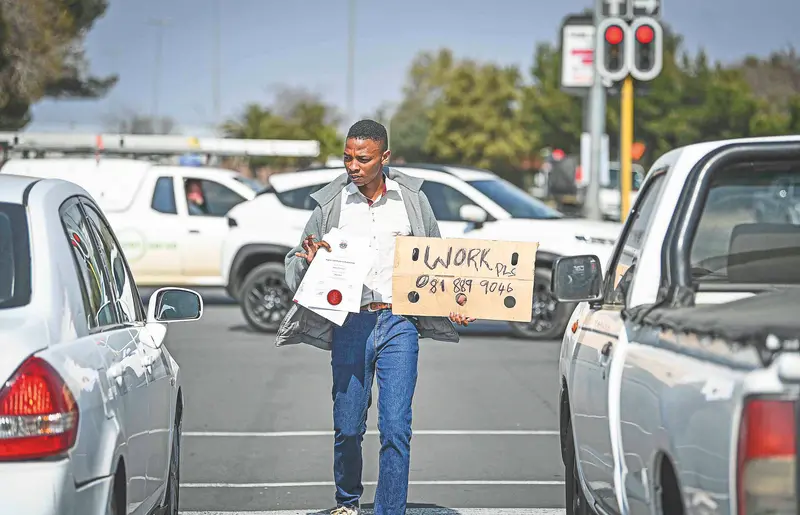
Unemployment crisis: Mokhale Poghiso, 26, stands at a traffic light with his degree certificate in one hand and a poster in the other asking for work Mokhale Poghiso (26) stands at a traffic light with his degree certificate in one hand and a poster in the other hand looking for work on August 25, 2025 in Bloemfontein, South Africa.Picture: Mlungisi Louw
The department of labour says businesses can apply for exemption, but in practice that’s “nonsense”, he says. “You need someone now. He’s prepared to accept a wage you can afford. But first you have to go through a protracted bureaucratic procedure. So the reality is that if you can’t afford to pay the minimum wage, you don’t apply for an exemption. You just don’t employ.”
For big and established businesses this is not a problem. But small businesses in rural areas, where unemployment is most acute, don’t have the mechanism to apply for exemption; they don’t have the financial statements.
Minimum wage compliance “puts a sword over the head of any potential employer anywhere. If the job applicant offers to work for less than the minimum, you’re taking a risk because if the guy later goes to the department and lays a complaint, you have no recourse.
“Without this law you will have thousands more businesses. The entrepreneurial spirit and potential in the townships are huge, but they live under this sword. The department of labour may think it doesn’t have an effect on the economy and jobs. I can tell them it does. The fact is that there is no freedom of contracting between employers and potential employees.”
With “real” unemployment of 43% and rising, a minimum wage is a luxury the country simply cannot afford, he says.
Although through Neasa SMMEs are party to wage negotiations, they’re always on a hiding to nothing. Because of collective bargaining, they’re at the mercy of agreements reached by big business and big labour.
The labour department’s stock response is that the law provides for exemption, but Papenfus says its exemption policy is as hostile to small businesses as the collective bargaining system it’s meant to protect them from. “The impact of collective bargaining on small and medium businesses that should be the engine of economic growth and jobs in this country has been devastating.”
Something Papenfus has been railing against for years is that SMMEs are not represented at Nedlac. “Big business and Cosatu have a vested interest in maintaining control over this club and not allowing the economically critical SMME sector a place at the table in its own right.”
Agreements hammered out at Nedlac “suit them but are devastating for the rest of the country”. Until Nedlac is restructured to allow for the voice of SMMEs in its structures and policymaking institutions, the unemployment crisis will get worse.
“You can’t leave it to the current role-players who have no skin in the SMME game. Big business, big unions and the government have a very cosy relationship, which is not good for what is coming out of Nedlac.”
Is he blaming Nedlac for the unemployment crisis?
“Well, Nedlac is where policy is made.”
It’s not where BEE is being doubled down on, is it?
“No, that’s the department of trade, industry & competition. But industrial policy, the way the country is run, is dictated to a very large extent by what comes out of Nedlac. And I think Nedlac has lost touch with what is really happening on the ground.”
Source: https://www.financialmail.businessday.co.za/features/2026-06-04-chris-barron-the-sting-in-the-tail
by Dev_SACCAWU | Labour Market News
The Congress of South African Trade Unions (COSATU) presented its submission on the 2026/27 Budget’s Appropriation Bill to Parliament’s Standing Committee: Appropriations.
COSATU is extremely disappointed with the lackluster 2026/27 Budget and Medium-Term Expenditure Framework. Whilst appreciating that there are some important allocations that COSATU campaigned for in the Bill, as an overall package it fails to respond decisively to the fundamental crises facing the working class and the economy, in particular a 43.7% unemployment rate, economic growth far below the 3% needed to create jobs, struggling public and municipal services and State-Owned Enterprises (SOEs), entrenched levels of poverty and inequality, and endemic crime and corruption. Tragically the Budget is focused on balancing the books not at aggressively kickstarting economic growth or tackling unemployment.
Key to providing an environment where the economy can take off and the lives of the working class improved, is to ensure frontline public services have the resources needed to fulfill their constitutional and developmental mandates. We welcome positive allocations for health and education, in particular R7.8 billion for the National Health Insurance Grants, R24 billion for revitalising public healthcare, R92 billion for district health programmes and R21 billion for the employment of doctors over the MTEF; and the recruitment of 3 000 staff to digitise civic services at Home Affairs. Progress made eradicating over 4 323 ghost posts plus to digitise public procurement will help free funds for frontline services. We are deeply worried that no funds have been allocated for the 10 000 permanent labour inspectors pledged in the State of the Nation Address (SONA).
Local government remains the Achille’s heel of the state with more than 60% of municipalities in financial distress and many struggling to provide basic services or pay staff. The allocation of R27 billion to improve metros’ abilities to provide basic services and bill correctly is critical as are plans to strengthen national government’s ability to timeously intervene in and hold failing municipalities accountable. Plans to connect over 320 000 houses to electricity and roll out 258 000 smart meters are welcome. These interventions do not go far enough to capacitate often highly dysfunctional municipalities, tackle rising municipal debt or deal with corrupt and incompetent municipal management.
COSATU commends the substantial progress made stabilising and rebuilding key SOEs. We, however, remain deeply opposed to Eskom’s unbundling. More must be done to enable Eskom to reduce the price of electricity, return Transnet and Metro Rail to full capacity to unlock mining, manufacturing and agricultural jobs as well as to provide efficient public transport for urban workers. The substantial infrastructure investments over the MTEF of R1.07 trillion, in particular for energy, rail, ports, water, roads and airports will help boost economic growth and jobs. We are dismayed by the lack of real turnaround plans to set Denel, the South African Broadcasting Corporation, Post Office and Postbank on the path to recovery.
SONA committed government to a bold plan to tackle our unacceptably high levels of crime and corruption, yet no new meaningful allocations have been provided for the Police, the Prosecuting Authority, Hawks or Judiciary to ensure they have the personnel, skills or infrastructure capacity to win this existential war. Additional allocations for the Border Management Authority as well as for the South African National Defence Force are important boosts, but the latter falls short of ensuring our military personnel receive the full support they require, in particular three meals a day.
The absence of a bold stimulus package for SMMES, industrial and export sectors badly needed to boost economic growth and jobs is deeply worrying. Allocating a meagre R3 billion for Small Business Development whilst providing R4 billion for bodyguards for politicians and cutting funding for the Department of Trade, Industry and Competition by 10% highlights the crisis of budget priorities.
COSATU is deeply angered that yet again not even an inflationary adjustment has been provided for the 8 million SRD Grant recipients, yet Members of Parliament were militant in demanding an increase for themselves over December. It is equally shameful that allocations for the NSFAS threshold have not been adjusted for inflation. It is disappointing that the Presidential Employment Programme has not been increased despite SONA’s commitment to do so, and in fact has seen its funding cut by half.
We are bewildered that more resources to boost the South African Revenue Service’s efforts to improve tax compliance have not been provided beyond a measly 2% annual adjustment.
Although there are important allocations for some frontline services and infrastructure, COSATU is extremely frustrated that Treasury and government collectively, have once again reduced the Budget to balancing books and missed the opportunity to table a bold stimulus package that would fix public and municipal services, spur economic growth, boost employment, provide relief for the poor and unemployed, and ramp up tax compliance. We cannot afford to continue to normalise 1% economic growth nor 43.7% unemployment. The patience of the working class and society are not unlimited.
Issued by COSATU
Matthew Parks (COSATU Parliamentary Coordinator) on 082 785 0687 or Tony Ehrenreich (COSATU Deputy Parliamentary Coordinator) on 082 773 3194
Source: https://mediadon.co.za/cosatu-presented-its-submission-on-the-2026-27-budgets-appropriation-bill-to-parliament
