
The politically driven anti-business agenda has led to catastrophic unemployment and stagnant economic growth
With ‘real’ unemployment of 43% and rising, a minimum wage is a luxury the country simply cannot afford, says Neasa’s Gerhard Papenfus.Picture: Antonio Muchave
Despite loud opposition to BEE, big business is complicit in it. This is killing SMMEs, driving unemployment to dangerously unsustainable levels and stifling economic growth, says Gerhard Papenfus, CEO of the National Employers’ Association of South Africa (Neasa).
“They’ve benefited hugely through it; they’re part of this game. If big business had said no to BEE, it wouldn’t have happened,” says Papenfus, whose organisation represents around 7,000 SMMEs, including 1,600 businesses in the metals and engineering sector.
He concedes that Business Unity South Africa, which represents organised business, has vocally opposed BEE for years, but says: “If they’re serious about ending BEE, why are they still participating in it? Why don’t they stop it?
“Why don’t they say to the government: ‘If you want something to be done, then award tenders on the basis solely of merit, not BEE compliance. The best company, the best price, the best product’?”

Gerhard Papenfus, CEO of the National Employers’ Association of SA Gerhard Papenfus, CEO of the National Employers’ Association of SA
It doesn’t do this because it’s benefiting from it, he says. “They may publicly say stop BEE, but they still play the BEE game.”
Is he in effect saying big business is partly to blame for the country’s unemployment crisis and near-zero economic growth?
“BEE is severely harming the economy, and the fact that big business are playing the game, in that sense, yes, of course. They can stop it, but they won’t because they are benefiting from it. It is what it is. They have the ability to stop it almost overnight.
“They can say: ‘Unless we do business in a proper manner in a free and fair market based on free-market principles, we won’t do business with the government.’” But the reality is that it will continue doing business in the manner that is beneficial to it, he says. “And this is the BEE manner.”
Until big business shows through action that it has the courage of its publicly expressed conviction that BEE is hobbling economic growth, South Africa’s unemployment crisis will get worse, he says.
“Big business have the influence; they have the inside track. They sit in Nedlac [the National Economic Development and Labour Council]; they sit in the committees of [the department of] trade & industry. They can change things. They don’t. The fact is that they benefit hugely through this. They say one thing, but their lived experience is very good. They make money out of the current arrangement. And it’s an arrangement that is killing small businesses.”
Big business would say it supports tens of thousands of small businesses in its supply chains, and it would be right, surely?
“These businesses still have to comply with BEE; they still have to give away 30% ownership to satisfy BEE requirements. That’s a condition for participating in the supply chains.”
It’s another example of how, while publicly demanding that BEE be scrapped, big business perpetuates it by playing the BEE game, he says.
“In an economic environment where the thrust is forcibly in a particular direction, it excludes a huge number of people. It suppresses entrepreneurship; it suppresses initiative. There’s huge talent out there that the system does not allow to flourish.”
By way of example, Neasa is losing at least 30 businesses a month, he says.
“We recruit new businesses, of course, but we close about 30 small companies a month employing five, 10, 15 people. Not because of poor service delivery — they simply cannot continue because of BEE compliance, minimum wage requirements, red tape. They’re victims of a politically driven anti-business agenda that makes it impossible for them to survive.
“Big business can exist in that environment; most SMMEs can’t. And so we have an economy that is in constant decline, which is measured in rising unemployment numbers.”
It’s a myth that BEE hurts only whites. It hurts everybody. If the economy is prejudiced by these BEE laws, then everybody suffers— Gerhard Papenfus
In theory, for businesses under a certain threshold, BEE is not required. But in practice, they are required by companies they want to do business with to comply with BEE shareholding requirements.
He hears this all the time. When they say they’re still a small business below the threshold, they’re told: “If you want to do business with us, this is what we demand from you.”
Papenfus says: “So it’s not only the government imposing BEE, it’s bigger companies. They argue that they must present their BEE compliance figures to the state in order to do business with the state.”
He says it’s a myth that BEE hurts only whites. It hurts everybody. “If the economy is prejudiced by these BEE laws, then everybody suffers.”
SMMEs that employ black and white people are being put out of business, forced to close because of BEE requirements. “This is why we have an unemployment crisis. This is not a natural economy. Everybody pays the price for this. The country is bleeding because of BEE and other government transformation policies.”
The minimum wage is a massive problem, he says. “It hurts at the point where people have entry into the economy. Unless you can persuade an employer to pay you the minimum wage, which is now R5,239 a month, you get nothing. There’s no lower figure. You get nothing.”
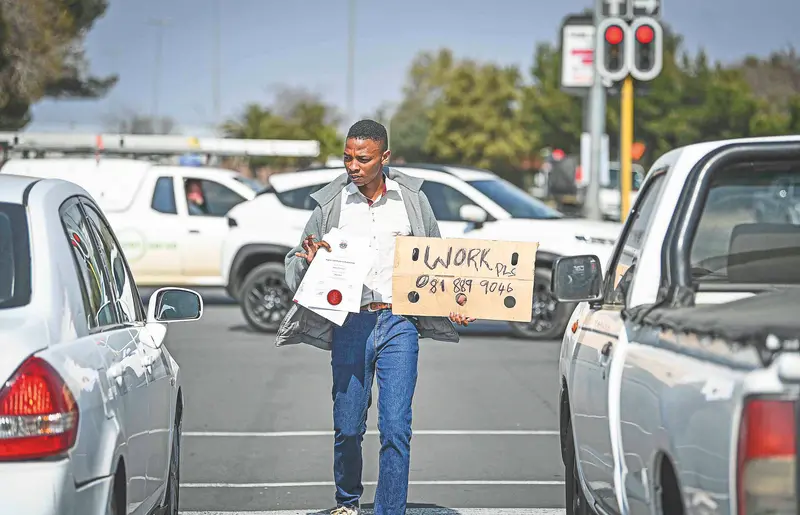
Unemployment crisis: Mokhale Poghiso, 26, stands at a traffic light with his degree certificate in one hand and a poster in the other asking for work Mokhale Poghiso (26) stands at a traffic light with his degree certificate in one hand and a poster in the other hand looking for work on August 25, 2025 in Bloemfontein, South Africa.Picture: Mlungisi Louw
The department of labour says businesses can apply for exemption, but in practice that’s “nonsense”, he says. “You need someone now. He’s prepared to accept a wage you can afford. But first you have to go through a protracted bureaucratic procedure. So the reality is that if you can’t afford to pay the minimum wage, you don’t apply for an exemption. You just don’t employ.”
For big and established businesses this is not a problem. But small businesses in rural areas, where unemployment is most acute, don’t have the mechanism to apply for exemption; they don’t have the financial statements.
Minimum wage compliance “puts a sword over the head of any potential employer anywhere. If the job applicant offers to work for less than the minimum, you’re taking a risk because if the guy later goes to the department and lays a complaint, you have no recourse.
“Without this law you will have thousands more businesses. The entrepreneurial spirit and potential in the townships are huge, but they live under this sword. The department of labour may think it doesn’t have an effect on the economy and jobs. I can tell them it does. The fact is that there is no freedom of contracting between employers and potential employees.”
With “real” unemployment of 43% and rising, a minimum wage is a luxury the country simply cannot afford, he says.
Although through Neasa SMMEs are party to wage negotiations, they’re always on a hiding to nothing. Because of collective bargaining, they’re at the mercy of agreements reached by big business and big labour.
The labour department’s stock response is that the law provides for exemption, but Papenfus says its exemption policy is as hostile to small businesses as the collective bargaining system it’s meant to protect them from. “The impact of collective bargaining on small and medium businesses that should be the engine of economic growth and jobs in this country has been devastating.”
Something Papenfus has been railing against for years is that SMMEs are not represented at Nedlac. “Big business and Cosatu have a vested interest in maintaining control over this club and not allowing the economically critical SMME sector a place at the table in its own right.”
Agreements hammered out at Nedlac “suit them but are devastating for the rest of the country”. Until Nedlac is restructured to allow for the voice of SMMEs in its structures and policymaking institutions, the unemployment crisis will get worse.
“You can’t leave it to the current role-players who have no skin in the SMME game. Big business, big unions and the government have a very cosy relationship, which is not good for what is coming out of Nedlac.”
Is he blaming Nedlac for the unemployment crisis?
“Well, Nedlac is where policy is made.”
It’s not where BEE is being doubled down on, is it?
“No, that’s the department of trade, industry & competition. But industrial policy, the way the country is run, is dictated to a very large extent by what comes out of Nedlac. And I think Nedlac has lost touch with what is really happening on the ground.”
Source: https://www.financialmail.businessday.co.za/features/2026-06-04-chris-barron-the-sting-in-the-tail