Sleeping on the pavement: The heartbreaking scenes unfolding on Che Guevara Road. Image: XOLILE MTEMBU
While children played and darted along the pavement outside the Home Affairs office on Che Guevara Road on Thursday, the difficult reality facing the refugee families living there remained impossible to ignore.
A walkthrough conducted by the Siyafana Sonke Action Campaign highlighted the conditions under which displaced men, women and children are currently living.
The Siyafana Sonke Action Campaign is a coalition of more than 160 civil society organisations established to oppose xenophobia, Afrophobia and anti-migrant violence across South Africa.
Ahead of the visit, campaign representative Yeshelen Govender described the challenges confronting those sheltering outside the Home Affairs office.
“There are women, very young children and men there and some have chronic illnesses for which they are [allegedly] not receiving any support from the state. It is purely civil societies that have been responsible for humanitarian aid.”
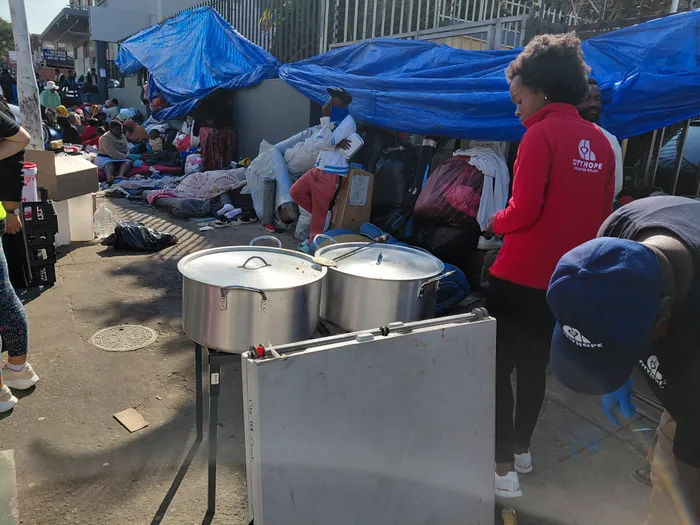
The makeshift camp stretches along the pavement beneath a patchwork of tarpaulins tied to fences and poles, offering only limited protection from the winter rain and wind.
Blankets, mattresses and thin foam sponges were spread across the ground, marking out cramped sleeping spaces for families who had spent weeks outdoors.
Plastic bags filled with clothing and personal belongings were stacked beside them, while pots, water containers and donated food supplies lay neatly arranged nearby.
Despite efforts to keep the area orderly, the camp bore the unmistakable signs of prolonged displacement, with people trying to create a semblance of home from whatever they had managed to carry with them.
The retailer provided no details on how these senior employees will be remunerated. Image: Supplied
Pool of senior talent to receive more than 1.5m shares in the group.
A total of 181 executive directors and managers of Boxer are due for a payday in November related to its listing on the JSE.
This is under a once-off ‘admission award’ granted as part of the retailer’s long-term incentive plan to “support leadership retention and stability through the transition to a listed environment and the early years as a listed company”.
In its 2026 annual report, the group confirms that the first tranche, being 40% of the award, will vest.
To achieve this for these ‘admission awards’, Boxer needed to attain certain performance conditions that compare its performance in the 2024 financial year (prior to listing) versus FY2026. The following 60% will vest next year.
With the November award, this pool of senior talent from the business will receive 1.511 million shares in the group (subject to their continued employment).
At a current share price of around R79/R80, this award has a total value in excess of R120 million, presuming the share price holds until November.
Conditions
For both this tranche and the next (which is due on 30 November 2027), it has to deliver growth of adjusted trading profit (after leases) – or so-called ‘Atpal’ – of at least CPI a year (average) across the measurement period.
The threshold, which is 40% vesting, is to simply hit this measure.
Achieving a compound annual growth rate (CAGR) of that plus 2% equals 70% vesting, while a CAGR of CPI + 3% equals the “stretch” target which is full vesting.
There is a gatekeeper condition being that the return on invested capital (ROIC) has to best the weighted average cost of capital (WACC) over two years. This was easily surpassed.
It exceeded these hurdles very, very comfortably on listing.
On the gatekeeper condition, Boxer achieved a ROIC of 25.75% versus (on the same basis) a WACC of 12.21%.
Then, on the other measure (profits) it set a two-year annual compound growth rate of 18.15% versus 3.1% of CPI.
The retailer provided no details on how these 181 (or fewer) senior employees will be remunerated.
The next hurdle, in November 2027, requires the same (basic) performance conditions as earlier (which might be considered as ‘different’ given the circumstances). It is unclear why the awards would be on the same terms as earlier.
Top two
Under this first tranche, CEO Marek Masojada and CFO David Wayne received more than 208 000 and over 84 000 shares respectively.
At current prices, these shares are worth R16.6 million and R6.7 million respectively.
BOX – Boxer Retail Ltd.
Loading…
7/13/2026, 7:40:01 PM
The next tranche, at current prices, will be worth significantly more than currently given that it accounts for a further 60% of the award. These shares will be awarded in November next year, if conditions have been met (it appears they already have been).
Aside from these awards, the two executive directors of Boxer (Masoaja and Wayne) were handed, along with other senior management, “once-off compensation” because they were affected.
In total, the two executive directors were paid more than R6 million.
“These legacy payments were ratified by the Boxer Remuneration Committee and paid in June 2025, including R4.2 million to CEO, Marek Masojada, and R2.2 million to CFO, David Wayne,” according to the annual report.
“These amounts represent once-off legacy settlements, and do not form part of Boxer’s ongoing remuneration framework.”
Losi argues that withholding funding will not resolve governance failures
She urges government to focus on improving governance instead of reducing funding to municipalities
Dive Deeper
Cosatu president Zingiswa Losi has criticised National Treasury’s decision to withhold funding from struggling municipalities, saying the move would deepen the local government crisis instead of fixing it.
Speaking on Thursday, Losi said reducing funding to municipalities already battling financial distress was equivalent to “cutting blood” or “cutting oxygen” from a body that was trying to survive.
Her remarks come after National Treasury announced that it would withhold equitable share allocations from dozens of municipalities over governance and financial management failures.
‘Ordinary residents to suffer’
Losi said the consequences of the decision would be borne by ordinary residents who depend on municipalities for water, electricity, sanitation and other basic services.
“We do not agree with the decision of Treasury in the manner that it has been done,” she said.
“How do you expect municipal workers to continue to wake up in the morning, go to work and service communities when the very same municipalities are underfunded? They are cutting funding. That’s literally like cutting blood when the body needs it. It’s like cutting oxygen when the body needs it.”
Cuts will undermine service delivery
She said the funding cuts would not only affect municipal employees but would ultimately undermine service delivery.
Losi said many municipalities were already unable to meet their financial obligations, with some workers reporting for duty despite not receiving their salaries on time.
She said the crisis facing local government had become a broader societal issue rather than simply a labour dispute.
“We are having local government elections on November 4, and yet we have dysfunctional municipalities,” she said.
“We have workers in municipalities that are not respected. Some are suspended and others are dismissed.”
Losi said municipal employees were part of the communities they served and wanted functioning municipalities as much as residents did.
“Municipal workers are here not only for themselves. They are also representing the interests of the communities that they come from,” she said.
“When you starve municipalities and do not deal with corruption, it is services that are not reaching ordinary poor South Africans.”
‘Prioritise tackling corruption’
She argued that withholding funding would not resolve governance failures and instead risked worsening already fragile municipalities.
“The salary negotiations stop. Municipal workers suffer, and ordinary South Africans who are paying for municipal services are the ones who will be at the receiving end,” she said.
Losi said the government should prioritise tackling corruption and improving governance instead of reducing funding to municipalities.
“Instead of government addressing issues of corruption, you are deciding to cut funding. We don’t think it is a response to the challenges that we are faced with,” she said.
She also suggested that those making the decisions were insulated from the consequences experienced by residents.
“People who are making these decisions may have water tankers at home. They may have solar at home. They may be living in suburbs where these services are already outsourced,” Losi said.
“What about ordinary South Africans who rely on the municipality?”
Summary
Cosatu president Zingiswa Losi condemned National Treasury’s decision to withhold funding from struggling municipalities, warning it would worsen the local government crisis.
Losi emphasized that cutting funding is like “cutting blood” or “oxygen” from municipalities already in financial distress, harming municipal workers and service delivery.
She highlighted that ordinary residents dependent on municipal services such as water, electricity, and sanitation would suffer the most from these funding cuts.
Losi urged the government to focus on fighting corruption and improving governance rather than reducing municipal funding.
She noted that decision-makers might be disconnected from the harsh realities faced by ordinary South Africans relying on municipal services.
Listen
🎧 Listen to this article
Cosatu president Zingiswa Losi has criticised National Treasury’s decision to withhold funding from struggling municipalities, saying the move would deepen the local government crisis instead of fixing it.
Speaking on Thursday, Losi said reducing funding to municipalities already battling financial distress was equivalent to “cutting blood” or “cutting oxygen” from a body that was trying to survive.
Her remarks come after National Treasury announced that it would withhold equitable share allocations from dozens of municipalities over governance and financial management failures.
Losi said the consequences of the decision would be borne by ordinary residents who depend on municipalities for water, electricity, sanitation and other basic services.
“We do not agree with the decision of Treasury in the manner that it has been done,” she said.
“How do you expect municipal workers to continue to wake up in the morning, go to work and service communities when the very same municipalities are underfunded? They are cutting funding. That’s literally like cutting blood when the body needs it. It’s like cutting oxygen when the body needs it.”
She said the funding cuts would not only affect municipal employees but would ultimately undermine service delivery.
Losi said many municipalities were already unable to meet their financial obligations, with some workers reporting for duty despite not receiving their salaries on time.
She said the crisis facing local government had become a broader societal issue rather than simply a labour dispute.
“We are having local government elections on November 4, and yet we have dysfunctional municipalities,” she said.
“We have workers in municipalities that are not respected. Some are suspended and others are dismissed.”
Losi said municipal employees were part of the communities they served and wanted functioning municipalities as much as residents did.
“Municipal workers are here not only for themselves. They are also representing the interests of the communities that they come from,” she said.
“When you starve municipalities and do not deal with corruption, it is services that are not reaching ordinary poor South Africans.”
She argued that withholding funding would not resolve governance failures and instead risked worsening already fragile municipalities.
“The salary negotiations stop. Municipal workers suffer, and ordinary South Africans who are paying for municipal services are the ones who will be at the receiving end,” she said.
Losi said the government should prioritise tackling corruption and improving governance instead of reducing funding to municipalities.
“Instead of government addressing issues of corruption, you are deciding to cut funding. We don’t think it is a response to the challenges that we are faced with,” she said.
She also suggested that those making the decisions were insulated from the consequences experienced by residents.
“People who are making these decisions may have water tankers at home. They may have solar at home. They may be living in suburbs where these services are already outsourced,” Losi said.
“What about ordinary South Africans who rely on the municipality?”
SAMWU says withholding funds and austerity measures will not solve the crisis and has called on government to address the systemic challenges facing municipalities.
The Union’s General-Secretary Dumisane Magagula, “What needs to change is the funding model of local government. Currently, the model does not speak to service delivery. It doesn’t enable municipality to deliver services. The funding model should not be over-reliant on collecting from residents only. It should go much broader than making sure that we get revenue and correct revenue even from business. kind of budget that goes to municipalities needs to be relevant for those municipalities.”
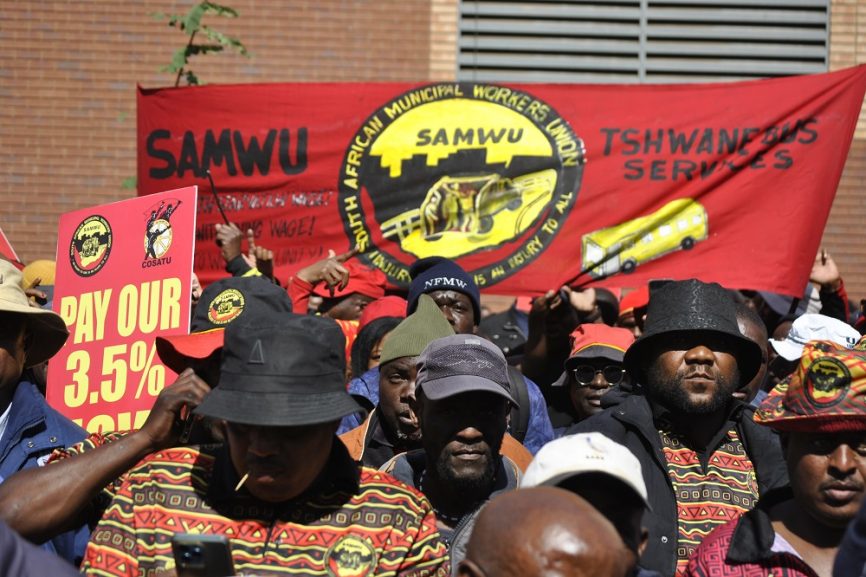
Meanwhile, SAMWU held a National Day of Action on Thursday to highlight a range of issues affecting municipal and water sector workers, including local government funding, wages, outsourcing and working conditions.
Impendle Municipality, which is one of the poorest municipalities in KwaZulu-Natal, is worried by the National Treasury withholding equitable share grants from poor-performing municipalities Image: x.com
Impendle Municipality, which is one of the smallest rural municipalities in KwaZulu-Natal Midlands, was on Thursday holding its breath, hoping discussions would persuade the National Treasurer to withdraw its decision to withhold equitable share grants from poor-performing municipalities.
The National Treasury revealed on Tuesday that it was temporarily withholding the July 2026 equitable share transfers to certain municipalities to instil fiscal discipline.
Treasury said this is to ensure that public money allocated to the municipalities is properly managed and these municipalities learn to address unauthorised, irregular, fruitless, and wasteful expenditure (UIFWE).
Equitable shares are funds that the National Treasurer unconditionally transfers to provincial and local governments for administrative costs.
The financial status in Impendle, which is among municipalities identified by the National Treasury as financially ill-disciplined, reached a boiling point when it failed to pay staff salaries on time early this year.
Mayor Kho Dlamini stated that the municipality would not survive without equitable shares.
“This is affecting us badly, but there are currently discussions with the National Treasury, which we believe will lead to a certain agreement by 2 pm,” said Dlamini.
He said the grant was important to Impendle, which had scarce rate collection sources.
“Impendle Municipality is mainly grant-dependent,” said Dlamini.
In the statement, the Treasury stated that its decision was meant to hold municipal officials and office-bearers accountable.
“The decision follows persistent and serious non-compliance with the Municipal Finance Management Act (MFMA) and its supporting regulations, despite support provided by the National Treasury through guidance, engagement, and formal or informal communication,” read the statement.
Other municipalities in KwaZulu-Natal, which are affected by the Treasury’s decision, are uMzinyathi, Amajuba, and uMkhanyakude districts, Newcastle, eMadlangeni, and AbaQulusi.
UMkhanyakude Mayor Siphile Mdaka said his municipality was included in the list through miscommunication between it and the Treasury.
“It is a matter that Treasury and us are dealing with (on Friday) in our meeting at 4 pm,” he said.
Mdaka said the municipality had provided reports to the Treasury that there is work in progress in terms of the issues that the municipality is addressing internally.
“But all issues that they (Treasury) have raised have been resolved.
“This is just a communication issue, which is why I am saying we are clarifying this with them tomorrow at 4 pm,” he said.
The Congress of South African Trade Unions (Cosatu) has called for urgent interventions for financially distressed municipalities, as the Treasury’s decision may worsen their situation.
The federation said, although it appreciates the need to install financial discipline in municipalities when it comes to their workers’ salaries and pension funds, Eskom, Water Boards, and other service providers, there would be unintended consequences for withholding the grant.
“Some of these municipalities are so financially cash-strapped that this action may cause some basic services to grind to a halt and leave many municipal workers unpaid once again,” said Cosatu’s parliamentary coordinator Matthew Parks.
Parks called for engagements between Treasury, the Department of Cooperative Governance and Traditional Affairs (COGTA), and the South African Local Government Association (SALGA) “to put in place interventions to resolve these ever-worsening crises”.
Parks said the solution to mishandling municipality finances would be to appoint competent management and deal with corruption and wasteful expenditure through the intervention of the Hawks and the Special Investigating Unit.
“It is key that these interventions do not lead to a further collapse of municipal services or see more workers sent home unpaid,” said Parks.
Woolworths has joined Checkers and Pick n Pay in launching an artificial intelligence (AI)-powered assistant on its on-demand delivery app.
Called ‘My Woolies Chef’, Woolworths’ AI tool will allow customers to ask questions, find meal ideas, plan dishes, and shop for ingredients more seamlessly.
My Woolies Chef will be available to a small group of existing MyDifference loyalty programme members from September 2026 as part of an ongoing beta testing phase. Woolworths intends to roll out the service more broadly in early 2027.
“Unlike general-purpose AI tools, My Woolies Chef is built specifically around the Woolworths food ecosystem,” the retailer said in a press release on 13 July.
“The assistant combines local recipe content, product information and shopping functionality to deliver recommendations that are relevant to the South African customer context and directly connected to the Woolworths shopping experience.”
My Woolies Chef will use generative and conversational AI to interpret customers’ questions and return relevant suggestions.
The AI tool has been trained on thousands of Woolworths TASTE recipes and, unlike a traditional search function, it is designed to understand the context behind a request.
“The system has been trained to interpret natural language prompts related to meal planning, cooking preferences, and household needs,” the retailer explained.
This allows customers to interact with the platform in a more intuitive and conversational way.
“Conversational AI allows customers to engage with Woolworths’ food content and digital shopping experience in a more intuitive way,” Woolworths’ group data and AI officer, Jose Rodrigues, said.
“Instead of navigating multiple searches, they can describe what they need in everyday language and receive suggestions that are relevant to the context of their request.”
“Our focus is on developing the technology responsibly, testing it through a phased rollout and improving the experience through customer feedback.”
South African retailers go all-in on AI
The announcement of My Woolies Chef comes shortly after Pick n Pay and Checkers have launched their own versions of an AI-powered chatbot integrated into their on-demand delivery apps.
Checkers was first to the punch, announcing its AI-powered shopping assistant, named ‘Pixie’, on its Sixty60 delivery platform in April 2026.
Described as a “trusted personal butler with a PhD in shopping”, Checkers’ tool learns from customers’ buying habits and generates personalised grocery baskets and product recommendations.
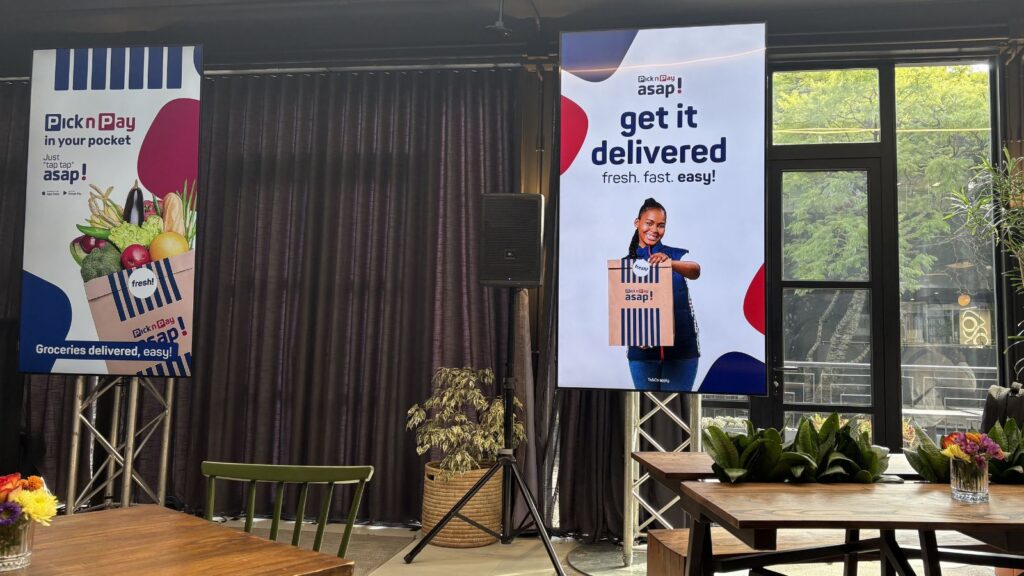
Pick n Pay responded to Checkers’ move in early July 2026, introducing ‘Penny’, an AI-powered, multimodal shopping assistant on its asap! platform.
Penny can assist asap! users with building shopping baskets, answering questions, and helping with “smart shopping”.
With Woolworths, Pick n Pay, and Checkers now having announced their AI-powered upgrades to their delivery platforms, it is becoming clear that the new retail battleground has shifted to convenience shopping.
All of South Africa’s major retailers have been investing heavily in their on-demand delivery platforms over the past few years, looking to capture more market share through these convenience options.
Currently, Checkers’ Sixty60 platform is the clear market leader and was the first to launch major upgrades that the other market players soon followed.
As South African shoppers increasingly prioritise convenience and the online shopping experience, retailers will need to differentiate themselves through their on-demand platforms.