by Temp_Dev | Labour Market News
The approval of salary increases of up to 4% for public office-bearers has sparked criticism from trade unions and civil society groups, as millions of South Africans struggle with unemployment, poverty and rising living costs.
The Presidency on Tuesday confirmed that President Cyril Ramaphosa approved salary adjustments of between 3.5% and 4% for the 2026/27 financial year, effective from 1 April 2026.
Members of Parliament, provincial legislatures and municipal councils will receive a 3.5% increase, while judges, magistrates and traditional leaders are among those receiving 4%.
President @CyrilRamaphosa has determined salary increases for public office-bearers for the 2026/27 financial year, effective from 1 April 2026.
— The Presidency (@PresidencyZA) November 10, 2026
The Presidency said the increases followed recommendations by the Independent Commission for the Remuneration of Public Office-Bearers, which considers economic conditions, inflation, affordability and stakeholder input.
However, the decision has renewed debate about whether salary increases for elected representatives are justified amid the country’s ongoing economic challenges.
COSATU has expressed its dissatisfaction with the increase for politicians, arguing that it is difficult to justify while ordinary citizens face mounting financial pressure.
“This hike for public representatives remains excessive and sends an ill-considered message to an increasingly frustrated public of a political elite that is dangerously out of touch with the lived realities of ordinary South Africans,” said COSATU’s Matthew Parks.
Parks added that it is not logical when government does not have the money to fulfil its constitutional mandates.
“It is beyond shameful that whilst government has consistently refused to provide any inflationary relief for the 8 million unemployed and destitute SRD Grant recipients, government has found an additional R536 million to fund the salaries of politicians, commissioners and judges,” noted Parks.
COSATU has, however, welcomed the salary increases for magistrates, citing the need to retain skilled professionals within an already overwhelmed judicial system.
Similarly, Forum for South Africa has questioned whether public representatives should receive higher salaries while communities continue to experience inadequate service delivery.
The organisation’s Tebogo Mashilompane called for greater accountability, arguing that remuneration should be linked to measurable improvements in governance and service delivery.
“It is deeply concerning that public office-bearers continue to receive salary increases while ordinary South Africans struggle to put food on the table, young people remain unemployed, municipalities fail to deliver basic services and communities continue to experience severe economic hardship… South Africans cannot continue to carry the burden of poor governance while those in positions of authority enjoy improved remuneration without corresponding accountability,” said Mashilompane.
Source: https://smilefm.co.za/tone-deaf-as-president-approves-salary-increase-for-cabinet-mps/
by Temp_Dev | Labour Market News
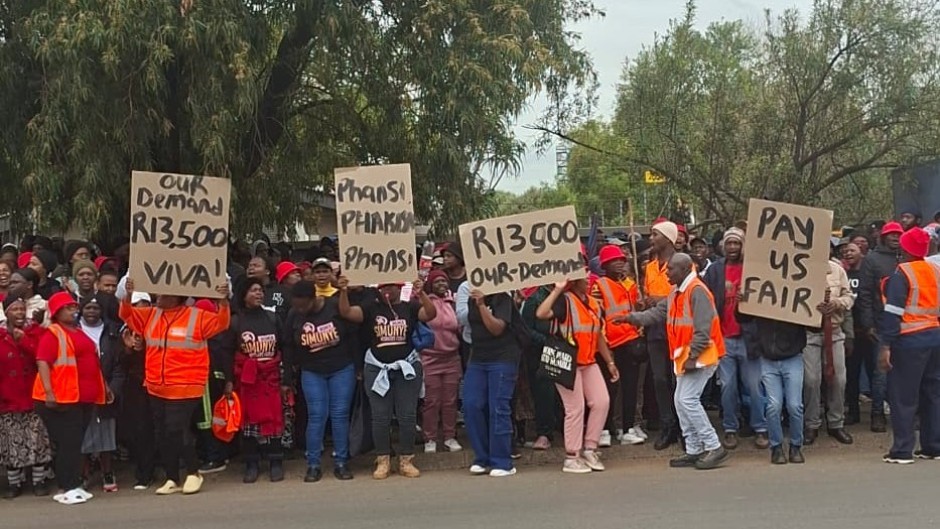
Workers at Festive Chickens in Olifantsfontein are demanding a R13,500 salary adjustment and medical aid. eNCA/Bafedile Moerane
KEMPTON PARK – More than 1,000 workers at Festive Chicken in Olifantsfontein have been on a protected strike for nearly two weeks, demanding better wages, permanent employment and improved working conditions.
Workers say their grievances include unsafe working conditions, freezing workspaces, inadequate protective clothing and long shifts without breaks.
Some employees claim they have spent more than 15 years working as casual employees without being made permanent.
The strike is continuing under the protection of a Labour Court ruling.
Source: https://www.enca.com/business-top-stories/festive-chicken-workers-strike-better-wages-and-permanent-jobs
by Temp_Dev | Labour Market News
Image: Daily Investor
President Cyril Ramaphosa promised the deployment of 10,000 permanent labour inspectors during his State of the Nation Address (SONA) on 12 February 2026.
However, the Labour Minister told Parliament that her department is still waiting for funding to employ these inspectors, with none having been deployed so far.
This is an example of President Ramaphosa promising something in his SONA that is, in reality, difficult to implement and unlikely to be implemented.
Unfortunately, the financial reality of the South African government is that it cannot afford to hire an additional 10,000 labour inspectors without a significant increase to the Department of Labour’s budget.
This increase would have to be permanent to keep these labour inspectors employed, working to crack down on undocumented workers.
President Ramaphosa promised in his 2026 SONA that Home Affairs and labour inspectors will work together to crack down on violations of existing immigration and labour laws.
“Employers that hire foreign nationals without the required visas will face the full might of the law,” Ramaphosa said.
“To tighten enforcement, we will hire an additional 10,000 labour inspectors this year. As we undertake these interventions, we insist that the laws of our country be observed by everyone.”
Ramaphosa coupled the increase in labour inspectors with enhanced efforts from Home Affairs to secure South Africa’s borders.
The Labour Department clarified after the SONA that this is a separate initiative from its Project 20K, which is a long-term plan to recruit 20,000 inspectors and enforcement interns over two years.
These efforts to increase the number of labour inspectors come after evidence of widespread non-compliance from South African companies with labour laws.
In particular, the department said many businesses are continuously breaking the law by employing undocumented workers.
“What is happening is that we have employers who are budgeting not to comply. They basically say they will pay the fines to keep employing illegal immigrants,” Deputy Minister Ntuthuko Sibiya said.
“That is how far they want to go. That is how bad things are on the ground. They are saving money for themselves and want to maximise profits.”
There is little scope for the department to increase the severity of fines, with its proposed solution being to increase the number of inspectors to make inspections and fines more frequent.
This, it hopes, will make it too burdensome and expensive for companies to willfully employ undocumented immigrants.
Zero of 10,000 deployed
The promise of 10,000 additional inspectors and closer work between Home Affairs and the Labour Department has not been borne out in reality.
Of the 10,000 promised, not a single additional labour inspector has been employed or trained by the Labour Department.
This was revealed by Labour Minister Nomakhosazana Meth in response to a question in Parliament from MP Joyce Basson.
Basson asked Meth about the promised 10,000 inspectors to be added in the 2026/27 financial year and the cost of their recruitment.
“The department has submitted a bid to request funding from the National Treasury and is awaiting feedback in that regard,” Meth said.
“So, thus far, there are no additional labour inspectors that have been approved, advertised, appointed, or deployed.”
As a result, increased compliance from the Labour Department is effectively nil, as it does not have the additional capacity to crack down on undocumented workers.
The strategy of more regular inspections and fines cannot work without a significant increase in capacity at the department.
While this may be the government’s desire, it does not have the financial space to hire 10,000 extra inspectors without significantly cutting the budget elsewhere.
“The department has not been able to secure the budget for implementation and deployment of additional labour inspectors,” Meth said.
“There is no budget that has been allocated yet for the recruitment, salaries, training, and deployment of the 10,000 additional labour inspectors.”
Meth said the lack of funding is the main obstacle to the project’s implementation and, ultimately, the only one that matters.
Without the additional funding, it is impossible for the department to hire additional inspectors.
Source: https://dailyinvestor.com/south-africa/163867/president-ramaphosa-promised-10000-extra-labour-inspectors-but-zero-have-been-deployed/
by Temp_Dev | Labour Market News
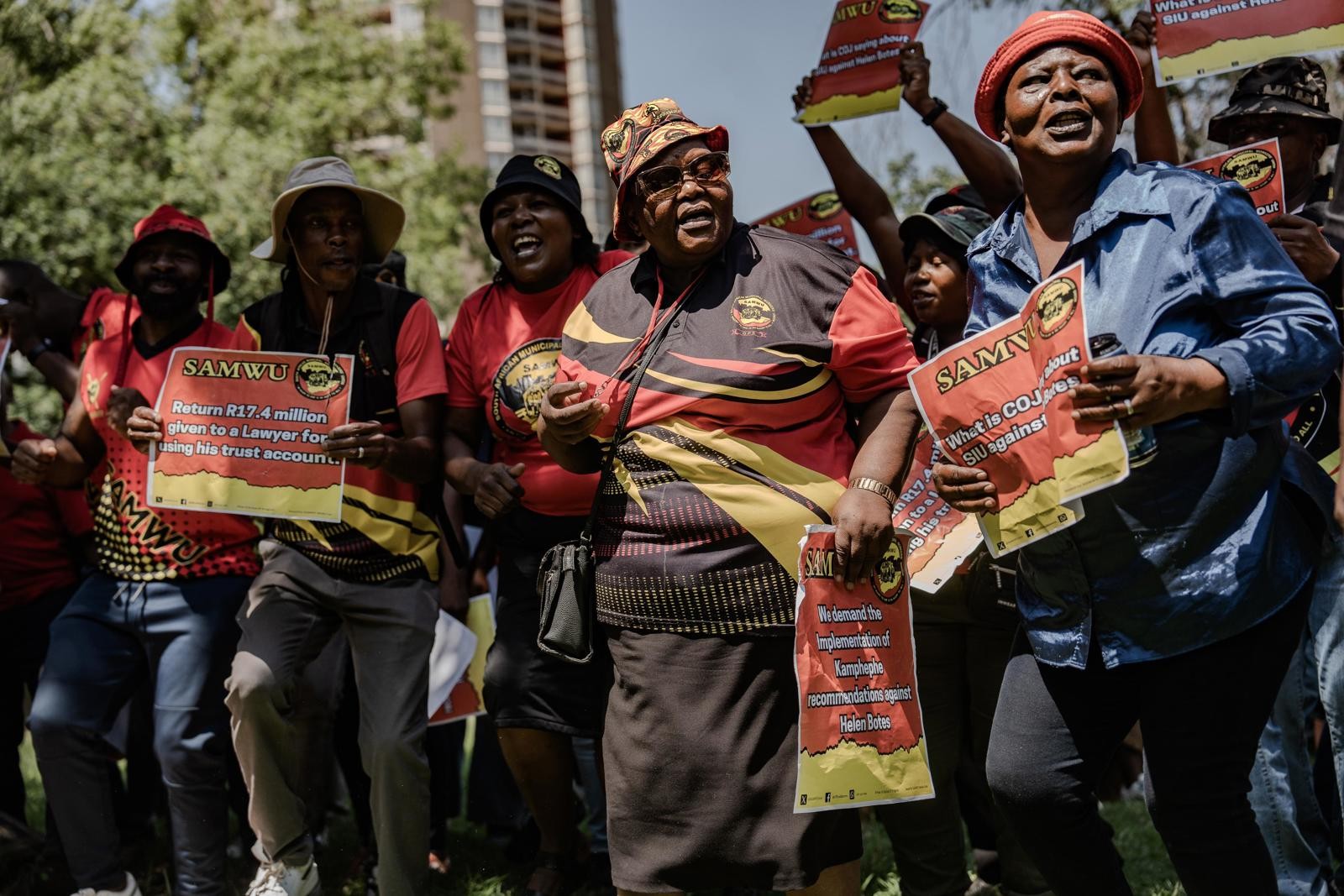
SAMWU members protested in Johannesburg on 30 January 2025 over the appointment of Helen Botes as the City of Joburg’s acting chief operating officer. Picture: Sphamandla Dlamini/EWN
This follows the signing of an addendum to the existing wage agreement between outgoing mayor Dada Morero and the South African Municipal Workers’ Union on the eve of the local government elections.
A R10.3 billion wage agreement, affecting an estimated 35,000 municipal workers, is likely to be one of the biggest challenges facing Johannesburg’s incoming administration.
This follows the signing of an addendum to the existing wage agreement between outgoing mayor Dada Morero and the South African Municipal Workers’ Union (SAMWU) on the eve of the local government elections.
The addendum seeks to clarify and fast-track the implementation of the controversial deal, which aims to address historic salary disparities among municipal workers.
But the multibillion-rand commitment has attracted strong objections from National Treasury over its affordability and legality.
SAMWU, however, is insisting that the incoming leadership must honour the agreement.
The big question is how the new administration will navigate this financial obligation while trying to get the city’s struggling finances and service delivery back on track.
SAMWU said the addendum signed with the city does not simply disappear with the departure of the current political leadership.
The union argues that the agreement is with the municipality as an institution and not with an individual mayor or political party.
It maintains that the wage deal is necessary to address long-standing salary inequalities affecting thousands of municipal workers.
“We have entered into an agreement with the City of Johannesburg in trying to address shortcomings of the city by making sure that we put mechanisms that will fund this particular PFA [Politically Facilitated Agreement] so that we see it through; it’s been many years that employees of the seat have been subsidising the City of Johannesburg.
“As of now on, we definitely know that this particular PFA is going to be a funded vehicle,” said SAMWU’s regional secretary, Thobani Nkosi.
Gauteng Cooperative Governance and Traditional Affairs (COGTA) MEC Jacob Mamabolo has also urged the incoming administration to honour the commitment.
But with National Treasury questioning the financial implications of the deal, the new leadership will face difficult questions about how it intends to fund the agreement.
The addendum, signed just before the elections, has effectively left the incoming administration with a major financial and labour relations issue to address.
Source: https://www.ewn.co.za/samwus-r103bn-wage-deal-likely-to-be-challenging-for-joburg-s-new-administration/
by Temp_Dev | Labour Market News

Cosatu says the ANC must take time to reflect on the message sent by millions of voters, many of whom stayed away from the polls due to frustration, pain and anger. (Per-Anders Pettersson/Getty Images)
CONCERNED that only half of eligible voters were registered and only half of those registered cast their ballots during the 2026 local government elections, the Congress of South African Trade Unions (Cosatu) is demanding legislative changes.
The union federation announced on Monday, 9 November, that it’d submit proposals to the government and Parliament to extend voting hours and declare election day a non-trading public holiday so that non-essential workers could vote without fear of losing their wages or jobs.
Cosatu says millions of voters stayed away from the polls because of frustration, pain and anger over poor public service delivery, unemployment, and a stagnant economy.
Addressing its alliance partner directly, the federation stated: “It’s no exaggeration to state that voters have sent in a final warning.”
The ANC has been warned that it could lose the confidence of voters for good, if it fails to intensify its renewal campaign and remove corrupt elements.
While congratulating the ANC and the SACP on their successes, Cosatu called for strict oversight in municipalities going forward.
The union federation warned against “coalitions formed merely to secure positions or tenders”, demanding that they prioritise working-class communities instead.
Furthermore, Cosatu said national and provincial governments, Parliament and Cogta must strengthen oversight over municipalities and act swiftly when they fail to improve service delivery, respect workers’ rights, and appoint qualified managers.
Source: https://www.snl24.com/news/elections/cosatu-warns-anc-read-the-room-20261109/
