
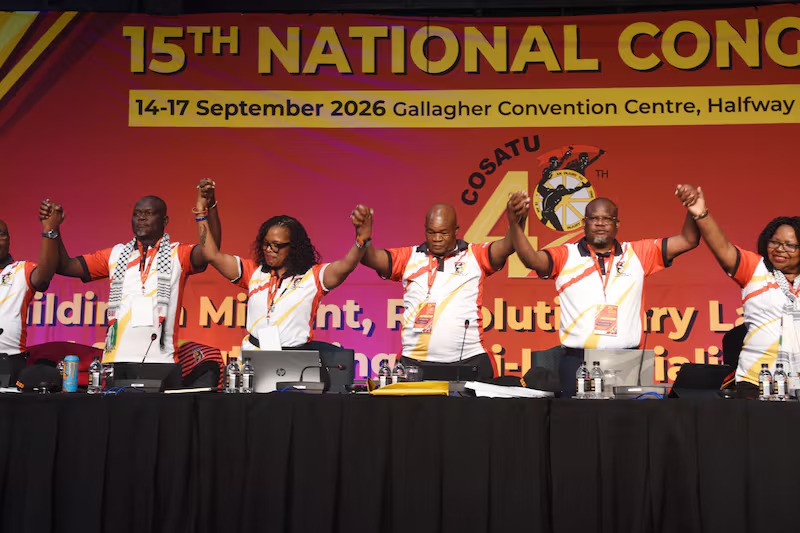
Cosatu’s leadership including president Zingiswa Losi, first deputy president Mike Shingange and first general secretary Solly Phetoe at the national congress in Midrand, Johannesburg, on September 14 2026. Picture: Business Day/ (Freddy Mavunda)
Story audio is generated using AI
The country’s largest trade union federation, Cosatu, is meeting in Midrand this week for its 15th national congress.
As has become the norm with such gatherings, the first day of the congress yesterday was marked by long delays as delegates from various affiliates argued over who should be allowed into the conference venue and who shouldn’t.
However, such delays over the mundane shouldn’t make anyone dismiss the importance of the congress.
From SA’s earliest days as a mining and industrialised country, organised labour has always played an important part in shaping the country’s future.
At times this role has been destructive, as in 1921, when white trade unions led a strike in the old Transvaal whose main objective was to keep black people from entering the labour market on an equal footing.
But mostly it has been positive, often resulting in moderate improvements in working conditions for union members. The role of trade unions in bringing about an end to apartheid can also never be overlooked.
In the post-apartheid era, organised labour agitated for much of the progressive labour legislation in the country– such as the Labour Relations Act (LRA) and the Basic Conditions of Employment Act – which resulted in increased rights and protections for working people in the workplace.
It can even be argued that in a number of sectors, both public and private, the work of the trade unions has resulted in the lifting of the standard of living for hundreds of thousands of workers and their families.
However, as Cosatu holds its congress this week, it does so in a context in which many of the gains made in the early years of democracy are now being reversed – largely as a result of stagnant economic growth, rising unemployment and the introduction of new technologies that are rapidly changing the nature of work.
Millions of working people are finding themselves outside of the protection provided by the LRA and other labour laws because, as contract and casualised employees, they are not deemed to be workers.
This is especially true of the youth − some of whom spend years in companies as “interns” while doing the work of full-time staffers but without the pay and benefits.
These are the issues that Cosatu delegates should be preoccupied with this week if the 41-year-old federation is to remain relevant in the future.
Expending too much time and energy on ruling party politics is to ignore the real dangers the trade union movement and its members face.