
Alliance politics overshadow urgent calls for union renewal and worker representation
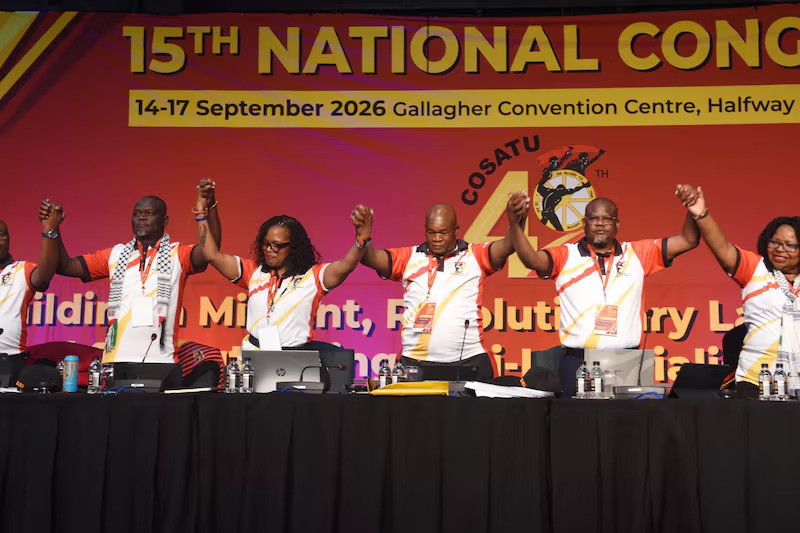
Cosatu’s leadership including president Zingiswa Losi, first deputy president Mike Shingange and first general secretary Solly Phetoe at the national congress in Midrand, Johannesburg, on September 14 2026. Picture: Business Day/ (Freddy Mavunda)
The Congress of South African Trade Unions (Cosatu) went into its 15th national congress promising a debate about the future of the working class.
But so far, the danger is that the workers themselves are being crowded out by a familiar contest over political power, leadership positions and the bitter battle about who it will support between ANC and SACP in the upcoming municipal elections.
That would be a serious failure of purpose, given that Cosatu championed workers’ rights as South Africa transitioned from apartheid to a constitutional democracy in the 1990s.
The congress, which runs until Thursday, is taking place at a consequential moment. The SACP has decided to contest the 2026 local government elections independently, while the ANC remains determined to preserve its political dominance.
Cosatu has been caught between the two, leaving the federation with the difficult question of where it stands electorally and, more fundamentally, what the future of the tripartite alliance looks like.
The political report before the congress makes clear just how central this question has become. It describes the alliance as requiring fundamental reconfiguration following the ANC’s electoral decline in 2024 and its subsequent decision to form a government of national unity with the DA.
It also records the failure of the ANC and SACP to agree on an electoral programme for the 2026 local government elections following the SACP’s decision to contest independently.
That is an important debate. It should not, however, become the only debate.
There is an irony here. Cosatu’s own political report repeatedly argues that alliance reconfiguration should be about putting working-class interests at the centre of policy rather than merely changing meetings, structures or electoral arrangements. It explicitly warns against reducing reconfiguration to the mechanics of the alliance.
Yet the congress risks doing precisely that, as by day two of the four-day meeting neither the political nor the organisational report of Cosatu had been discussed.
The leadership contest has already consumed attention. The opening day was delayed by a dispute over credentials, while questions surrounding the status of first deputy president Mike Shingange became entangled with the contest for the federation’s top positions. The leadership elections are important, but Cosatu should be wary of allowing the congress to become primarily an exercise in deciding which faction controls the federation.
The organisational report presents a far more urgent set of questions.
Cosatu itself acknowledges that unemployment, retrenchments, company closures and economic stagnation have weakened workplace organisation and union membership. It identifies precarious employment, casualisation, outsourcing and labour broking as growing obstacles to organising workers. It acknowledges declining worker participation, organisational fatigue, financial pressures and fragmentation within the labour movement.
Those are not secondary matters. They are the reason Cosatu exists.
The report is blunt about the need for organisational renewal. It says the challenge is not simply to preserve Cosatu’s existing structures but to rebuild worker power under changing economic conditions. Its proposed priorities include rebuilding workplace organisation, revitalising locals, organising precarious workers, improving leadership accountability and modernising organising methods.
This should be the centre of the congress. South Africa’s workers are facing an economy in which permanent employment is giving way to fragmented and insecure forms of work. Cosatu’s own assessment notes that although the majority of union members remain in the private sector, organised labour has become concentrated in the public sector, while union density in the private sector remains considerably lower.
At the same time, the federation’s political report acknowledges uneven implementation of previous resolutions. It lists declining membership, financial instability, inconsistent reporting, uneven organisational capacity, weaknesses in recruitment and workplace organisation and ideological confusion arising from coalition politics among its challenges.
This is where the congress should be judged. Cosatu has no shortage of analysis. Its documents contain detailed positions on austerity, industrialisation, collective bargaining, social protection, public services, unemployment, political education and the changing world of work.
The political report itself notes that the 14th national congress resolved to strengthen organisational renewal, recruitment, collective bargaining, economic transformation, the alliance and campaigning capacity.
The test now is whether those ideas translate into decisions that workers will actually experience.
There is still time for the congress to correct course. The resolutions have yet to emerge in full, and they will provide the clearest measure of whether Cosatu has used its congress to confront the problems facing its members or merely to arbitrate the political dispute between its alliance partners.
The federation should leave Midrand with more than a new leadership collective and a position on whether to favour the ANC or the SACP. It needs a programme capable of rebuilding union power among young, precarious and unemployed workers; defending collective bargaining; confronting the cost of living; reversing declining membership; and holding its own leadership structures accountable for implementing the resolutions they adopt.
Cosatu’s political report says that the greatest lesson of its 40-year history is that working-class advances depend on organisation, unity and political clarity. That is precisely the standard by which this congress should be judged.
The ANC and SACP can fight their political battles. Cosatu’s job is to make sure that, when the fighting is over, it has not forgotten the workers it was created to represent.