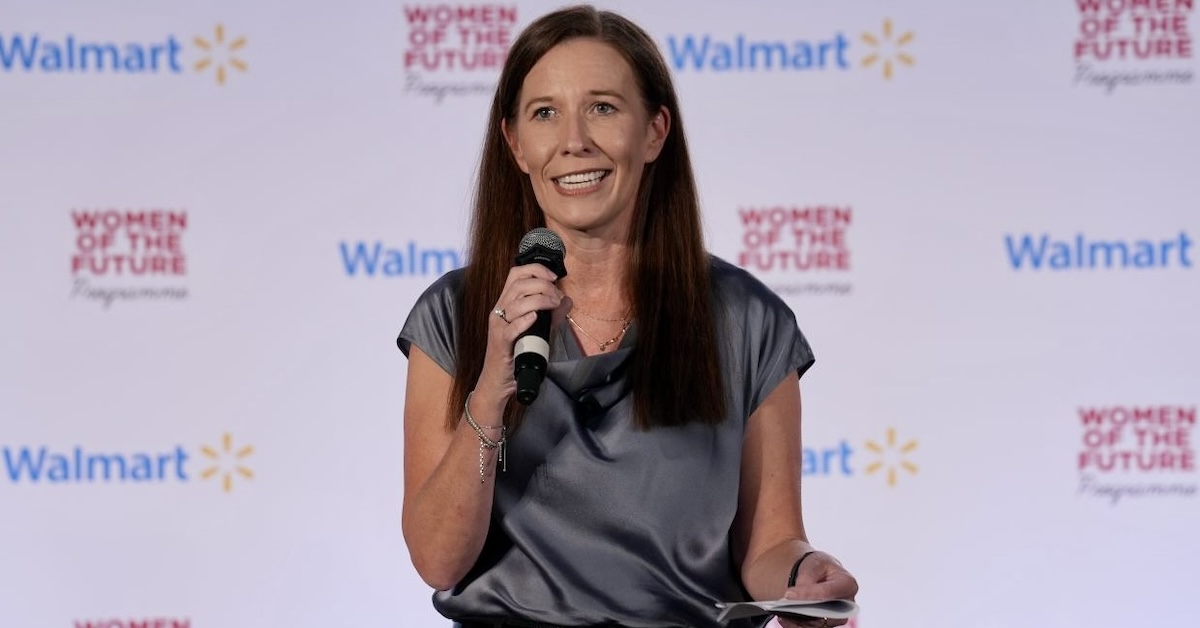
Caption: Kath McClay, President and CEO of Walmart International, Image Supplied.
South Africa’s retail landscape is taking shape as Massmart, the owner of Game, Makro and Builders considers closing about 20 Game stores across Gauteng, the Western Cape and KwaZulu-Natal.
Game currently operates about 122 outlets locally, part of a wider network of roughly 150 stores across 12 African countries.
In a statement shared with media, Massmart noted: “The potentially affected stores represent a small part of our total Game store portfolio, and we continue to invest in the future growth of Game, including through the rollout of our pantry merchandise proposition, which is enjoying high demand from Game customers.”
The group added that there are no plans in place to close the Game business.
That assurance comes despite mounting pressure on traditional big-box retailers, as analysts tracking the sector point to years of economic strain, rising competition and the rapid growth of online shopping as factors reshaping consumer habits.
Electronics and appliances, long staples of Game’s offering, rank among the most popular categories for e-commerce purchases.
Momentum behind the strategy became more visible late in 2025 when Walmart opened its first branded South African stores at Clearwater Mall and Fourways Mall, both converted from former Game sites. Another location is scheduled for launch in Boksburg during the first quarter of 2026.
Walmart, which first acquired a 51% stake in Massmart in 2011, moved to take full control in late 2022.
Kath McLay, who is the president and CEO of Walmart International, highlighted the company’s local ambitions.
“By partnering with South African suppliers and entrepreneurs, Walmart brings its signature Every Day Low Prices and global standards to the market.”
Massmart chief executive Miles Van Rensburg echoed that focus on affordability, noting: “Every rand matters when it comes to price. This balance of quality and everyday low prices enables us to build customer trust.”
Founded in 1962 by brothers Sam Walton and James “Bud” Walton in Rogers, Arkansas, Walmart has grown from a small discount store into a global retail powerhouse. It now operates 10,750 stores and clubs in 19 countries, alongside eCommerce platforms, and employs approximately 2.1 million people worldwide.
Johannesburg – Walmart’s push into South Africa is picking up speed, with new stores opening and more on the way, while Game’s network across the country continues to get smaller. This shift comes as Massmart, the local group fully owned by Walmart, looks at closing around 20 Game outlets in key provinces to make room for Walmart-branded shops. The changes highlight how the US retail giant is stepping up its game to offer better prices and quality goods to local shoppers facing tough economic times.
Walmart’s Growing Presence in South Africa
Walmart first dipped its toes into the South African market back in 2011 by buying a 51% stake in Massmart. By late 2022, it had taken full control, setting the stage for bigger moves. The company announced in September 2025 that it would open its first branded stores before the end of that year, marking a bold step to bring its well-known name directly to local consumers.
This expansion goes beyond just rebranding. Walmart aims to stock a wide mix of items, from fresh groceries and household basics to clothing and tech gadgets. Shoppers can expect exclusive private label products and unique items from around the world, all at competitive prices. The strategy focuses on quality and affordability, which Walmart sees as key to winning over South Africans hit by rising costs and weak growth.
Game’s Shrinking Network Amid Challenges
Game, a long-time favourite for electronics, appliances, and general goods, has been under strain for more than a decade. Fierce competition from other retailers and a sluggish economy have squeezed its profits and forced tough choices. Since late 2022, at least 13 Game stores have shut their doors, with some sites quickly turned into other formats or left empty.
Now, Massmart is reviewing about 20 more Game locations in Gauteng, the Western Cape, and KwaZulu-Natal. These could close soon, with plans to rebuild many as new Walmart outlets. This follows a pattern where struggling Game spots are repurposed to fit Walmart’s vision. For example, the Game store at East Point Shopping Centre in Boksburg closed in July 2025, paving the way for potential changes.
These closures are not taken lightly. Massmart has promised to talk with affected workers about options like moving to new roles or other support. The moves aim to streamline operations and focus on stronger brands, but they also reflect the harsh realities of a retail sector where only the most adaptable survive.
Key Store Openings and Rollout Plans
The rollout kicked off in November 2025 with Walmart’s first two stores in South Africa. One opened at Clearwater Mall in Roodepoort, and the other at Fourways Mall in Johannesburg. Both replaced former Game sites, allowing Walmart to hit the ground running without starting from scratch.
Building on that success, a third store is set to open in Boksburg on the East Rand by the end of February 2026. This location, likely at the old Game spot in East Point Shopping Centre, will bring Walmart’s affordable range closer to more communities. Company leaders have hinted at speeding up growth beyond Gauteng in 2026, with sites in other provinces under consideration.
Massmart plans to share more about its long-term strategy in the second quarter of 2026. This could include details on new builds, not just conversions, and how Walmart will blend with existing chains like Makro and Builders. The approach shows Walmart’s commitment to adapting to local needs while using its global muscle to offer better deals.
Impact on the Local Retail Scene
South Africa’s retail market, worth around R1.3 trillion, is heating up with Walmart’s arrival. It puts the US giant in direct rivalry with home-grown leaders like Shoprite, Woolworths, and Pick n Pay. These chains have long dominated groceries and general merchandise, but Walmart’s focus on low prices and wide variety could shake things up.
For shoppers, this means more choices and potentially lower costs on everyday items. Walmart’s entry follows a growth summit held in Johannesburg in April 2025, where the company connected with local suppliers to boost opportunities. This not only helps build a stronger supply chain but also supports jobs and small businesses in the area.
However, the changes raise questions about Game’s future. With roughly 100 stores left, Massmart might convert more to Walmart or shift them to mini-Makro formats, as seen in some past trials. Analysts see this as a reset for Walmart in Africa, sticking with South Africa despite pulling back from other low-growth spots worldwide.
Looking Ahead: Opportunities and Challenges
As Walmart ramps up, it faces hurdles like high unemployment, power outages, and supply chain snags that plague the local economy. Yet, with a population hungry for value, the timing could be right. The company’s 2.1 million global workforce and nearly R13 trillion in yearly revenue give it the tools to tackle these issues.
For Game employees and loyal customers, the transition brings uncertainty but also hope for fresh starts. Massmart stresses that any changes will involve talks to minimise job losses, possibly through transfers or training for new positions.
This evolving story underscores a bigger trend in South African retail: adaptation is key to survival. As Walmart grows and Game shrinks, the landscape is set for exciting shifts that could benefit consumers in the long run. Keep an eye out for updates as more stores open and strategies unfold.
Central News Special Edition | Issue 122: Download the Latest Print and E-Edition | Suspended Ekurhuleni Deputy Chief Julius Mkhwanazi Vows ‘I Can’t Go to Jail and Leave My Kids’ Amid Blue Lights Saga Scrutiny
Central News also offers Sponsored Editorial Content, Podcasts , Radio / Social Media Simulcast, Video Production , Live Streaming Services, Press Conferences, and Paid Interviews (Video/Audio) etc.
We guarantee exceptional exposure, reach, and engagement, with an excellent return on investment.
Advertisement:
To place your advert on our platforms (Print Newspaper or Digital Platforms) : Please email : sales@centralnews.co.za
For Business Related:
business@centralnews.co.za
Newsroom:
Send your Stories / Media Statements To: newsroom@centralnews.co.za
General Info:
info@centralnews.co.za
Office Administrator:
admin@centralnews.co.za
Whatsapp / Call: 081 495 5487
Website: https://www.centralnews.co.za
Social Media Platforms (@centralnewsza) : Linkedin, Facebook, Tiktok, Twitter, Instagram, Youtube
JOHANNESBURG – Game’s footprint in South Africa is shrinking, while Walmart’s presence is rapidly expanding.
Massmart is considering shutting down 20 Game stores across Gauteng, the Western Cape, and KwaZulu-Natal. The plan is to redevelop those sites into new Walmart outlets.
The game has been under pressure for over a decade, squeezed by rising competition and weak economics.
Walmart, which first bought a 51% stake in Massmart in 2011, took full control of the group in late 2022.
Its South African ambitions became clearer in November 2025, when Walmart opened its first branded stores at Clearwater Mall in Roodepoort and Fourways Mall
Both outlets replaced Game, signalling how Massmart planned to repurpose struggling Game sites as part of a larger rollout.
Massmart says further details of its long South African strategy will be announced in the second quarter of 2026.
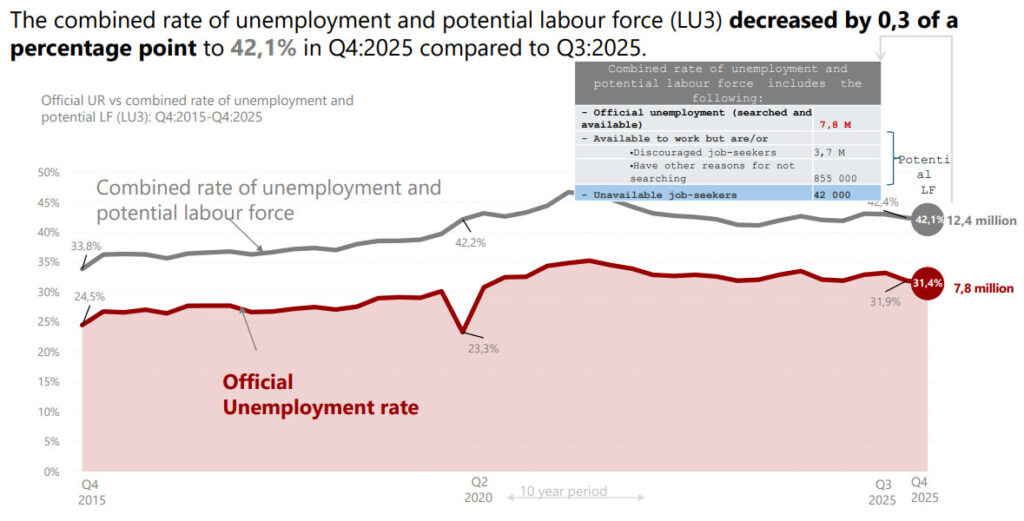
South Africa’s unemployment rate has dropped by 0.5 percentage points in the final quarter of 2025, to 31.4% from 31.9% in the previous quarter.
However, the country has added 2.6 million people to the number of unemployed over the past ten years, with shocking levels of youth unemployment persisting.
According to Stats SA, this marks an increase of 44,000 people employed in the country, taking the total to 17.1 million.
There was also a decrease of 172,000 unemployed people—now down to 7.8 million—with the labour force dropping by 128,000 people on a net basis.
The changes in employment and unemployment led to the official unemployment rate decreasing, while the combined rate—the new proxy for the previous “expanded unemployment rate”—remains at 42.1% (down from 42.4% previously).
The combined rate reflects the number of unemployed persons, as well as those who are available to work but are discouraged or not seeking employment.
Stats SA noted that this is a different metric from the previous expanded unemployment rate, but it tracks very closely to that rate and will be used going forward.
Over the fourth quarter, discouraged job-seekers increased by 233,000 to 3.7 million.
Other available job-seekers decreased by 110,000 to 855,000, and unavailable job-seekers decreased by 41,000 to 42,000, resulting in a total net increase of 82,000 to 4.6 million in the potential labour force population.
Others outside the labour force increased by 165,000 to 12.5 million. Outside the labour force, which is the total of the potential labour force and other outside the labour force, increased by 248,000 to 17.1 million in Q4 of 2025.
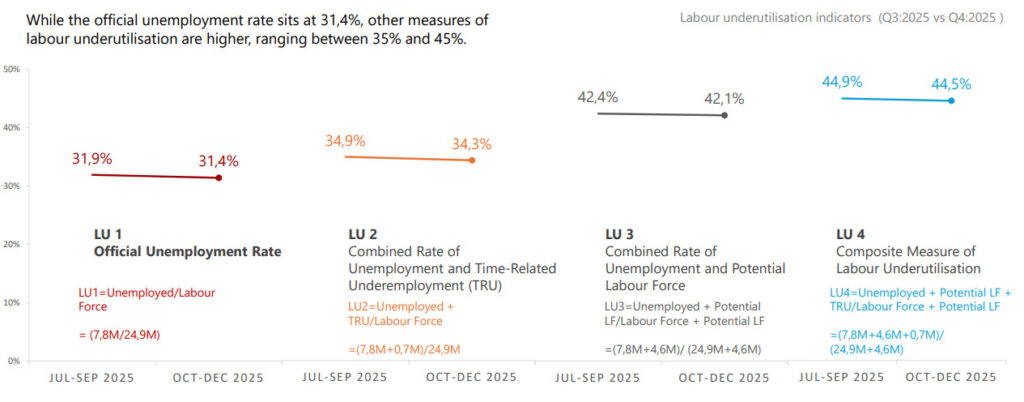
In addition to the unemployment rate, other measures of labour underutilisation were measured.
The combined rate of unemployment and time-related underemployment decreased by 0.6 of a percentage point to 34.3%.
The composite measure of labour underutilisation—which combines time-related underemployment, unemployment and potential labour force as a proportion of the extended labour force—was 44.5% in the fourth quarter of 2025 (down from 44.9% in the previous quarter).
These labour underutilisation measures highlight people in different situations and with different degrees of attachment to the labour market.
Overall, South Africa’s labour market shows improvements across all measures; however, the rates are still extremely high and reflect the persistent jobs crisis in the country.
Between Q4:2015 and Q4:2025, the number of unemployed persons in South Africa increased from 5.2 million to 7.8 million, with the proportion of those in long-term unemployment increasing from 66.9% to 79.7% over the same period.
Youth unemployment also remains extremely high, with unemployment rates of those in the working age 25-34 sitting at 44.3%.
Approximately 3.5 million out of 10.3 million (or 34.0%) young people aged 15-24 years are also not in employment, education or training (NEET).
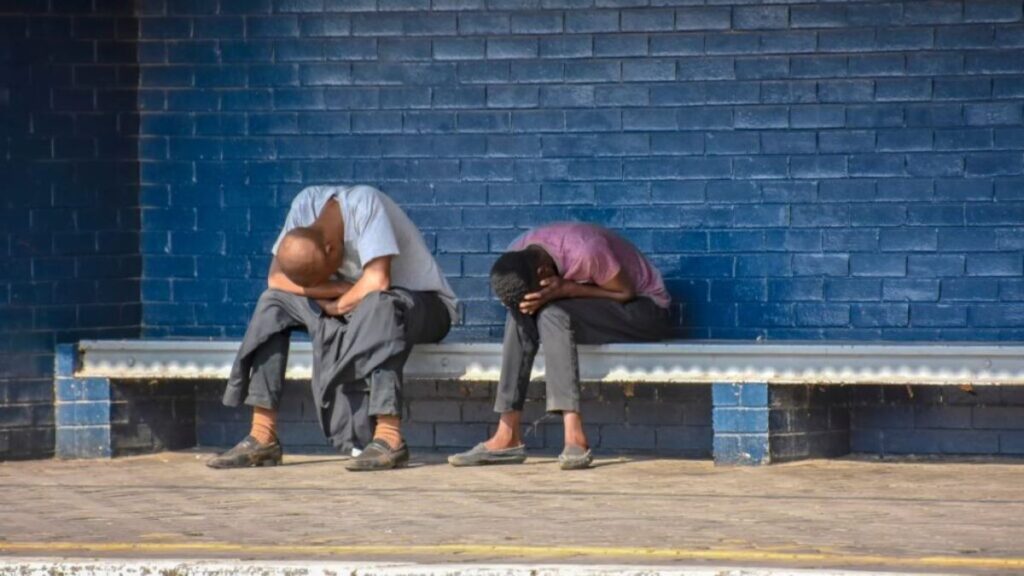
Unemployed job seekers line a street waiting for casual employment. File photo (REUTERS/Nic Bothma)
A busy local data calendar this week will ground South Africa’s economic ambitions in reality after heady reform talks buoyed sentiment following President Cyril Ramaphosa’s state of the nation address on Thursday night.
The president’s speech reiterated that job creation remains a priority for government, one which the state’s Operation Vulindlela aims to tackle by removing structural barriers to investment, such as power cuts, data costs and logistics bottlenecks.
On Tuesday, Stats SA will release the results of its quarterly labour force survey for the last three months of 2025, revealing the movement of the official unemployment rate over the quarter.
Structural unemployment continues to plague South Africa’s economy, with about a third of the country unable to find jobs.
The official rate was 31.9% in Q3 — five times higher than the average of South Africa’s G20 peers. While the Q4 reading is unlikely to be materially different, improving business sentiment offers some cause for optimism.
“While labour market conditions remain structurally weak, some economic growth momentum and an uptick in business confidence in Q4 could have helped with job growth,” said Bureau of Economic Research (BER) chief economist Lisette Ijssel de Schepper.
Investec economist Lara Hodes said she expects unemployment to have remained largely unchanged, potentially easing marginally to 31.7%.
Later in the week, Stats SA’s retail sales figures for the final month of 2025 will offer fresh insights into consumer spending and the demand side of the economy.
The BER’s latest retail survey pointed to increased confidence in the fourth quarter, with the metric climbing to 43% from 32% in Q3. The improvement was attributed to “more favourable trading conditions, buoyed by improved sales volumes and profitability in the sector”.
“Retail sales have been on a strong run and are set to cap off a solid year, reinforcing the view that household demand remained resilient despite still-tight financial conditions,” said Ijssel de Schepper.
According to Hodes, sales in the sector are expected to have climbed by about 3.2% year-on-year in December after a 3.5% uptick in the previous month.
On Wednesday, Stats SA will release its first consumer price index (CPI) for 2026, with January’s reading expected to have eased slightly on an annual basis thanks to a drop in fuel and food prices.
After contributing positively to inflation through Q4, fuel prices flipped back into deflationary territory in January, with the petrol price down 66c/l.
International food prices also fell by 2.1% month-on-month in January, with further downward pressure on domestic prices coming from a bumper maize harvest.
From 3.6% in December, Hodes forecast CPI at 3.5% year-on-year in January, while Ijssel de Schepper predicted a 3.4% rate.
Last, Stats SA will also release motor trade sales for December, providing an additional read on “big ticket” consumer spending at the end of 2025.
“These releases will help further refine our high-frequency GDP tracker and firm up views on the growth momentum heading into 2026,” said Ijssel de Schepper. – Business Day
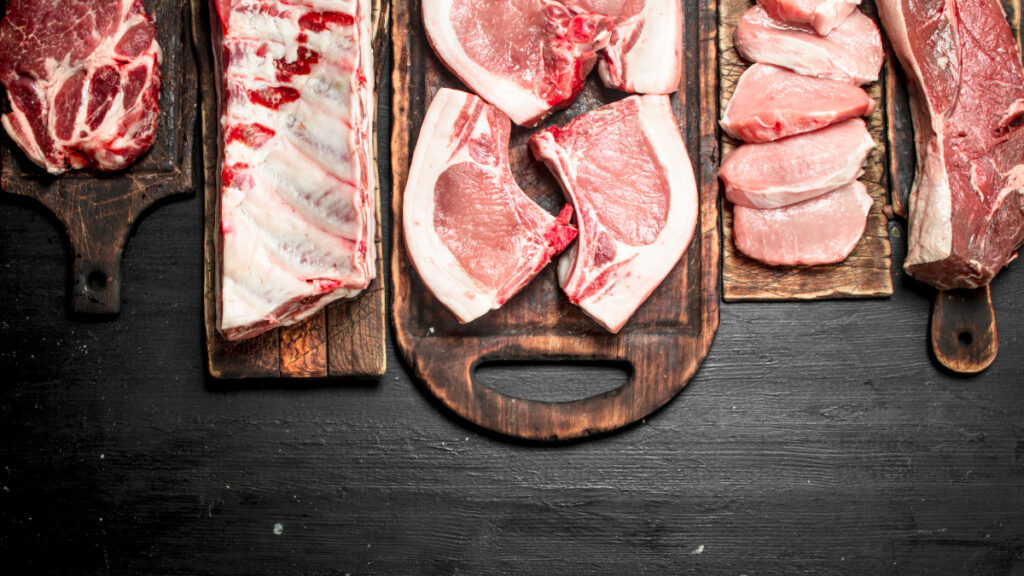
On top of the Foot and Mouth Disease outbreak hitting beef prices in South Africa, consumers and retailers have been warned that African Swine Fever (ASF) will hit pork prices in the coming months.
This follows recent communication to the trade from the South African Pork Producers’ Organisation (SAPPO), detailing the extent of disease outbreaks affecting commercial piggeries in the Free State, North West, KwaZulu-Natal and north-east of Pretoria.
According to Arnold Prinsloo, CEO of Eskort, the pork market is highly sensitive to even small supply disruptions.
“South Africa slaughters roughly 72,000 pigs per week across the formal and informal sectors. The formal market has lost approximately 7,000 pigs due to the combined impact of ASF and FMD outbreaks,” he said.
“While this represents a relatively small percentage of total supply, even a 2% shortage can drive price increases of around 10%. This is the reality of pork’s price elasticity.”
Pork prices have moved significantly in recent weeks, with wholesale prices rising from about R32 per kilogram to R40.
Further increases are expected as the effects of disease outbreaks work through the supply chain.
“Until recently, we were able to hold prices stable because the industry had surplus stock that served as a buffer,” Vosloo said.
“That buffer has now been depleted, and we’re seeing the same supply-and-demand dynamics that recently affected the beef industry.”
Eskort, which accounts for about 10% of South Africa’s pork market, has had no cases of ASF or FMD among its farmers.
“While our biosecurity measures have protected our operations to date, we remain vigilant,” Vosloo said. However, this does not mean the group is not impacted.
“Even though Eskort has not lost animals to these diseases, we operate in a broader market where supply and demand determine pricing. When the overall supply contracts, it affects pricing across the board.”
Bad news for inflation
herd of cattle in silhouette at sunset
SAPPO has confirmed that all pork entering the market through formal channels remains safe for consumption, as ASF and FMD are animal health diseases that pose no risk to human health.
Strict veterinary oversight and inspection protocols under the Meat Safety Act continue to ensure food safety.
The organisation is working closely with producers, abattoirs and state veterinary services to manage the outbreaks while maintaining market stability and consumer confidence.
Rising meat prices are one of the key drivers of inflation at present.
While overall inflation is stable around 3.5%, inflation data for food & non-alcoholic beverages (Food NAB) is higher.
In December 2025, Food NAB remained stable at 4.4% y/y, after ticking higher since the outbreak of FMD in mid-2025.
Headline inflation is expected to remain fairly stable for the rest of this year, but economists have flagged meat as a major risk factor.
In December, meat inflation continued its upward trajectory in Stats SA’s basket, rising to 12.6% from 12.2% in November.
Economists at Nedbank warned that the ongoing outbreak of Foot and Mouth Disease in South Africa would keep pushing up meat prices for the months to come.
They warned that, on top of the past six months or so of large increases, consumers can expect double-digit meat price inflation to last until roughly April 2026.