
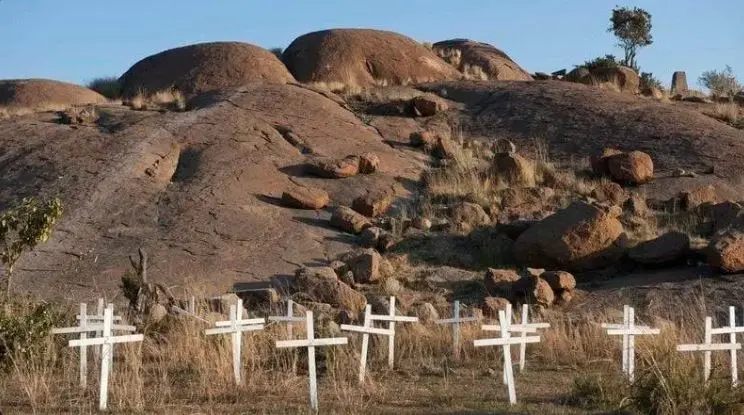
Marikana exposed the fault lines between labour, power and profit, leaving families to bear the deepest costs
Fourteen years after the tragedy at Lonmin’s platinum mine in Marikana, the 16 August 2012 massacre remains a significant event in South Africa’s democratic history.
The state’s killing of 34 striking miners was more than just a failure in policing; it highlighted a serious crisis in the country’s political economy. Marikana revealed the weaknesses in South Africa’s post-1994 class compromise and underscored the fragility of its institutions.
State-corporate collusion and capital extraction
South Africa’s post-apartheid capitalist system relies on cheap black labour, historically supported by migrant labour systems.
At Marikana, Lonmin operated within this framework, prioritising profits and shareholder dividends over worker safety and fair wages. When miners organised an independent strike to demand a living wage, the state deployed the police service, not to mediate but to protect corporate interests and economic stability. The situation illustrates how the state functions as an arm of patriarchal-capitalist power, enforcing compliance through violence rather than democratic negotiation.
South Africa’s industrial relations were meant to balance capital growth with social fairness, aiming for shared prosperity in a growing economy. Marikana exposed this as a false promise. The political economy of the platinum belt depends on cheap, racialised migrant labour, low corporate tax contributions and aggressive profit-shifting by multinational companies. Firms like Lonmin amassed significant wealth while leaving workers in poor, informal settlements lacking basic sanitation and infrastructure.
It is essential to recognise that the R12 500 demand was not just a dispute over wages. It highlighted the organisation of migrant labour and the burden of sustaining workers that fell elsewhere.
Migrant labour systems depend on workers whose families remain in rural areas. These communities bear the domestic responsibilities needed to support workers’ lives away from the mine. The demand questioned whether the pay at the mine was enough to support the life it was meant to sustain.
The industrial relations system failed to address the inequalities because its focus shifted to maintaining stability for investors rather than redistributing economic power. Marikana demonstrated that capital and labour cannot negotiate shared prosperity peacefully while the economy remains rooted in colonial-era extraction.
The structure of South Africa’s labour relations, established under the Labour Relations Act, aimed to control class struggle through regulated collective bargaining. It relied on a supposed harmony among the state, organised businesses and formal labour.
However, Marikana indicated a serious decline in the system.
Crisis of representation and bureaucratic unionism
The rock drill operators’ strike began outside the usual bureaucratic collective bargaining channels. It disregarded a comfortable corporatism where major trade unions became disconnected from workers’ concerns. When miners demanded a
living wage of R12 500, they challenged not only Lonmin’s profits but also the legitimacy of a rigid bargaining system.
Their disconnection stemmed from a crisis of representation. The National Union of Mineworkers’ (NUM) position in Cosatu and the ANC-led Tripartite Alliance created tension between representing workers in conflict with capital, which the state protected and operating within a political alliance tied to the state. The rise of independent worker committees revealed a lack of meaningful representation. Also, the state’s use of deadly force indicated what could happen when institutional methods failed to suppress class resistance.
For nearly 20 years after 1994, South Africa celebrated the strength of labour because of its partnership with the governing ANC. Marikana violently shattered the belief, showing that the working class’s nominal power was constrained by its integration into state processes.
The traditional labour movement became ideologically divided, torn between loyalty to a liberation movement that became a governing party and the harsh realities of worker exploitation.
When workers took real action by organising outside established structures, they quickly found that state power was used to protect capital against labour struggles. Labour power proved conditional, permitted only within state-approved channels but met with violence when it threatened the status quo.
As the strike gained momentum beyond established bargaining structures, the miners were gradually depicted not as workers uniting for a labour issue but as a threat to public order and capital.
The night before the massacre, the then-minister of mineral resources, in discussing the situation with then Lonmin non-executive director Cyril Ramaphosa, asserted that it was “not a labour dispute but a criminal act”. The label had significant consequences.
Once the miners’ actions were framed as criminal rather than labour claims, their demands could be minimised by “concerns” over disorder. The shift meant that their form of organisation was not viewed through a lens of negotiation but through the need for containment. This led to one of the deadliest uses of force by the police since the Sharpeville massacre.
