
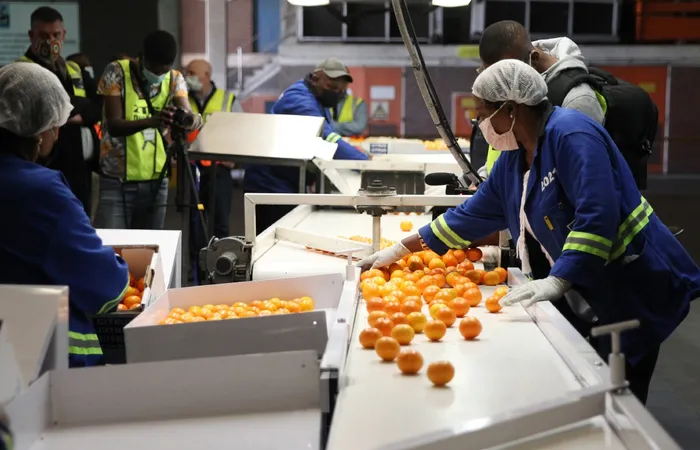
Citrus farmers and workers in export-dependent communities face uncertainty after the US announced plans to end South Africa’s AGOA trade benefits from January 2027. Image: Doctor Ngcobo / ANA Studio
Thousands of South African jobs could be at risk if the United States withdraws the country’s preferential trade benefits under the African Growth and Opportunity Act (AGOA), with Cosatu estimating that 3 000 jobs could be lost, a figure that could rise to 10 000 in a worst-case scenario.
Asked how many jobs it expected to be lost following South Africa’s exclusion, Cosatu parliamentary co-ordinator Matthew Parks said: “Most likely 3 000 jobs. At most 10 000.”
Citrus Growers’ Association of Southern Africa chief executive Dr Boitshoko Ntshabele said that at least 35 000 farm-level jobs in the Western and Northern Cape were sustained by citrus exports to the US, although it was too early to estimate how many could be lost if South Africa was excluded from AGOA.
The US buys 5% to 6% of South Africa’s citrus export volume, but that trade is concentrated in those provinces.
Washington announced on Monday that it intended to end South Africa’s and Rwanda’s AGOA eligibility from January 1, 2027. The programme removes ordinary US import duties on qualifying goods from eligible African countries, although additional tariffs may still apply.
US Trade Representative Jamieson Greer cited concerns about barriers to American trade and investment, corruption, and US national security and foreign policy interests.
Parks identified agriculture, particularly citrus, and manufacturing as vulnerable in the Western Cape.
He said existing US tariffs introduced by President Donald Trump had already cost about 100 jewellery jobs in Cape Town, 450 furniture manufacturing jobs in Atlantis and Malmesbury, and 450 food-canning jobs in Tulbagh, with further losses in Cape Town’s packaging sector.
Those losses preceded the proposed AGOA withdrawal.
Cosatu called for continued negotiations and support for affected workers and companies, including industrial incentives, tax holidays and assistance through the Unemployment Insurance Fund’s Temporary Employment Relief Scheme.
“We cannot afford to abandon a single worker, business, industry or community,” the federation said.
Parks said negotiations should continue even if the January deadline passed, noting that countries previously removed from AGOA had later been reinstated.
The citrus association identified Citrusdal as heavily dependent on American buyers.
Its chairman, Gerrit van der Merwe, said growers could not readily redirect their fruit.
“A citrus grower cannot simply divert his crop to another market – markets have different phytosanitary requirements and consumer tastes. Entire orchards have been planted specifically for the US market.”
The association said losing Agoa would expose citrus exports to ordinary US duties generally ranging from 1.5 to 2.5 US cents per kilogram. Mandarins, lemons and grapefruit would face those alongside an existing 12.5% tariff, putting exporters at a disadvantage to competitors such as Peru and Chile.
Ntshabele said a bilateral trade agreement with the US would be the best solution. Alternatively, she proposed separate Agoa treatment for seasonal fresh produce.
Agricultural economist Wandile Sihlobo said the US accounted for about 4% of South Africa’s agricultural exports, worth $504 million in 2025. Losing preferential access would not close the American market but could make products less competitive.
He urged diversification into Asia and the Middle East without abandoning established markets.
Johann Els, chief economist at PSG Financial Services, said the direct effect on national economic growth was likely to be small.
“The bigger concern is the potential impact on business confidence, investment and diplomatic relations between the two countries,” he said.
IMM Graduate School research dean Dr Ernest van Biljon said national trade figures could conceal the impact on individual communities. Automotive products accounted for 64% of Agoa exports in 2024, although Europe bought more than half of South Africa’s automotive export volumes, he said.
Naamsa, the Automotive Business Council, was approached for comment but had not responded at the time of writing.
Government said Agoa exports fell from $4 billion in 2024 to about $1.7 billion in 2025, representing roughly 10% of South African exports to the US. Most exports entered under ordinary trade terms.
Pretoria said it had offered further trade concessions to Washington and would assess the impact on individual companies while retaining measures introduced in response to earlier US tariffs.
Trade, Industry and Competition Minister Parks Tau said negotiations would continue alongside efforts to find alternative markets and protect jobs.
karen.singh@nationalmg.co.za