
Organised labour wants a seat at the table as government and business deepen economic co-operation
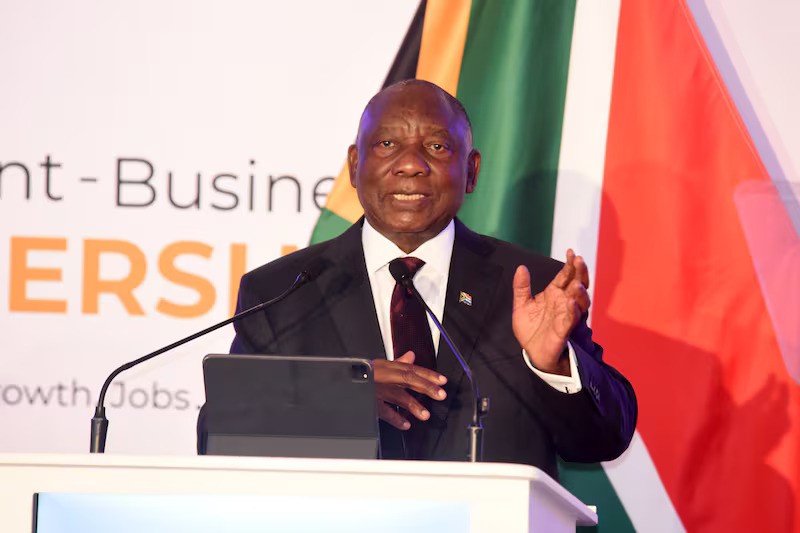
President Cyril Ramaphosa during the launch of phase 3 of the government-business partnership, an economic partnership aimed at driving reforms, boosting investment and creating jobs, at Summer Place in Johannesburg. Picture: (Freddy Mavunda)
While big business and government have rallied behind a partnership aimed at unlocking 3% economic growth, creating jobs and boosting investment confidence, organised labour has raised concerns about being excluded from the pact.
This follows President Cyril Ramaphosa’s recent launch of phase 3 of the business-government partnership, which he said marked the next chapter in the joint effort to accelerate inclusive economic growth, unlock investment, strengthen confidence and create jobs.
“Phase 3 is focused on urgently addressing the societal crisis of low growth and unemployment. It adds additional sectors to the partnership platform, with the goal of 3%+ growth and one-million additional jobs by 2030,” Ramaphosa said at the launch.
“The challenge is urgent. While growth has improved over the past two years, it remains too low to meaningfully expand employment; 8.5-million people are without work, and about 300,000 net new work-seekers enter the labour force every year. At below 3% growth, new entrants outpace job creation; above it, jobs compound. Phase 3 is designed to get South Africa decisively above that line.”
SA Federation of Trade Unions (Saftu) general secretary Zwelinzima Vavi said Saftu had no objection in principle to the government engaging business.
“Government must engage all sectors of society. Our objection arises when a bilateral relationship between government and corporate South Africa increasingly becomes an important centre for developing and implementing economic policy and structural reforms, while organised workers — who will experience the consequences most directly — are outside the room.”
He said Saftu supported genuine measures to end mass unemployment, rebuild infrastructure, restore reliable electricity and logistics systems, reindustrialise the economy and create millions of decent jobs. “But we must ask: growth for whom? Jobs of what quality? And on whose terms? The scale of the unemployment catastrophe makes the exclusion of organised labour even more indefensible.”
It was extraordinary that a programme whose central declared objective is “growth and jobs” can be developed through an institutional partnership between government and business without organised labour sitting at the table as an equal partner, Vavi said, describing the partnership as “Operation Vulindlela at its most advanced”.
The government launched Operation Vulindlela, a joint initiative between the Presidency and the Treasury, in October 2020 in a bid to accelerate structural reforms to drive rapid, inclusive economic growth, job creation and improved service delivery.
Vavi bemoaned the fact that “business enjoys direct institutional access to the president, ministers and senior government officials through this partnership, while organised labour has no equivalent position within it”.
“South Africa already has an established institution for social dialogue — Nedlac [National Economic Development and Labour Council] — precisely because economic and social policy should not be determined through privileged bilateral arrangements. Government, organised business, organised labour and the community constituency are supposed to engage each other as social partners,” he said.
“A government-business bilateral must therefore not gradually become an alternative economic decision-making centre that sidelines Nedlac, organised labour and working-class communities.”
Vavi said Saftu’s position was not that government must stop talking to business. “Our position is that business cannot enjoy privileged access to the state and a privileged role in shaping the country’s economic trajectory while organised workers are excluded. Nor can workers simply be invited afterwards to manage the social and employment consequences of decisions already taken elsewhere,” he said.
“South Africa needs genuine social dialogue and ultimately a genuine social compact — not a government-business compact presented as though it represents society as a whole.
“Any credible programme to reconstruct South Africa’s economy must therefore place organised labour, unemployed workers and working-class communities at the centre of determining our economic future — not invite them to comment after government and business have already decided what constitutes ‘reform’, ‘growth’ and ‘job creation’.”
The Federation of Unions of SA (Fedusa) acting general secretary Ashley Benjamin said the government-business relationship was welcomed, as it is in “the greater interest of millions of South Africans who are in need of employment and sustainable livelihoods”.
“However, we note that while organised labour is acknowledged as an important stakeholder, it is not formally included as a partner in the government-business partnership. Fedusa believes that organised labour should have a formal role in the governance, design, monitoring and implementation of the workstreams, particularly in mining, agriculture, tourism, infrastructure, energy and logistics,” Benjamin said.
“As organised labour, we have an important role to play as the collective voice of workers in advocating for fair wages, safe and decent working conditions, job security and inclusive economic policies. As new jobs are created, it is equally important to ensure that workers’ rights are protected and that working conditions are conducive to decent work.”
He said job creation must not come at the expense of workers’ rights or result in the creation of unsafe and unsustainable jobs.
“With youth unemployment remaining alarmingly high, Fedusa trusts that the partnership will deliver on its commitment to empowering young people, creating meaningful employment opportunities and ensuring that young South Africans are able to participate meaningfully in the economy. Fedusa reiterates its opposition to the privatisation of state assets, as they play an important role in economic development, industrialisation and job creation.”
Cosatu national spokesperson Zanele Sabela said the ANC-aligned labour federation had been asking why organised labour had been excluded from the partnership. “We have asked the same question many times. We warned them not to undermine Nedlac. They blue-ticked us. We need to work together to attain the 3% to 5% growth to slash unemployment,” Sabela said.
National Council of Trade Unions (Nactu) general secretary Narius Moloto said: “Nactu does not support this business-government exclusive partnership. That will be considered a conspiracy against workers. The economy that excludes organised labour cannot work. Even the apartheid government, towards its end, realised the inclusion of organised labour to make progress.”
Contacted for comment, Ramaphosa’s spokesperson Vincent Magwenya said: “There are regular consultations with labour, within Nedlac and during direct engagements. The partnership with business is project-specific and focused on resource mobilisation.”
Business Leadership South Africa CEO Busi Mavuso, who has rallied behind the partnership, said a government committed to reforms and creating a policy environment to support growth, coupled with a business partner committed to successful implementation, is likely “to lead to far greater levels of investment”.
“We are seeing how that leads to growth through the huge investments into new energy generation and new logistics infrastructure, including rolling stock and port capacity. Private investment of more than R360bn has flowed into new renewable energy projects. While still early, we have seen commitments of more than R20bn to new port and rail projects, from the Durban Container Terminal to new locomotives and waggons,” Mavuso said.
Ramaphosa has said by deepening these social partnerships and maintaining collective momentum, “we will convert confidence into investment, growth and jobs. And we will convert transformational reforms into shared prosperity for all.”
Phase 3 is built on three tiers, said Mavuso, explaining: “First, conclude the reforms required in the growth-enabling sectors, energy and transport and logistics. Second, focus on a few key sectors in which South Africa has a global competitive advantage, [which] have the potential to create many jobs, and which have underperformed relative to their potential, namely mining, agriculture, tourism and infrastructure.
“Third, focus on the confidence multipliers that are key to marshalling investment, namely crime and corruption, a more evidence-based ‘SA Inc’ narrative and the City of Johannesburg.”
The partnership that business and government had built is an example to the world of how social partners could work effectively together, Mavuso said.
“I am often frustrated at the pace of reform, but last week was a moment to step back and recognise how far we have come and how the opportunity ahead is real. Growth of more than 3% is the target we must all be held to. The jobs South Africa needs depend on us hitting it.”
South Africa’s unemployment rate rose to 33.6% in the second quarter of 2026 from 32.7% in the first quarter, the highest since the second quarter of 2022. Deputy President Paul Mashatile told the Nedlac annual summit three years ago that ideology seemed to be at the centre of the inability of social partners at the country’s policy formulation body to hammer out a social compact to address joblessness and low economic growth.
This was because the government, business, labour and community bloc at Nedlac all share different ideologies about the trajectory the country should take to tackle runaway unemployment, low economic growth, entrenched poverty, violent crime, systemic corruption and infrastructure development, among other socioeconomic ills.
Nedlac spokesperson Moipone Molete said: “The partnership was birthed through the economic reconstruction and recovery plan, which was crafted by Nedlac social partners and later endorsed by the president in parliament. The [recovery plan] was developed to restore, reform and transform our economy after the Covid-19 crisis.”
She noted that Nedlac regularly receives progress updates on the implementation of the interventions and provides inputs for these measures to achieve the intended objectives. “So, Nedlac is not left out in the process.”