
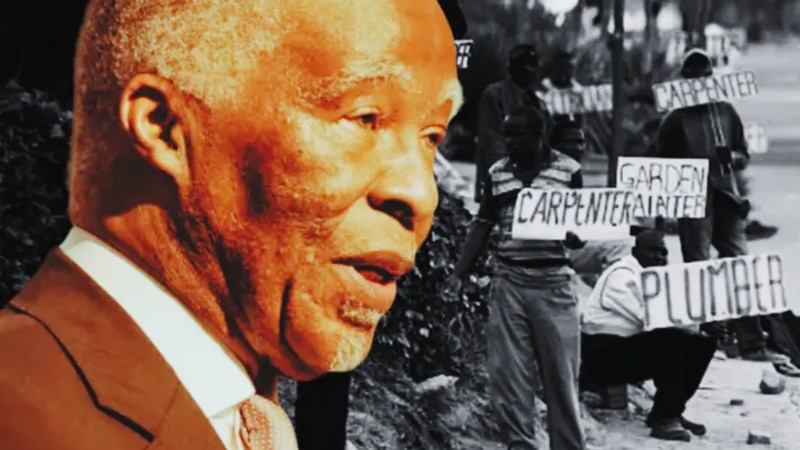
RESPONDING to the current anti-immigrant crisis in South Africa, former President Thabo Mbeki is fundamentally wrong when he strongly asserted that the country is under an externally organised and coordinated political destabilisation campaign and that it was not a spontaneous eruption.
I completely disagree with Mbeki. Instead, the root causes of the unprecedented anti-immigrant crisis, while very complex, multifaceted and convoluted, are deeply systemic and structural.
It is not true that these huge and combustible protests, especially over the past few weeks, suggest that these are the results of an organised effort to isolate South Africa from the rest of the African continent.
I think Mbeki wants to deflect our attention from his role in our current neoliberal economic policies, especially when the Reconstruction & Development Plan office was shut down in March 1996 and just three months later, in June, the Growth, Employment & Redistribution and Strategy (Gear) was imposed by the ANC government, in which he, as deputy president, and former finance minister Trevor Manuel played the biggest roles.
The allies of the ANC, the Congress of South African Trade Unions (Cosatu) and the South African Communist Party (SACP), have, in public, many times criticised these policies and attribute the ongoing austerity budgets we are saddled with to those macroeconomic policies.
While the roots of the current unlawful immigration crisis are undoubtedly serious problems with corruption and inefficiencies at the Home Affairs Department over many years, there must be no doubt that we have had an unprecedented socioeconomic crisis which has had a devastating effect on the daily lives of the majority black working-class communities.
Things have never been as bad as they are today in South Africa. We have the biggest jobless, food, health, housing and education crisis since 1994, if not since the Union of South Africa was formed in 1910.
It is a devastating crisis which has torn communities apart, affecting both South Africans and immigrants from other parts of Africa.
It is this same and ever-worsening crisis which has pitted poor Black South Africans in townships against immigrant workers and small business operators, such as spaza shop owners.
We have had a generalised infrastructural crisis for many years, which has increased cost-of-living pressures on both these sections of what is essentially a Black working class living under similar social conditions.
When people are daily and intensely affected by a devastating socioeconomic crisis and struggling to survive, they tend to take out their accumulated frustrations on others within their communities. In this sense, there indeed has been a largely scapegoating of African migrants from other countries in Africa.
But it was the responsibility of the government to have taken administrative enforcement measures to deal with and act against unlawful or undocumented migrants over the years. They did not do so or certainly not to the extent necessary.
This is the root cause of the undocumented crisis, and there can be no doubt that corruption in the Home Affairs department played a huge role in this administrative failure.
So, it is not only a failure by undocumented migrants to deal with the problems, but also the failure by the authorities to enforce the relevant laws timeously. It is this administrative failure by Home Affairs which must bear the biggest responsibility for the undocumented crisis.
But to understand the real roots of this crisis, we need to locate it within the overall societal context we have had for many years. This has been a context of persistent cost-of-living increases and daily struggles to eke out a living in the black townships.
It is this context which gave rise to both Operation Dudula and the March and March organisations. While much of the conduct and sentiments of supporters of these organisations do point to xenophobic and Afrophobic elements, I think it is a worsening socioeconomic crisis which underlies it.
I repeat what I stated recently: the crisis is not really as a result of conscious xenophobia or Afrophobia by Black South Africans towards Africans from other parts of the continent but much more the devastating impacts of a worsening socioeconomic crisis of unemployment, poverty and raging inequalities.
There has been much in the media which strongly points to the fallacy of the belief that the problems of unemployment and a whole host of social evils experienced by Black South Africans will be resolved if those who are undocumented return to their countries of origin.
This is a vitally important, factual and compelling observation, which those who glibly attribute their problems to the presence of other African migrants should consider, because it shows that indeed they are being scapegoated.
But a very big and ominous danger is that it strongly appears that many black South Africans want all migrants to leave South Africa, including those who are properly documented. That would not only be highly unlawful but, in fact, plainly xenophobic or Afrophobic.
On the other hand, if indeed it is true that Nigerians are prominently involved in the drug trade and especially the selling of drugs to teenagers, then it must be dealt with, but we must try to avoid generalisations.
I am sure that there are also Black South Africans who are involved in the drug trade in Black townships.
But there can be no or little doubt that the ANC is going to be adversely affected by the African migrant crisis in the upcoming local government elections in November.
The comments expressed on various social media platforms on this crisis strongly suggest that many or even most think the ANC bears primary responsibility for the immigrant crisis.
This is not to say that the ANC government, until they lost the 2024 national elections, did nothing to address the problems in the Home Affairs Department. But very clearly, they allowed the problems and weakness there to worsen over a long period of time.
It appears that the corruption in Home Affairs over many years has had a very negative impact on both dealing with those problems and available resources. We learnt recently that the department nationally only has 832 officers dealing with these complex immigration issues.
But it is very important to understand that the primary causes of the immigrant crisis are not exogenous, as much as the global situation is so complex that there could indeed be other unfavourable agendas at play. I doubt very much that those are of pivotal causal importance.
No, it is the devastating socioeconomic crisis of worsening poverty, unemployment, inequalities and the related daily miseries and fierce competition for dwindling resources which lie beneath it, which are the biggest causes of the immigration crisis.
Besides, we are the most unequal society in the world, with one of the highest unemployment rates in it, especially among Black youth.
But not even all of that prepared me for the horrors I seen on TV and social media over the past few weeks, when affected undocumented migrants and their families hurriedly tried to get out of the country by the deadline of June 30.
Though not official, the stern warning they were given was to be out of the country by that date.
Migrants being terribly beaten up included some who were documented, and some were even killed, signalling the most dangerous, unfortunate, chaotic and, in fact, tragic situation to have developed recently.
The biggest danger is the insane demand by some protesters that all migrants, included those documented, must leave this country.
If that inclination persists, we are going to descend into utter chaos and naked vigilantism, some elements of which we already seen recently. It is my earnest wish that the government and all forms of our media actively combine to play a role in dissuading such a course of action.
To go down such a disastrous path is going be the worst and most catastrophic development in post-apartheid SA, which we must very urgently avoid. It is a doomsday scenario we must collectively do our utmost to avoid because there will be no winners.
* Dr Ebrahim Harvey is a political writer, analyst, and commentator.
** The views expressed here do not reflect those of the Sunday Independent, Independent Media, or IOL.
Source: https://africannewsagency.com/mbeki-is-wrong-about-the-anti-immigrant-crisis-south-africa-faces/