
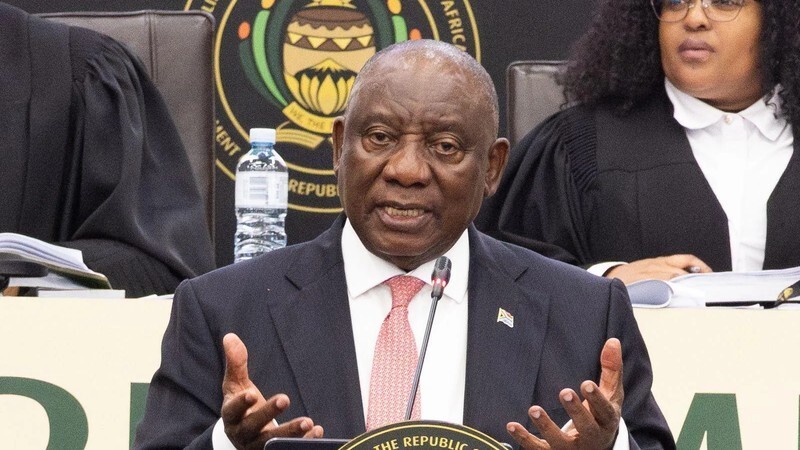
Nearly a year after President Cyril Ramaphosa unveiled the National Dialogue as South Africa’s blueprint for tackling the country’s deepest social and economic divisions, its role is being questioned after weeks of anti-illegal migrant protests unfolded with little visible intervention from the flagship initiative.
Launched in August last year, the National Dialogue was billed as a citizen-led process to help South Africans confront poverty, unemployment, inequality, and social divisions.
While critics argue the recent migration tensions presented exactly the kind of national conversation it was created to facilitate, the government said the initiative is a long-term democratic process rather than a crisis-response mechanism.
As protests targeting undocumented migrants spread across several communities in recent weeks, many expected the Dialogue to provide a platform for national engagement on an issue that has increasingly polarised public opinion.
For the Rural Women’s Assembly (RWA), that opportunity was missed.
Denia Jansen, the organisation’s Western Cape representative, said very little had happened on the ground since the Dialogue was launched.
“Nothing much has been done. Things have not yet started concerning the dialogues, and different sectors are trying to reach out to members to pilot the National Dialogue,” Jansen said.
“Our sector – land, rural communities, and agriculture – has a draft plan to invite all the stakeholders to identify pilot areas for the National Dialogue, but at the moment nothing has been done.”
Jansen said that if the National Dialogue was genuinely intended to be a bottom-up process, it should have played a visible role as anti-illegal migrant tensions escalated.
“The National Dialogue should have prioritised the anti-illegal migrant protests. The absence of the National Dialogue proves it exists only on paper.“
She argued that the demonstrations reflected deeper structural failures that the government had failed to address.
“Poverty, unemployment, hunger, and violence are daily struggles for our communities. Women are at the centre of all these crises. The anti-illegal migrant issue is another burden on communities, especially women, whose responsibility is to put food on the table.
“Migrants were never our enemies. We live and work together and become friends and neighbours. Women and children will suffer the consequences of a collapsed local economy.”
Jansen also linked the current tensions to stalled land reform.
“The president has not adequately provided land for women to grow food to feed their families. As long as women cannot access land, hunger and unemployment will always be huge issues in South Africa while the government watches the poor fight each other for crumbs – like what is happening now with migrants.”
The government, however, maintains that the National Dialogue should not be viewed as an emergency response mechanism.
Deputy Minister in the Presidency for Women, Youth and Persons with Disabilities, Mmapaseka Steve Letsike, said the initiative was never intended to replace government institutions responsible for maintaining public order.
“We should be careful not to judge the National Dialogue as though it were a once-off event that could immediately resolve decades of social and economic challenges.”
Letsike said the purpose of the Dialogue was to strengthen democratic participation over time.
“The success of the National Dialogue should not be measured by whether difficult issues continue to arise. Rather, it should be measured by whether South Africans increasingly choose dialogue over division, participation over polarisation, and democratic engagement over violence.”
Letsike acknowledged that the recent protests exposed deep anxieties around unemployment, inequality, crime, service delivery, and belonging, but said those were exactly the kinds of issues the Dialogue was designed to confront.
“The National Dialogue provides an opportunity for citizens to engage honestly on complex issues such as migration, unemployment, inequality, social cohesion, and public trust.”
The minister said sustainable peace could not be secured through law enforcement alone and argued that South Africa needed democratic spaces where citizens could confront difficult issues before they escalated into conflict.
“The National Dialogue should become part of South Africa’s democratic infrastructure.”
Organised labour has also urged patience.
Matthew Parks, parliamentary coordinator for the Congress of South African Trade Unions (COSATU), said the process was still in its rollout phase.
“The dialogue is still in its rollout phase with sectoral engagements taking place and soon ward engagements to begin.”
Parks said that expecting the Dialogue to intervene directly during the recent protests was a misunderstanding of its purpose.
“The Dialogue would not have the capacity or mandate to do so. It’s intended to engage society on its issues and proposals, and to provide solutions for government and society on issues like migration, unemployment, and crime.”
However, he agreed that the initiative now needed to become more visible in communities.
“We need it to move to engaging people on the ground and coming with concrete proposals on what needs to be done,” he said.
lilita.gcwabe@inl.co.za