
Party’s 87-member decision-making body lays down the law for Ramaphosa and his top ANC aides
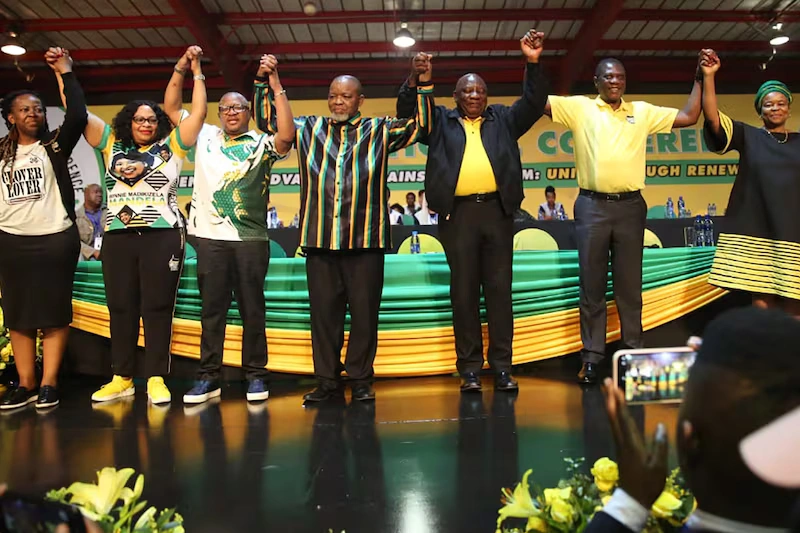
The ANC’s new top seven officials — Maropene Ramokgopa, Nomvula Mokonyane, Fikile Mbalula, Gwede Mantashe, Cyril Ramaphosa, Paul Mashatile and Gwen Ramokgopa. File photo: Theo Jephta
The ANC’s top seven, their party reeling from another electoral shock, came under fire this week at a meeting of the national executive committee (NEC) where senior members accused them of sidelining the decision-making structure and taking unilateral decisions on critical matters.
The tensions came to a head at the NEC meeting on Thursday, when at least 20 members are understood to have challenged the national officials over what they described as growing disregard for the authority of the committee, which has 80 members elected by branches and is the party’s top decision-making structure.
The top seven comprise:
Divisions over the ANC’s proposed coalition strategy following the local government elections on November 4, which left the party without an outright majority in any of the eight metros, took centre stage at the NEC meeting.
Members rejected a recommendation by the national working committee (NWC), which oversees the party’s day-to-day operations between NEC meetings, that the DA should be considered a strategic and preferred partner in municipal coalition negotiations.
Several NEC insiders who spoke to the Sunday Times said members were particularly aggrieved that the national officials had failed to convene NEC meetings at crucial points during the election period, with the top seven taking their own decisions on issues that should have debated by the entire committee.
“There is frustration with the way the officials have conducted themselves, especially in the latter part of this term,” one source said.
We directed the officials to speak to other parties to extend the GNU last year. That decision was ignored. That can’t be right
— ANC NEC source
“I think most people have taken issue with the fact that the NEC has failed to convene meetings at critical times. We are elected by conference and trusted to make decisions on behalf of the organisation by branches. Many of us felt that this power has been stripped by the officials,” this person said.
Another source said senior NEC members were unhappy that the top seven had also decided the meeting this week, which was initially intended to be a special NEC meeting, should be extended to include Cosatu and the South African National Civic Organisation.
“It started with leaders calling out the [top seven] for calling a special NEC meeting then extending it to the alliance. We felt that it was the NEC which should have agreed to extend the [meeting] to our alliance partners. This was another example of how the officials are arrogant and make unilateral decisions,” this source said.
“Senior leaders were quite aggrieved and said they have noticed disrespect by the officials.”
This person said the only NEC members who tried to defend the top seven were “the Limpopo deputy ministers”.
The ANC’s failure to meet the deadline to submit candidate lists in six municipalities in KwaZulu-Natal, the Eastern Cape and Free State also came under scrutiny, with members questioning why the NEC had not been convened to deal with the matter.
The discontent extended to what members said was the failure of the top seven to implement a previous NEC directive that they engage other political parties as possible partners in the government of national unity (GNU) following last year’s budget dispute with the DA over VAT.
“There were a few people who wanted to know what happened to that decision. We directed the officials to speak to other parties to extend the GNU last year. That decision was ignored. That can’t be right. In my eyes, it’s dereliction of duty. If they do not abide by the decisions of the NEC, why are we here?” another insider said.
One NEC member said a senior leader, a health minister, had warned the top seven they had to change their ways. “He said we will not ask you to resign for now, but you must know that you cannot continue taking decisions by yourself. We were all elected here as the NEC,” the member said.
The pushback could fundamentally affect the ANC’s coalition negotiations for hung councils, with the NEC making it clear that the negotiations team cannot conclude agreements or commit the party to any arrangement without first returning to the full structure for approval.
Usually when there’s a mandate like this one, they would go sign and implement and then only tell us later in the next meeting what they have done. Now we said, ‘No, before you announce, come back here to the NEC’
— ANC NEC insider
The team is expected to report back to the NEC after its engagements with political parties, with another meeting scheduled for Thursday or Friday to consider the outcome and provide further direction.
“Even on the coalition negotiations it was clear that the team will not be allowed to take any decision,” one of the insiders said. “We said, ‘Go there, but don’t sign or agree with any party on anything. You must come back and we, as the NEC, will tell you what to do.’ The mandate is not to sign. It is to negotiate and come back to say this is what the negotiations have produced.”
This person said the NEC had warned that anyone who ignored the instruction would face consequences.
“Usually when there’s a mandate like this one, they would go sign and implement and then only tell us later in the next meeting what they have done. Now we said, ‘No, before you announce, come back here to the NEC.’”
This source said the committee’s tougher line was also apparent in its handling of the NWC report, which reportedly recommended that the DA be regarded as a “strategic ally” in local government in light of the relative stability achieved in the GNU.
But the NEC rejected the recommendation, with members arguing that they did not regard the DA as a strategic partner. “They changed the NWC report. For the very first time, I don’t know since when, we got to the NEC meeting and the NEC members said, ‘Nope, we don’t agree,’” this person said.
One committee member said the meeting had made it clear that the days of the top seven taking decisions and reporting back to the NEC afterwards were over.
“We’ve reached a point where we will have to have an NEC meeting every month to report and consult. The tradition of taking decisions and reporting later is gone if you look at the posture of that meeting,” the source said.
“They are going to control every decision that is taken. I can tell you now that the party is over where we say, ‘The president has taken this decision and here is how it was implemented.’ Not anymore. We will now have to say, ‘Here’s what we think, what does the NEC say?’”
Source: https://www.timeslive.co.za/politics/2026-11-14-anc-nec-reins-in-top-seven-over-coalitions/